


 Customer experience prioritization is your greatest (missed) opportunity for growth.
Why?
1) Customers fund what’s received:
✓ By investors (earnings per share).
✓ By employees (salaries and budgets).
2) CS (Support, Success) reveals your enterprise’s:
✓ Strategic mis-direction.
✓ Operational weaknesses.
3) CX management (CXM) aims to maximize value:
✓ Highest gains (ease of business: brand preference).
✓ Lowest costs (prevent issues: enterprise agility).
Yet, CX prioritization is typically misdirected!
January 2026 LinkedIn post examples:
CXM Metrics Mis-Prioritized
“The biggest brake for CX is internal competition of priorities. When the company is in survival, cutback mode — sometimes disguised as ‘transformation’ — CX initiatives lose to end of month commercial urgency. And CX colleagues migrate to other areas to feel more useful.” — Sonia Zavala1
My pro tips:
1) Reward your CXM team by % use of CX data by growth endeavors and cost decisions across your firm.
2) Always quantify costs of inaction when sharing CX data.
3) Always request specific action by your CX report audience.
4) Track and give high visibility to actions taken and savings achieved by your CX report audience.
“What I’m tracking right now ↴
• Product/UX Design saw 26% layoff rates.
• 21% of companies laid off UX researchers in 2025.
• 2 out of 5 of my clients are managing smaller teams.
If you’re still defending design with usability metrics, you’ve already lost the game. New framing: ‘This decision creates margin risk because…’. CFO-speak wins.” — Marina Krutchinsky, VP UX Design2
“Burnout comes from unclear priorities, constant firefighting, and being held accountable for outcomes without authority.” — Carrie Mann, VP Customer Success3
My pro tip: Use the prioritization advice shown below in this article.
CX Metrics Mis-Prioritized
“I fill out your surveys, I take your calls, and I explain over and over again what isn’t working. … You say you value my voice. … I still have the same challenges. … Over time, I just stopped being honest. Why bother? … When customer feedback stops, it’s not engagement that disappears (although that’s what you’re focused on). It’s belief … both in your product and your brand promise. And my belief in you, is what shows up on your P&L.” — Andee Silverman4
My pro tips:
1) Measure action on customer feedback before requesting more feedback.
2) Set up ways to give high visibility to actions and gains across your firm.
“You’re tracking the number of years/months I’ve been with you, but not the recurrent dissatisfaction with your products/services! The churn signals have been buried in your transitional data, but you’ve been measuring and tracking the same, old metrics.” — Rosebella Abok5
My pro tips:
1) Always emphasize value to customer.
2) Track your value quotient.
3) Track consequences of execs’ cost decisions.
“I stopped looking at averages and started looking at where friction actually lived:
• High CSAT — but only on simple cases.
• SLAs met — but customers contacted us 3 times.
• Lower AHT — because tickets were closed fast, not fixed right.” — Diego Garay Alatrista6
My pro tips:
1) Show % good vs % NOT good, instead of averages.
2) Ask “why” 5 times to get to the real root cause.
3) Quantify cost of the “NOT good”.
4) Show execs this is the tip of the iceberg: the domino-effect of the “NOT good” absolutely spiral into gigantic ongoing costs.
“Many companies want to ‘Improve the Experience’… but they do not know where to start.” — Tatiana Ramirez7
My pro tips:
1) Re-think how consequences flow. Speak and manage this way!
2) Follow the prioritization advice below in this article.
a) Experience Leadership
b) Enterprise Top Priority
c) CXM Top Priority
d) Bad CX Prioritization
Discover exponential opportunities by re-focusing on what leads to what.
This is the fourth of a 8-part series: CX Prioritization is 9th of the 26 bad CX metrics practices to stop in 2026.
The first 3 bad CX metrics practices are 1) Requesting a score, 2) Automating interactions, 3) Upselling after a CX fail [Part 1: Insults], 4) Bias, 5) Inconsistent interpretation, 6) Population misrepresentation [Part 2: GIGO Metrics], 7) External benchmarks, 8) Internal benchmarks [Part 2: GIGO Benchmarking].
Experience Leadership vs. Customer Management
First CX priority: Clarify CX vs. CXM.
1) CX = customers’ experience: their view of goodness.
= their realities compared to their expectations.
= what they got vs. what you promised.
= your brand’s integrity.
Pro tip question: do your CX metrics track this?

2) CXM = our proactive and reactive management of CX.
a) Proactive is aligning and embedding customer voice into products, etc.
= proactively managing expectations.
= delivering 100% to promises.
= brand integrity.
Pro tip question: Do your CXM metrics track this?
b) Reactive is Support (CS), Success (CS), and Loyalty (Marketing).
= making up for lack of aligning and embedding customer voice into products, policies, processes, plans, partners, people, and performance.
My pro tips:
1) Use CS data to re-think your ideal customer.
2) Reward/penalize Marketing and Sales for proactive expectations management.
3) Re-think Support as a value center, not a cost center, nor a revenue center.
Second CX priority: Clarify your purpose.
1) Experience Leadership: Align & Embed = customer-centered decisions enterprise-wide.
2) Customer Management: Gain & Retain = Marketing + Sales + Success + Support.

My pro tip: Balance Experience Leadership and Customer Management.
“Align and Embed” multiplies all “Gain and Retain” achievements.
While this article’s emphasis is Experience Leadership, this prioritization advice also improves value from Customer Management.
Enterprise Top Priority: Value to Customers
Respect the natural ecosystem of financial prosperity:
Value to customers increases value to employees, which grows value to partners, which maximizes value to investors.
Investors’ outcomes are your end-game, not your starting point.
1) Value to Customers
As your 1st enterprise-wide priority, you flip the script with this growth domino-effect:
 Focus on right things right
⇒ gain organic engagement
⇒ lower costs to serve
⇒ reduce marketing/sales quotas
⇒ expand budget for growth
⇒ empower employees
⇒ strengthen partners
⇒ drive higher market share
⇒ maximize revenue
⇒ improving your community and nation.
2) Value to Employees
As your 2nd enterprise-wide priority, you:
Focus on preventing negative surprises
 ⇒ increase productivity
⇒ stop quiet quitting
⇒ improve cross-org coordination
⇒ avoid sloppy handoffs
⇒ strengthen consistent CX
⇒ waste less time and resources on gaps and fixes
⇒ empower better marketing
⇒ help partners thrive.
3) Value to Partners
Focus them on their strengths
⇒ avoid administrative busy work
⇒ reduce costs and enjoy greater gains.
4) Value to Investors
Avoid robbing them of current waste from dishonoring the hierarchy above!
⇒ multiply margins, profit, market share, and revenue growth!
Like any ecosystem, pay attention to what leads to what, and everything thrives.
CXM Top Priority: Customers’ View of Value
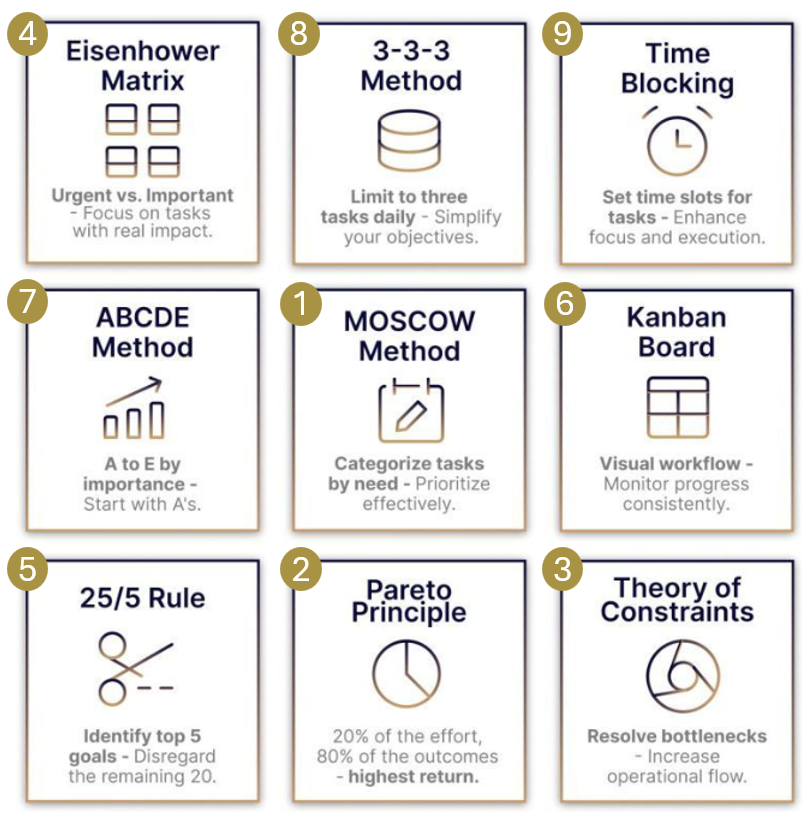
Here are 9 techniques for prioritizing goals, projects, and actions.8
How to prioritize them?
a) Action & ROI: (1) MoSCoW and Correlation, (2) Pareto.
b) Flow & Momentum: (3) Constraints, (4) Eisenhower, (5) 25/5, (6) Kanban.
c) Time & Accountability: (7) ABCDE, (8) 3-3-3, (9) Time-Blocking.
a) Action & ROI
(1) Start with customers’ view of MoSCoW:
Must-have, Should-have, Could-have, Won’t-have.
Pro Tips: Data-mine what customers have already told you to identify these.
Modify your Voice of Customer portfolio to collect, clarify, and/or confirm your assumptions.
(1a) Statistical Correlation Analysis:
Find the correlation between loyalty ratings and experience ratings.
Pro Tips: Rank the MoSCoW items by highest correlation coefficients.
Statistical correlation is more accurate in effect on costs and revenue.

(2) Pareto Analysis among top correlated items in each MoSCoW category.:
Rank-order the frequency of each issue’s occurrence in a bar chart.
80/20 rule: Focus on the 20% of tasks that drive 80% of results.
Pro Tips: Focus on the Vital Few that actually move the needle.
Useful Many are “quick wins” that do not sustain high ROI.

b) Flow & Momentum
Always prioritize by costs to customers, employees, partners, investors.
| (3) Constraints | What: Solve bottlenecks to increase operational flow. | Pro Tips: Solve customers’ delays and then your internal delays. | Otherwise: Customers’ bottlenecks spiral your costs. |
| (4) Eisenhower Grid | What: Evaluate urgency vs. importance. | Pro Tips: Decide what % of your energy is deserved by each grid square. | Otherwise: You do what’s urgent, not what’s important. |
| (4a) RFM Matrix | What: Recency, Frequency, Money. | Pro Tips: Focus on customers’ view of frequency and money consequences first. | Otherwise: You risk higher costs and lost revenue. |
| (5) 25/5 Rule | What: Focus only on the top 5 areas. | Pro Tips: Focus each business unit on their top 2 improvements for the year for bonus pay. | Otherwise: Gains are too slow and too low. |
| (6) Kanban | What: Track progress with a visual workflow. | Pro Tips: Swim-lane diagrams and Gantt charts reinforce inter-dependencies and accountability. | Otherwise: One-sided decisions derail deployment. |
c) Time & Accountability
Always prioritize by costs to customers, employees, partners, investors.
| (7) ABCDE Ranking | (7a) RACI Matrix | (8) 3-3-3 | (9) Time-blocking |
| What: Rank by importance, from A’s to E’s. | What: Responsible, Accountable, Consulted, Informed. | What: Limit your day to 3 tasks. | What: Specific time slots for important tasks. |
| Pro Tips: Continually refine urgencies in-sync with findings from MoSCoW, Pareto, Constraints. | Pro Tips: Clarify who does the work, who approves it, who provides input, and who is kept updated. | Pro Tips: Achieve daily progress steps. | Pro Tips: Guard your concentration for success. |
Bad CX Prioritizations
| Net Promoter Score | Why: Assumes all Promoters are profitable, high quality data, and customers should and will sell for you. | Metrics Test: What % of Promoters are “Ideal Customers” and vice versa? Who refers? | Better: Align VoC reports and action to Marketing’s top-growth segments. |
| AI-First Design | Why: Assumes generic circumstances as default, requiring extra steps for customers in their unique situations. | Metrics Test: Do internal efficiencies offset costs of customer frustration? | Better: How about giving customers the choice from the start: AI or person? |
| Product-Led Growth | Why: Assumes minimally viable product is the fastest way to grow, instead of truly human-centered design. | Metrics Test: Does time-to-market offset costs of CS and word-of-mouth effect on sales? | Better: How about using voice of customer throughout product development? |
| Journey Mapping | Why: Part of a journey for a persona is low visibility into overall best financial use of resources. | Metrics Test: Do micro journey gains offset total costs of your journey mapping? | Better: How about using correlation analysis and Pareto as scientific ranking? |
My pro tip: Follow the prioritization advice in the Experience Leadership and Customer Value sections of this article.
Conclusion
Growth budgets are inadvertently sabotaged by mis-prioritization:
✓ Lack of clarity: CX vs. CXM vs. CS, etc.
✓ Over-focus on gain and retain vs. align and embed.
✓ Backwards hierarchy of investors first.
✓ Missing domino-effect of value to customers 1st.
✓ Overlooked value to customers and partners.
✓ Popular prioritization methods aren’t sequenced.
✓ AI-first, product-led growth, journey maps are mis-guided priorities.
✓ Quick wins gain too little, too slowly, and are unsustained.
✓ Internal criteria too often overshadows costs to customers.
✓ Overlooking costs to customers spirals your costs.
✓ Inter-dependencies and accountability are missing.
✓ Consequences are shrinkflation, customer distrust, CXM skepticism, CXM budget disempowerment, CXM team dissolution, and corporate restructuring.
Top-growth CX prioritization:
✓ Focus 1st on aligning and embedding.
✓ Do the right things right from customers’ perspective.
✓ Prevent negative surprises for employees.
✓ Empower partners to focus on their strengths.
✓ Know what customers say you must have, should have, can’t have, won’t have.
✓ Correlate this list to loyalty ratings.
✓ Emphasize the Vital Few that customers will continually reward.
✓ Remove bottlenecks for customers before removing your bottlenecks.
✓ Focus every product team, account team, and functional team on the top 2 CX gaps they’re causing, as basis for their bonus pay.
✓ Drive coordination, accountability, and completion via visual maps such as swim-lane diagrams and Gantt charts.
When CX prioritization follows this advice, you’re respecting these natural growth factors:
1) Customers fund what’s received by investors (earnings per share) and by employees (salaries and budgets).
2) CS (Support, Success) reveals your enterprise’s strategic mis-direction and operational weaknesses.
3) CX management (CXM) aims to simultaneously and holistically maximize value for highest gains (ease of business for distinctive preference) and lowest costs (prevent issues for distinctive enterprise agility).
References:
1Internal Competition of Priorities, by Sonia Zavala, LinkedIn, January 2026.
2The Conversation in UX Leadership Rooms Has Changed, by Marina Krutchinsky, LinkedIn, January 2026.
3Your CS Team Isn’t Burned Out: Your Strategy Is, by Carrie Mann, LinkedIn, January 2026.
4Why Do Companies Ask for Feedback with No Intention of Acting On It?, by Andee Silverman, LinkedIn, January 2026.
5Hallo Financial Services, by Rosebella Abok, LinkedIn, January 2026.
6I Once Reported Green Dashboards While the Business Was Quietly Bleeding, by Diego Alatrista, LinkedIn, January 2026.
7CXM is Reactive, Putting Out the Same Fires Over and Over Again, by Tatiana Ramirez, LinkedIn, January 2026.
8Prioritize Like a CEO, by Lynn Hunsaker, in response to Eric Partaker and Alan (AJ) Silber, Global CXO Terminal, LinkedIn, August 2025.
This is the fourth of a 8-part series: 26 Bad CX Metrics Practices to Stop in 2026.
Part 1: Insults repel customers: the opposite of your goals.
1) Requesting a Score: disrespects customers’ truth.
2) Automating Interactions: makes CX hard in unique situations.
3) Upselling After CX Fail: is self-serving, not good CX.
Part 2: GIGO Metrics: misleads managers.
4) Bias: shows your self-centicity.
5) Inconsistent Interpretation: leads to shaming customers.
6) Population Misrepresentation: makes CX data irrelevant.
Part 3) GIGO Benchmarking:
7) External Benchmarks: deceptive, slippery slope.
8) Internal Benchmarks: must enhance customers’ prosperity.
Part 4) Prioritization
Coming Soon
Part 5) Business Value
Part 6) Leading Indicators
Part 7) Goal Silos
Part 8) Metric Silos
Image licensed to ClearAction Continuum by Shutterstock.