


Bad CX practices deceive managers and rob investors:
A) Insults repel customers: the opposite of your goals.
B) Falsehoods derail customer-centric growth.
C) GIGO (garbage-in, garbage-out) metrics stunt your potential.
D) Misdirected actions squander opportunities.

This is the first of a 4-part series covering (A) insults, (B) falsehoods, (C) GIGO, and (D) misdirected CX practices.
3 CX Insults
1) Stop Requesting a Rating
“I went to have my oil change over the weekend and the service manager handed me a copy of the survey and highlighted how to answer the questions. It was upsetting.”
“No, just no! ‘After the delivery, you’ll receive an email survey from Lowe’s. We kindly ask that you provide a rating of 10 on the likelihood to recommend question. This question specifically pertains to the quality of our delivery team members.'”
“At my local Safeway, the cashiers just reach over and select ’10’ on the NPS survey that appears on the customer payment screen. The store manager said they were under pressure from corporate to get more responses.”
“BMW: ‘We’re so sorry that you didn’t give us a 10. Is there anything we can do to improve this?’ Me: ‘For the service I received, would you be angry?’ BMW: ‘Just wanted to see if you would reconsider your score?‘ After escalation, I was offered a cash resolution in return for a 10.”
Pre-filled questionnaire handed to the customer. “The rep probably would have told me to give them a 9 or 10 if I hadn’t cut her off. I let them know it’s a horrible practice.”
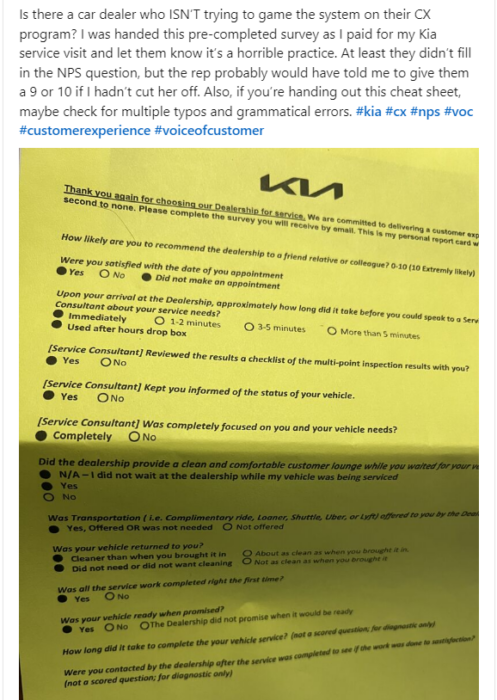
“I have seen much much worse from certain dealers in the UK who complete surveys on behalf of customers, by substituting their own email address with that of the customers.”
“Most of the manufacturers are doing their best to skew the national/international satisfaction metrics on sales and service benchmark studies from NCBS, JD Power, etc.”
“Almost as bad are the post-phone contact surveys that only focus on the agent’s service instead of the failure of product or policy!”
Here’s what customers say about these bad CX practices:
- “Why don’t they just send the survey before delivery and say if you give us all 10s we will deliver your item. These surveys are so useless.”
- “They pay out max bonuses, but customers think the service is sub-standard, so the industry suffers negative perception as nothing aligns. Madness.”
- “There is a golden opportunity here for a brand to differentiate themselves from EVERY other by calling this practice out in an ad with humour, and reminding customers ‘we want to know how we can serve you better’.”
- “Who are people trying to kid! I think 4 and 5 stars are perfectly fine and, what the hell, even a few 3 stars as at least you are meeting an average expectation, which isn’t always a bad thing. I’m always dubious when I see a complete 5 stars sweep!”
- “If I see 5 star reviews only, I automatically imagine the business owner made their employees and family and friends give all 5 star reviews. For humans and businesses alike, there are days that aren’t just your best. But owning it and doing something about it is what truly matters.”
- “Ridiculous!! Here’s what we all should do instead: 1) Refuse to participate in any such ‘feedback’ and tell the General Manager it’s insulting. 2) Instead of basing compensation on surveys, link compensation to what you are doing about it.”
2) Stop Automating Interactions
“I’ve been on the receiving end of some inappropriate answers from AI support for an escalated issue. Not a great look for that company.”
“All of my own personal experiences with companies using AI have been truly awful.”
“We stopped at a hotel for the night and they were doing a pilot on check ins and check outs kiosk style. I avoided the kiosk with its line of more than 10 people. You could see some were frustrated they couldn’t go to the desk representative, even though there were two people at the desk with two customers.”
“I applied for a specific type of account that had a time limited promotion on January 4th. I was looking for a way to follow up with them I saw their message came from a NO-REPLY email address. So as a customer; what do I do? who do I call? This is nothing but frustrating, and trust me when I tell you this should be considered important business for this company.”
“AI Agents are more expensive than humans. AI SDRs and AI Customer Support Agents rarely come with early adopter or freemium pricing. Add on top of that the FTE overhead of training and supervising the AI, and the cost becomes very material.”
“AI’s true value lies in performance, not cost savings.”
- “Don’t think about AI as headcount replacement/reduction — think about AI as a force multiplier that lets you outcompete at unprecedented scale.”
- “AI isn’t just automation — it’s clarity. Many organizations are sitting on mountains of data, but the real challenge is making sense of it all. AI has the power to transform data into actionable clarity. Instead of sifting through endless reports, leaders can leverage AI to surface trends, flag risks, and recommend next steps—all in real-time without the noise.”
- “I used ChatGPT to streamline the creation of a Quarterly Business Review (QBR) document by pulling insights from multiple input docs. It was a huge time-saver. I tested Gemini’s Google folder summarization feature to draft a Monthly Business Review (MBR) for a customer project. I didn’t change a single word. The MBR was ready in minutes. It’s not just a time-saver — it’s a mechanism for continuous learning and customer alignment.”
3) Stop Upselling in Support
People contact Support after your failure in delivering your value proposition, primarily. Your defect, lateness, confusing message, or lack of proactive expectations management is an inappropriate and illogical basis for requesting a purchase.
Support is already a gold mine of value — Support is NOT a cost center!
- Gold is in customer comments about what they expected, what they got, and how it affected them. Use this for originators of these issues to solve root causes. This creates Sales advantages in conversion, velocity, retention.
- Gold is in prevented churn and negative word-of-mouth. Without this, Sales works harder to make a bigger quota.
Stay tuned for 22 more prevalent bad CX practices in the next 3 issues of this series.
What are CX and CXM?
To help you rise above bad CX practices, ensure your whole company is crystal clear in your shared definition of Customer Experience and Customer Experience Management.
A) Customer Experience (CX) is what customers experience.
Customers buy for an ultimate aim in their life/business.
— Their ultimate aim shapes their expectations.
Your value proposition sets customers’ expectations.
— Delivering to it is a good experience.
— Deviation is a bad experience.
— Deviation is a ripoff to customers (money, time, energy, and lost opportunities that weren’t what they bought into from your value proposition).
CX starts and ends when the customer says so:
— Interaction with maker or seller may be brief or non-existent.
— It’s cumulative over time.
CX is customers’ realities vs. expectations.
B) Customer Experience Management (CXM) is your reactive and proactive management of CX.
Reactive CXM is value-rescuing:
— After a glitch in delivering to your value prop.
— Compensating for low differentiation.
— Making up for cutting corners in value delivery.
— Anything you do that bothers customers costs you a lot in budgets for Support (remedies, returns, refunds, escalations), Success (retention), and Loyalty (retention), discounts and promotions, and doubts in the market reducing sales velocity and margins.
Proactive CXM is value-creating:
— Value proposition meets their needs?
— Value delivery matches value prop?
— Value continually increases?
Marketing and Sales communicate value.
— Engineering and Manufacturing create value.
— Operations and Service Delivery deliver value.
— Corporate functions enhance or limit value.
CXM is alignment to customers’ expectations.
C) Customers’ prosperity is your path to prosperity.
Customers pay for salaries, budgets, and profit-sharing.
— Investors depend on customers, not vice versa.
— When customers leave, then investors and jobs leave.
CXM removes revenue roadblocks systemically.
What’s missing in your company is a team facilitating company-wide proactive alignment to customers’ expectations. This means CXM jobs are 80% internal-focused, helping every functional area get in-sync with customers’ aims. This is your growth strategy to multiply savings and gains in all customer touchpoint tactics.
Ban Bad CX Practices in 2025
Bad CX practices become the norm when industries are in crisis (pandemic, economic downturn, etc.). For survival, “customer experience management” gets twisted to self-centric management.
Bad CX practices are perpetuated when managers are in bandwagon mentality: everyone’s doing it, so it must be great!
As seen in the examples above, self-serving approaches complicate retention and acquisition.
You invest a lot to get customers. Don’t sabotage your ROI with bad CX practices!
This is the first of a 4-part series: 25 Bad CX Practices to Stop in 2025.
- Part 1: Insults
- Part 2: Falsehoods
- Part 3: GIGO
- Part 4: Misdirected
Image licensed to ClearAction Continuum by Shutterstock.
Lynn, this is a sharp and much-needed analysis of bad CX practices that continue to plague the industry. The manipulation of feedback, forced ratings, and misguided automation are not just counterproductive—they actively erode trust and distort the real customer experience. Your breakdown of how these practices deceive managers and investors while repelling customers is spot on. I particularly appreciate your emphasis on how CXM should align with customer expectations rather than serve internal metrics. Looking forward to the next parts of this series!
Yes, Ricardo, thanks. Customer Experience is obviousy supposed to be about customers, not providers.
If I called something Ricardo Experience, then we’d expect it to revolve around you, rather than me or anyone else’s interests.
It’s so obvious, yet somehow bandwagon mentality has seeped into managers’ pores to the extent that it’s hard for them to acknowledge what they’re doing is all wrong on several levels.
“Lemmings jumping off a cliff” is what these CX insults are doing to the CX profession and to their brand reputations. Grand travesty.