


The definition of customer experience typically centers erroneously on the word “interactions”.
1) B2C Example:
Celebrating my nephew’s winning soccer season with brunch at a busy restaurant, my brother got a pager from the reception desk, and we enjoyed the pretty landscape in the parking lot while waiting for our table to be ready. After 40 minutes, we were led inside by the waiter, and we eagerly reviewed the menu to place our orders.
I mentioned to my sister-in-law: “Customer Experience experts would say our interactions with the receptionist and waiter, or in making a complaint, is what our experience is here as customers.”
She replied: “Hardly! They’re forgetting food preparation and variety, supplier management to ensure all ingredients for everything on the menu are available and high quality, the general manager’s and accountant’s ability to keep costs and prices reasonable, and the facility manager’s attention to detail for cleanliness and maintenance in the seating area, restrooms, kitchen, storage, parking lot, and waiting area — and probably more than that, too.”
Wow! She got it right:
All apects of running the restaurant WERE what we experienced as customers.
- Does your customer journey map include all of that?
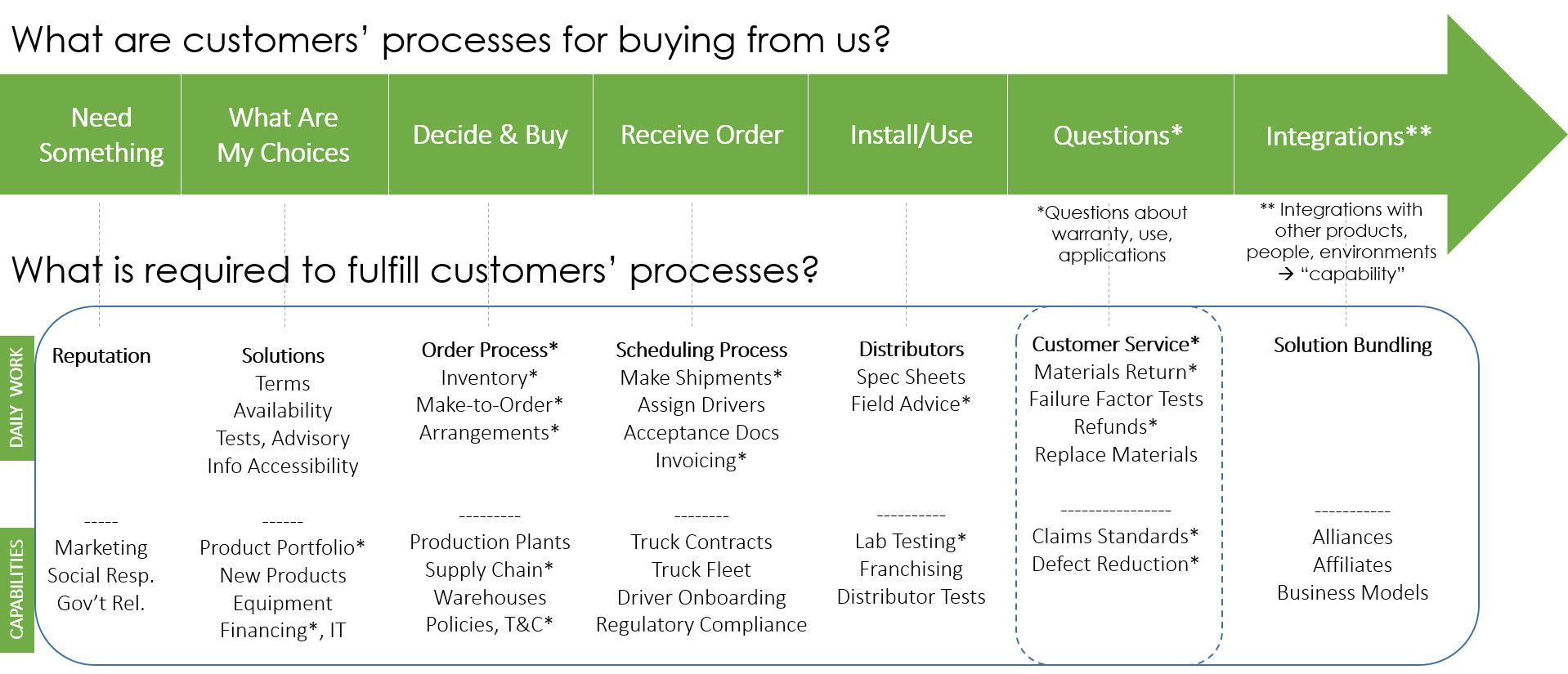
- Do your voice-of-customer analyses provide guidance to every type of manager about customers’ expectations and realities?
- Does your customer experience strategy aim for gap-free performance among all managers company-wide, without exception?
2) B2B Example:
Making the equipment that makes chips in semiconductor factories was our Voice of Customer (VoC) focus at Applied Materials, where I worked for 11 years.
“Close to the Customer” was one of our core values, and some of our managers said, “Well, you can’t get closer to the customer than we already are! Many of our customers have our Field Engineers working permanently at their locations.”
Yet, frequency of customer interactions had little to do with customer-centricity, according to our VoC analyses.
Creating next-gen equipment for the next new factories and for factory upgrades our main focus, while high performance of equipment they’d already bought from us was our customers’ main focus.
Gaps between our customers’ expectations and their realities went beyond interactions with our dedicated Account Teams and our Field Engineers.
 This is why our customer experience metrics always included customers’ gains and savings in time, resources, and stress. “Our customers’ business results come first” was a frequent reminder from our Board Chairman.
Does this amaze you? We did not have a contact center. Same situation at my first role as VoC Manager at Sonoco, maker of packaging for numerous industries globally.
In both of these B2B firms, dedicated account teams handled everything as the sole interface to our customers, except for certain circumstances — like my VoC interviews — with their express permission and supervision.
This is a key reason why you should not assume that B2B is less mature than B2C in CXM: many aspects of taking care of customers are built-in to the dedicated account team’s relationship management. By definition, they already understand customer journeys better than most B2C firms do.
What did this mean for me as company-wide CX Leader? Freeing-up customers and Account Managers to do their work wonderfully without any gaps between their expectations and realities.
This is why my small CX team worked through every General Manager company-wide to permanently stop gaps they were causing. That’s CXM with ongoing gigantic gains for everyone!
3) Government Example:
Everyone in your community enjoys public spaces, such as parks and roads. Some community members pay taxes toward these, and others do not. Some funding comes from federal government or grants or bonds supported only by property owners’ taxes, etc. My father’s career was with the U.S. Forest Service, where funding was determined by Congress, and supplemented by timber sales and permits to the public for camping, etc.
So, who is the real customer for government? It’s the end-user!
Government agencies — just like B2C and B2B firms — exist for the purpose of serving end-users’ needs. End-users are top priority, because when their needs aren’t met, then the existence of all parties in between are at-risk.
Unmet needs open the door for alternative solutions. We’ve seen whole industries upset by this fact, such as taxis disrupted by ride-share apps.
How much “interaction” does a community member have with the government in their use of parks, roads, forests, and so forth? Hopefully, the public never has direct interactions with government, except for providing feedback and obtaining permissions — and hopefully, those are efficient, good experiences as well.
4) Product Replacement Example:
A rust-colored circle appeared in a bedroom ceiling in my house recently. I haven’t yet checked whether a roof tile is broken, or perhaps it’s shoddy workmanship in laying down the membrane below the tiles, or maybe there’s a leak in my air conditioning vent, or an animal might be causing this.
Regardless, I bought this house 3 years ago, so I wasn’t the person who interacted with maker or seller or installer of any of this.
Yet, I am having an experience with this situation every time I walk into that room. I’m a customer of these materials and workmanship, no matter how long ago those interactions happened, and with whom.
My resolution of the situation will likely involve a different maker, seller, and installer — without using a contact center to do so. My expectations are that nothing will go wrong with all of that for a decade or two.
For products or services that wear out over time, or that I outgrow, or as trends and preferences change, my expectation for replacing them is realistic. Replacing them is what I expect, so the reality that I will do so eventually is not in itself a bad experience.
5) Discount Store vs. Luxury Store Example
Saturday I went to a discount store to find a $1 bin for rinsing feet before getting into bed. On the same day, I shopped at a luxury store for a new dress. For breakfast, we went to a bagel shop, and for dinner we went to a high-end restaurant.
My expectations for each store were different, and I was equally happy with each place, because what I saw and received (my realities) matched my expectations.
6) Circumstances Example
One customer could go to a coffee shop several times in one day: first, on their way to work, next with a business client after lunch, and after work with a child as a tide-me-over before a delayed supper. This customer may interact with the same employee or store manager in each transaction.
In each circumstance, this single customer’s expectations may differ. On the way to work, speed is paramount; with a business client, ability to hear one another with pleasant seating is ideal; and with a child before supper, small sizes and short waiting time are important.
Right-sizing the realities you deliver to your customers’ shifting circumstances is what makes good experiences consistent.
Identifying different expectations by circumstances, and helping your organization deliver the realities to expectations gap-free is what customer experience management is all about.
Common Sense
In my walking group, people ask: “So, what do you do for a living?” My answer is: “I help companies be customer-focused — getting everything right for customers not to need self-service or the 800-number.” They reply: “Thank goodness! Every company should be doing that!”
Think of everything you use in a week: dozens of food items, numerous services, thousands of items you’d bought previously, and lots of public services. Thankfully, we don’t have to interact with maker or seller very often or ever for most of it. If we had a dazzling experience or even a save-the-day (rescue) experience with each of these, it would be overwhelming and exhausting.
Customer Exerience is customers’ realities vs. customers’ expectations.
Help your organization understand this simple fact. And get crystal clarity across your firm for the hierarchy of customer needs, starting with end-users’ success as the path to your success.
Next, obviously, is becoming smartest in your industry about your customers’ expectations. What types of interactions do they want, and what types do they not want? What is their wildest dream for a wonderful experience with your type of solution?
Keep it simple for your whole company to free-up customers, aiming for zero gaps.
This clarifity goes a long way toward customer-centered mindsets that proactively manage expectations and realities for a continually better world.

Thank you Lynn, loved the article .
“Your perspective on using specific customer expectations – naming it – rather than relying on a generalised definition of CX is spot on. This approach ensures that customer experience strategies are not just theoretical but practical and relevant to the actual journey of the customer. Tailoring CX to meet specific expectations helps drive meaningful engagement and tangible results, which you always emphasis in all your articles.
Your insights emphasize the importance of understanding the unique nuances of each customer interaction. It reminds me of how impactful it can be to shift focus from ‘what CX should be’ to ‘what CX needs to be for this customer at this moment.’ Thank you for sharing such a fresh and actionable take on customer experience “
Yes, thanks, Natasha. I’ve found that best customer experience happens when the whole company is in-sync with expectations of customers. So much about a customer’s experience is not in interactions, but rather, straightforward products, processes, policies, and everything else that prevents gaps for anyone.