


A Profit and Loss (P&L) financial statement shows:1
a) How much value is generated
b) Cost efficiency opportunities
c) How well the business is run
Isn’t this what CX management is all about?
a) How much value is CXM generating?
b) How can CXM drive cost savings?
c) How does CXM make business run better?
Let’s explore this!
Below are 3 CX P&L methods drafted for next-level thinking.
1) Why Customers Bought
2) Who Caused CX
3) Cost Decisions
Different P&L methods are normal: cash or accrual reporting is your CFO’s first decision.
This is a precedent for CXM choice of most appropriate CX P&L to use for different situations.
Let’s collaborate to make them pragmatic. Let’s start using CX P&L statements in investor calls, annual reports, board discussions, and strategic planning.
P = Profit (gains exceed costs).
Money value of right things right the 1st time.
Value of resources freed-up.
Credits: preventing the root causes of a chronic issue.
CX Annuities: Freed-up resources re-allocated to growth opportunity.
Top-Line: revenue, effectiveness, productivity.
L = Loss (costs exceed gains).
Money value of resources to solve bad CX.
Value of resources tied-up.
Demerits: causing the need for Support or rework or incentive.
Bottom-Line: profit, efficiency, energy.
1) Why Customers Bought CX P&L
Revenue attribution — why customers bought — is one way to track CX P&L.
Give credit to the organization that spurred each purchase.
— Your Sales Team’s actions determines top-line value.
— CXM, Success, and Support actions determine bottom-line value.
A financial P&L has distinct sections for Net Revenue (top-line value) leading to Gross Profit, and then Operating Income, and finally, Net Income (bottom-line value).1 In this template, you can see the CFO’s view (Financial P&L) side-by-side with CX value (CX P&L):

Sales & Marketing CX P&L
Their revenue is obvious . . . with a few caveats.
— Whenever they over-promise, they create losses.
— Over-promising results in Support inquiries.
— Inflated expectations burden Success and CXM.
— Unmet expectations cause churn and negative word-of-mouth.
— And all of this makes retention and new acquisition more expensive.
So, subtract revenue that would not exist without intervention from Success, Support, and CXM. (See below for revenue attributable to Success, Support, and CXM.)
Value: This sets accountability for Sales and Marketing (a) mis-targeting ideal customers and (b) over-promising relative to your Operations strengths and weaknesses. It motivates prevention of spiraling costs from (a) negative word-of-mouth and (b) churn and (c) retention expenses.
Success Team P&L
Their revenue is existing customers’ purchases after efforts from the Success Team.
- In current practices, Success takes credit for all recurring revenue (annual or monthly recurring revenue, gross or net).
- SaaS firms make ARR, MRR, NRR, etc. their “sacred cow” metrics for selling the company for multiples of present revenue.2
- However, this is overstated when customers would have churned without Support.
- Additionally, recurring revenue would be higher with CXM as defined below.
So, subtract revenue that would not exist without intervention from Support and CXM.
Value: This encourages executives to use human-centered design for SaaS products instead of minimally viable product3 which requires substantial expenses for Customer Success to compensate for design shortcuts.4
Support Team P&L
Their revenue is existing customers’ purchases after their frustrated mood turned to a happy mood in a Support conversation.
- In current practices, Support is encouraged to upsell and cross-sell.
- However, this is illogical and insulting to customers when the reason they called was a CX failure (over-promise or under-deliver = CX fail).
So, give Support credit for preventing churn and protecting your reputation.
Value: Savings are substantial through (a) reduced retention costs by strengthening mutual respect and trust, (b) reduced customer acquisition cost thanks to less negative word-of-mouth causing reputation doubts that require more proof points and purchase incentives, and (c) increased sales velocity (cycle time for revenue arriving in your bank account).
CXM Team P&L
Their revenue comes from new and existing customers’ purchase decisions which were based on (a) customer journey friction removal and (b) customer-aligned value generation in products, policies, processes, and execution (hand-offs).
This is achieved by (a) crystal clear understanding of customers’ aims and (b) alignment internally to deliver accordingly. As Peter Drucker said, when you “… know and understand the customer so well the product or service fits him and sells itself.”5
Value: Focusing here first will multiply the cost savings and revenue gains by Sales and Marketing, Success, and Support. This approach prevents past costs that would have continued forever and it gains exponential value by re-allocating those freed-up resources to new growth.
How to Monitor This CX P&L
a) Track existing customers’ purchases after interactions with Support and Success.
b) Track new customers’ journey digitally.
c) Ask new customers why they bought.
Do you have more ideas for this CX P&L? Please share your thoughts in Comments below.
2) Who Caused Good/Bad CX P&L
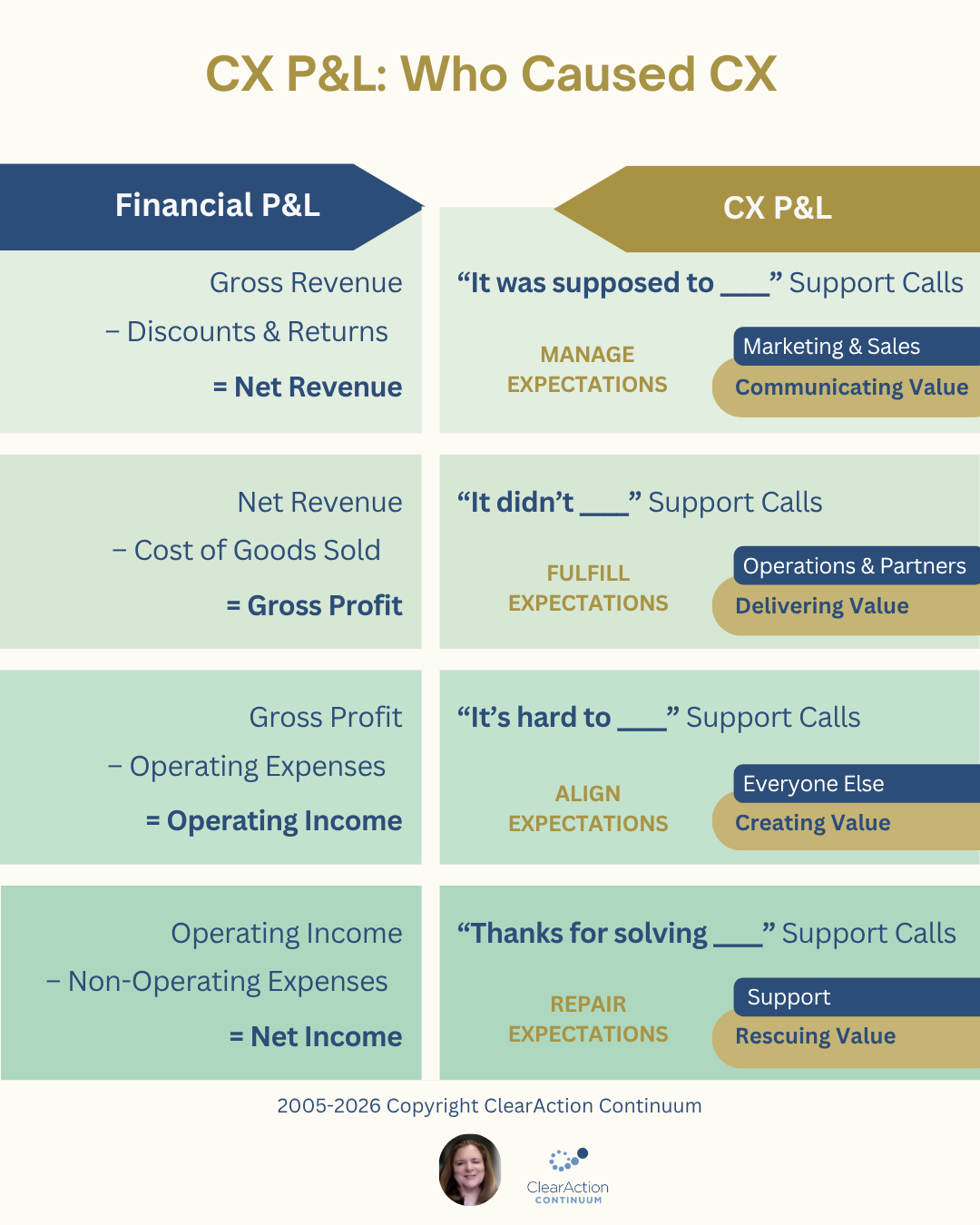
What customers say in Support inquiries tells you the source of bad CX.
This is your key to this CX P&L:
Manage Expectations
 “It was supposed to X” = What customers got was less than than promised, from their perspective.
Marketing and Sales communicate value.
— They set expectations.
— They must proactively manage expectations.
— They get demerits as more customers say they expected something else.
— They get credits as they reduce this.
Fulfill Expectations
“It didn’t X” = Customers are delayed in getting value from what they bought.
Shipping, Installation, Onboarding (Operations) fulfill value.
— They ensure customers get what they bought.
— They get demerits as more customers say it wasn’t right.
— They get credits as they reduce this.
Align Expectations
“It’s hard to X” = Customers experienced a hassle.
Non-Customer-Facing Groups create value.
— They decide products, services, strategies, policies, processes, prices.
— They must get it all in-sync with customers’ priorities.
— They get demerits as more customers say it’s a hassle.
(Not intuitive, not worthwhile, not to their standards.)
— They get credits as they reduce this.
Repair Expectations
“I contacted you about X” = Customers struggled to get solutions.
“Thanks for solving X” = Customers’ value was rescued.
Support rescues value.
— They must solve what went wrong.
— They must anticipate efficient facilitation of customers’ requested changes.
— They get demerits as more customers say Support contact was repeated.
— They get credits as more customers say thanks for the solution.
How to Monitor This CX P&L
a) Data-mine transcripts of Support conversations across all channels.
b) One Support conversation may tally demerits for all buckets.
c) Data-mine for costs expressed by customers: time, effort, stress, lost opportunities.
d) Estimate costs and savings tied to these 4 types of customer comments.
Do you have more ideas for this CX P&L? Please share your thoughts in Comments below.
3) CX P&L: Customer-Centered Cost Decisions
What do investors want most?
— Earnings per share (EPS; profit).
— Rapid value increase.
These are determined by customer lifetime value (cumulative profit).
The lifetime value equation is represented in each row below:
Revenue minus costs for the duration of a customer relationship with you.
Relationship duration is longer when relationship strength is higher.
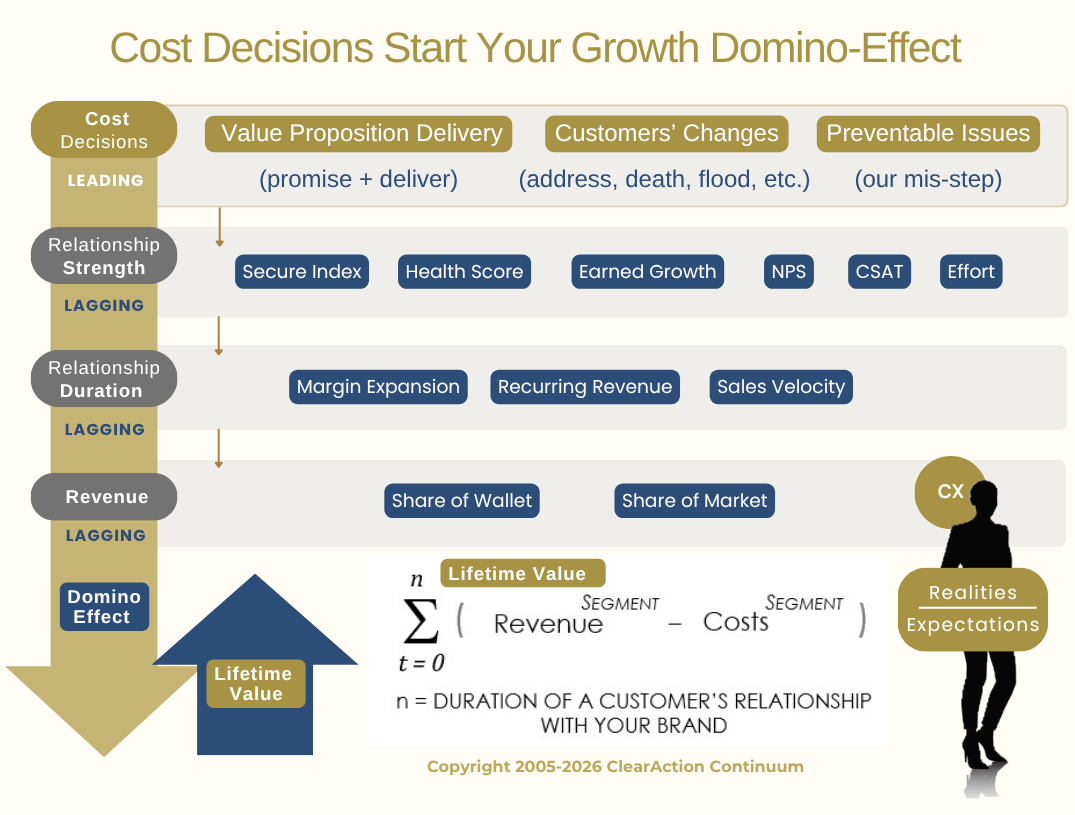
Your cost decisions set all subsequent tiers in motion:
— How you align for maximum efficiency and effectiveness.
— How you anticipate changes.
— Where you take shortcuts.
By focusing managers on these 4 costs, all subsequent metrics perform accordingly.
1) Promise accurately.
2) Deliver what’s promised.
3) Make inevitable changes simple.
4) Learn deeply from mis-steps.
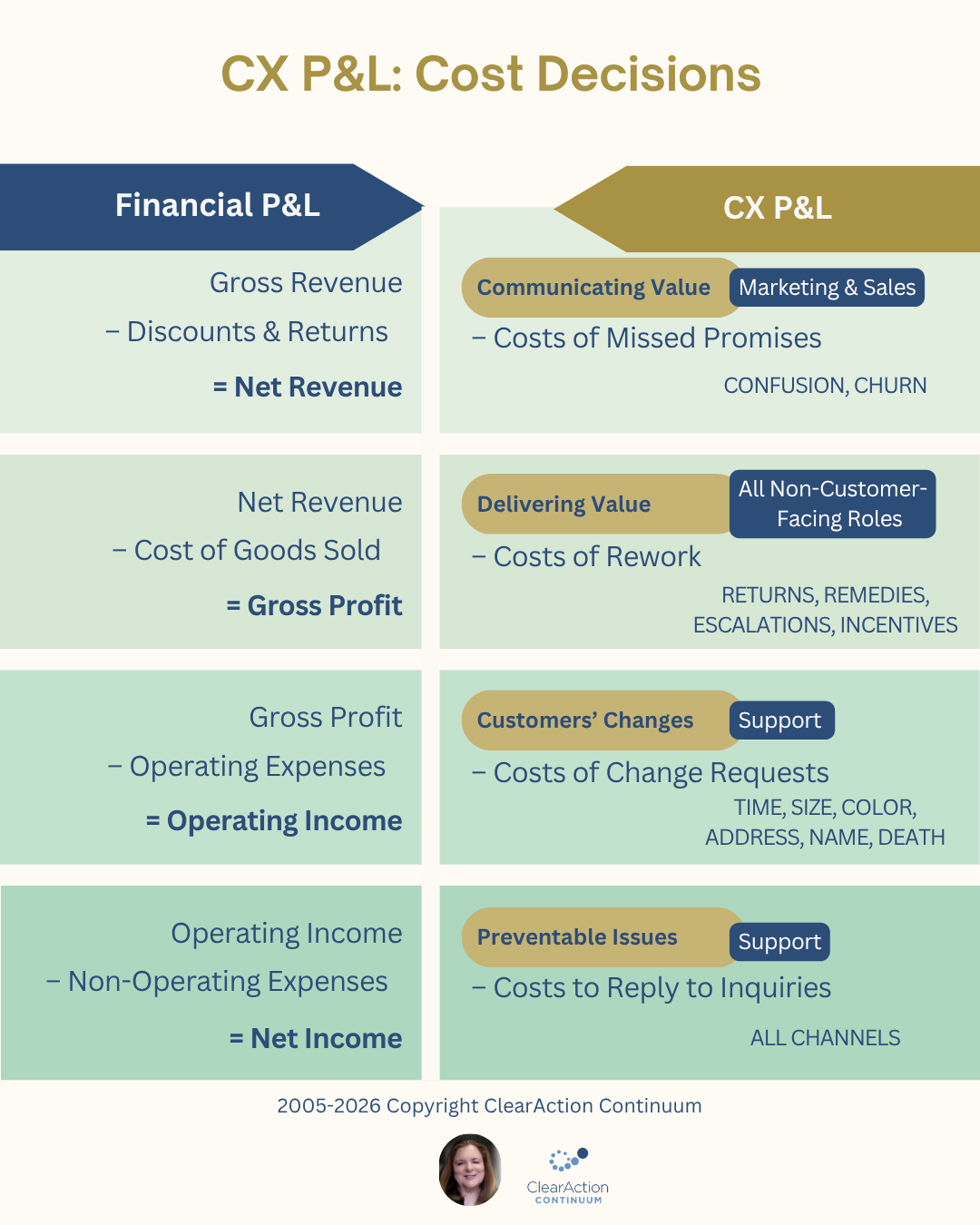
Costs of Missed Promises
Your CEO sets your company mission.
Marketing sets value propositions.
Sales makes the final promise.
Marketing and Sales proactively manage ongoing promises.
Measure by costs of customers’ confusion, doubts in the market, churn.
Costs of Rework
Delivering to your value proposition is why the rest of your company exists!
You could permanently cut any role that is at-odds with your value proposition.
Measure by returns, refunds, remedies, escalations, endless emails and meetings to address issues, incentives to buy and rebuy, etc.
You can get 8X revenue when development is VoC-guided for products, policies, processes, people, plans, performance, according to a study by Massachusetts Institute of Technology (MIT).
Costs of Changes
Life happens. Customers inevitably request changes.
Emotions are strong during these circumstances.
How nice you make it — or not — wll be remembered.
Customers will reward or penalize you accordingly.
How simple is it for customers to change:
a) Their purchase? (returns, refunds, timing, color/model, etc.)
b) Their name, etc.? (due to a move, re-org, marriage, death, birth, etc.)
c) Their account? (due to natural disaster, weather, theft, change in income, etc.)
Measure by costs to facilitate these types of changes, and double penalty for costs of failing to facilitate these types of changes efficiently and effectively (churn, etc.).
You can get 3X higher revenue growth by removing hassles for customers in comparison to referral revenue, according to a study by London School of Economics.
Costs to Reply to Inquiries
You can and should prevent nearly any inquiry from customers that is not a type of change described above.
If costs of all 3 of this CX P&L’s sections are low, then this section will also be low.
The higher the costs of the other sections, the higher this cost will be. With no end in sight.
The key is how much your entire enterprise learns from preventable issues.
Measure by costs of all Support channels to reply to customers’ inquiries.
How to Monitor This CX P&L
a) Data-mine Support inquiries, social media and review sites, and Lost Sale reports.
b) Audit email strings and meetings held to solve issues, and extrapolate (project this math for the full year).
c) Categorize all Support-related costs (returns, requested changes, etc.).
d) Categorize all incentives used for Marketing, Sales, and Loyalty.
Do you have more ideas for this CX P&L? Please share your thoughts in Comments below.
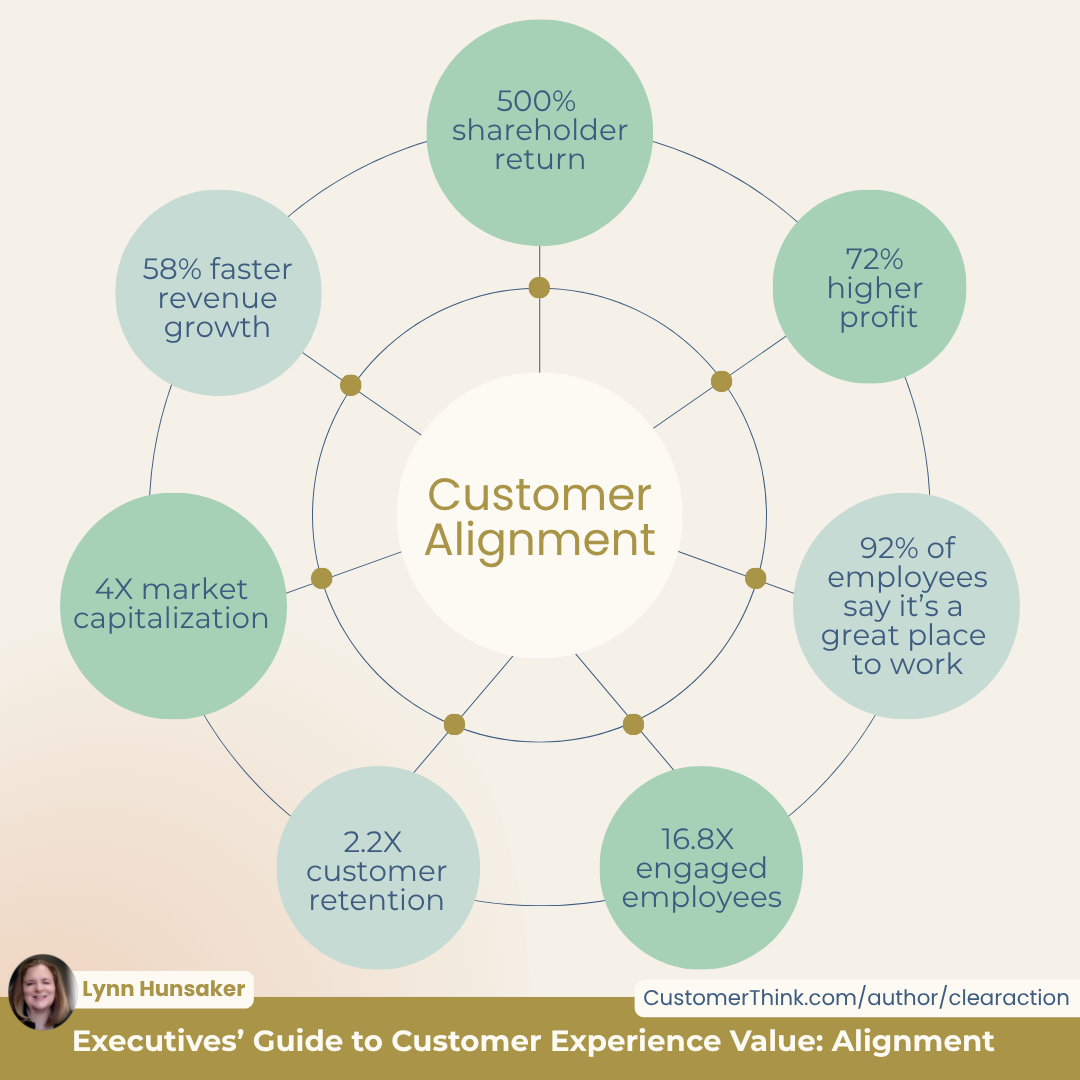
You can get 5X growth via Customer Alignment!
Conclusion
Marketing and Sales work hard to acquire customers.
Then bad CX creates an ongoing spiral of costs that make everything harder for Marketing and Sales, and everyone else.
— More doubts in the market.
— Higher quotas due to churn.
— Less budget available for growth (new markets, new products, alliances, hiring, salary increases, empowered spending, profit-sharing).
The spiral of costs is Negative Word-of-Mouth + Self-Service + Support Channels + Returns + Refunds + Escalations + Incentives + Churn + Higher Quotas + Higher Cost of Acquisition + Lower Sales Velocity + Lost Opportunities + Lower Budgets Available for Growth + Disempowerment + Austerity + Lost Talent, etc.
Goal = right the first time — by everyone!
Accountability is motivated by demerits and credits.
There are far better ways to measure CXM value than revenue attribution.
- New value achieved by customers = Their time, resources, and opportunities.
- New value achieved by your company, by pursuing new value to customers = Your time, resources, and opportunities.
- New value achieved by re-assigning freed-up time and resources and opportunities to new growth efforts.
Engineering, Finance, HR, IT, and every other group in your firm are measured similarly — not by revenue.
In this article, “CXM” is defined as “Leadership CXM” in this table:

Coordinate everything for a 1-to-1 ratio between what’s promised vs. received by customers, and you maximize both profit and revenue growth.
References:
1 What is a Profit and Loss Statement, by Marshall Hargrave, Quickbooks Blog, April 30, 2025.
2 SaaS Multiples: A Guide for Business Owners, by Tejan Kapoor, Axial Blog, January 5, 2026.
3 Minimally Viable Product, Wikipedia.
4 MVP Reliance on Customer Success, Google AI Overview.
5 Management: Tasks, Responsibilities, Practices, by Peter F. Drucker, 2008 Revised Edition with Joseph A. Maciariello, page 99.