


High-potential customers are your starting point for customer experience management.
— What are their aims?
— How aligned are you?
If you don’t know the aims of your high-potential customers, what does that say about your aim?
High-Potential Customers
High-potential customers might not be the biggest firms.
— Who’s spending more in future quarters?
— Who’s costing less to serve?
Intersection of lowest cost and spend trend heightens your growth!
— More budget is free for more growth opportunities.
— Less doubt in market to slow sales velocity.
— Less churn raising sales quotas, shrinking margin.
— Less negativity tying up everyone’s producitivity.

You must be their preferred choice, for best growth
a) Does this drive everyone’s strategies?
b) Is someone driving perfect experience for them?
High-Potential Revenue
8X revenue growth by customer-inspired innovation vs. internally-inspired innovations was found in a study by Massachusetts Institute of Technology (MIT; 1,193 successful innovations across 9 industries over 5 years).

Customer-inspired innovation yields:
1. Faster adoption curve.
Lower Marketing/Sales expenses.
2. Quicker time-to-productivity.
Lower Success/Support/Product Management expenses.
3. Stronger recommendations and repurchase.
Lower loyalty/incentive expenses.
4. Faster sales cycle.
Fewer proof points, lower acquisition cost expands Marketing/Sales resources.
5. Easier cross-selling and upselling.
Margin expansion for more growth!
Right the first time is best.
— First = product launch.
— First = upon purchase.
“Right” is defined by customers:
A. Deep-dive analysis at start of every growth effort.
Products, markets, business models, partners.
Data-mine comments of customers, partners, employees.
Who’s facilitating this? Your core CXM Team should!
B. Agile check-ins to course-correct assumptions while developing.
C. Feedback loops with rapid adjustments post-launch.
Lack of deep customer-focus — from the start — plunders precious budget — that otherwise could be used for untapped growth opportunities.
High-Potential Profit
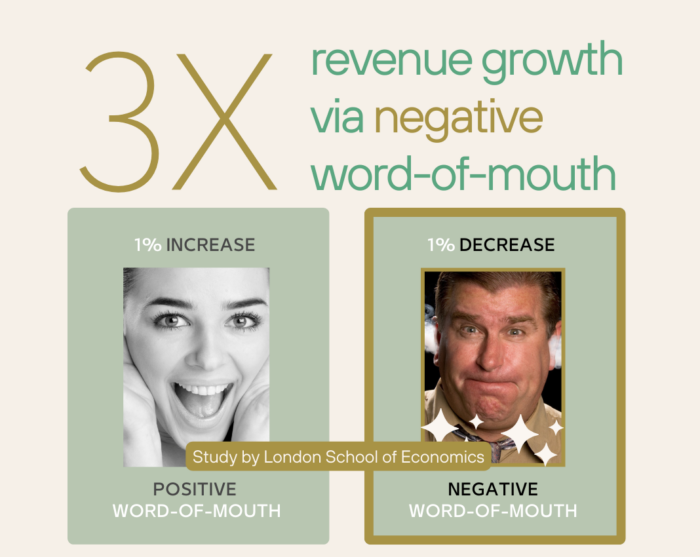
3X revenue grew from reducing negative word-of-mouth (CXM) by 1% compared to increasing positive word-of-mouth (Marketing) by 1% in the Advocacy Drives Growth study by London School of Economics.
Less negative word-of-mouth multiplies value:
— Less doubt in the market grows sales velocity (fewer proof points needed).
— Uninhibited referrals.
— Allows redirecting value-rescuing resources to value-creating opportunities for yourself and your customers and partners!
Value-rescuing is due to anything “not right” with customers.
It causes spiraling costs in:
— Success: correcting Minimally Viable Product gaps.
— Support: self-service and inquiries.
— Remedies, returns, refunds.
— Escalations, endless internal emails and meetings.
— Marketing: loyalty incentives, purchase incentives (lower margins).
— Sales: churn, negative word-of-mouth, more proof points (higher cost of acquisition), longer sales cycle (lower sales velocity).
— Technologies, staffing, and facilities to run all of the above.
— And less growth overall due to budget tied up with all this value-rescuing.
Q: How to decrease negative word-of-mouth? (Not by making it hard to give criticism!)
A: By collecting truth from customers:
— Helping every manager absorb it.
— Inspiring managers to adopt it.
— Guiding managers to apply it.
— Holding managers accountable.
— Applauding progress in customer prosperity as your path to prosperity.
Who’s facilitating this? Your core CXM Team should!
These are the 6 A’s of Walking the Talk: Growth=CX — universal to customer, partner, and employee experience.

High-Potential Customer Experience Value
To achieve these multiples, clearly define CXM vs. Experiential Marketing:
— CXM is customer alignment internally.
Customer-inspired innovation.
Preventing negative word-of-mouth.
Multiplying revenue and profit alike!
— Experiential Marketing is customer engagement externally.

See the first part of this Executive Guide for:
— Experience Management is Integrity
— Experience Management Removes Revenue Risks
— Customer Alignment Multiplies Revenue
“Endearing companies tend to be enduring companies”, explained the authors of the Firms of Endearment book by Sisodia, Sheth & Wolfe.
They asked a broad sample of people which companies they love. A partial list is Amazon, BMW, Caterpillar, Google, Harley Davidson, IDEO, IKEA, JetBlue, Johnson & Johnson, LL Bean, REI, Trader Joe’s, UPS.
Then they studied these companies’ core values, policies, operating attributes, and return on equity (ROE; 10-year trend).
— 1026% ROE for Firms of Endearment.
— 122% for S&P 500 (for same time period).
— That’s more than 8-to-1 ratio!
— 1026% is 3.1X higher than the companies in the Good to Great book by James C. Collins.

“[Firms of Endearment] actively align the interests of all stakeholder groups, not just balance them . . . and can do seemingly contradictory things such as pay high wages, charge low prices, and get higher profitability.”
Stay tuned for Part 3 of this Executives’ Guide, focusing on alignment as vital key to business growth.
This is the second of a CustomerThink Advisors 5-part series: Executives’ Guide to Customer Experience Value.
Part 1) Revenue Risks
Part 2) High Potential
Part 3) Alignment
Part 4) Walking The Talk
Part 5) Top Tier Leadership