


 How you run your business is what customers experience.
Customers are the funders of your employees, partners, and investors. Investors reinforce customer spending only as it increases. Employees, partners, and investors exist only as customers prefer your solution.
Accordingly . . .
North Star for running your business must be customers’ goals.
Customers’ prosperity fuels everyone’s prosperity.
So, how well do managers in every function understand customers’ goals?
____ Are core-growth customers’ goals distilled to 2-3 over-arching themes as guiding light?
____ Are all managers’ strategies aligned to these themes?
____ Does internal engagement drive customers’ goals?
____ Are you tracking value TO customers?
____ Do you audit Vision, Mission, Values, Pillars, structure, cap-ex and op-ex policies yearly for out-of-sync gaps vs. the over-arching themes?
If “no”, then you’re leaving loads of money on the table:
Precious budget and time flowing down the drain:
$3.8T reduced spending due to bad CX.1
53% of consumers spend less after bad CX.1
(= tip of the iceberg! lost growth per tied-up resources)
3x revenue potential via lower negative word-of-mouth.2
Growth opportunities flying out the window.
8X revenue via customer-inspired innovation.3
50% shorter productization via alignment to customers.4
“Customers are at the center of everything we do.” (Keysight Technologies)4
Robbing growth of investors, partners, employees, customers, and your nation.
500% total shareholder return by centering on customers, outpacing the S&P 500.5
Let’s explore your untapped growth potential!
This is the 5th of a 5-part series for Executives’ Guide to Customer Experience Value:
(1) Revenue Risks + (2) High Potential + (3) Alignment + (4) Metrics + (5) Top-Tier Leadership.
Table of Contents
1. Expectations
2. Top-Tier Leadership
3. Urgent Turning Point
4. VP-CX Role
5. Board & Senior Leaders Roles
1. Expectations
Business success is a 1:1 ratio of meeting expectations.
 It’s your obsession quarterly for investors.
(1) Proactively manage investors’ expectations.
(2) Manage 100% delivery to their expectations.
Meeting investor expectations is vital to strong stock price growth.
Missing expectations is a slippery slope of spiraling costs and opportunities lost.
And since investors’ trust relies on:
customers’ spending (revenue growth)
and low cost to serve (earnings per share)
Why would you focus elsewhere?
Do it for customers first.
1:1 ratio for performance to customers’ expectations is:
Crystal clarity of core-growth customers’ goals.
North Star for everyone’s decisions.
Doing the right things right the first time.
Avoiding temptation to cut corners.
Attracting customers who fit your operational strengths.
Fine-tuning operational strengths to fit attractive customers.
Lowest costs for highest growth.
Best way to grow investors, partners, employees, and customers.
Proactively managing expectations.
In-sync performance to promises.
. . . Impossible without embedding 1:1 performance in how you run your business.
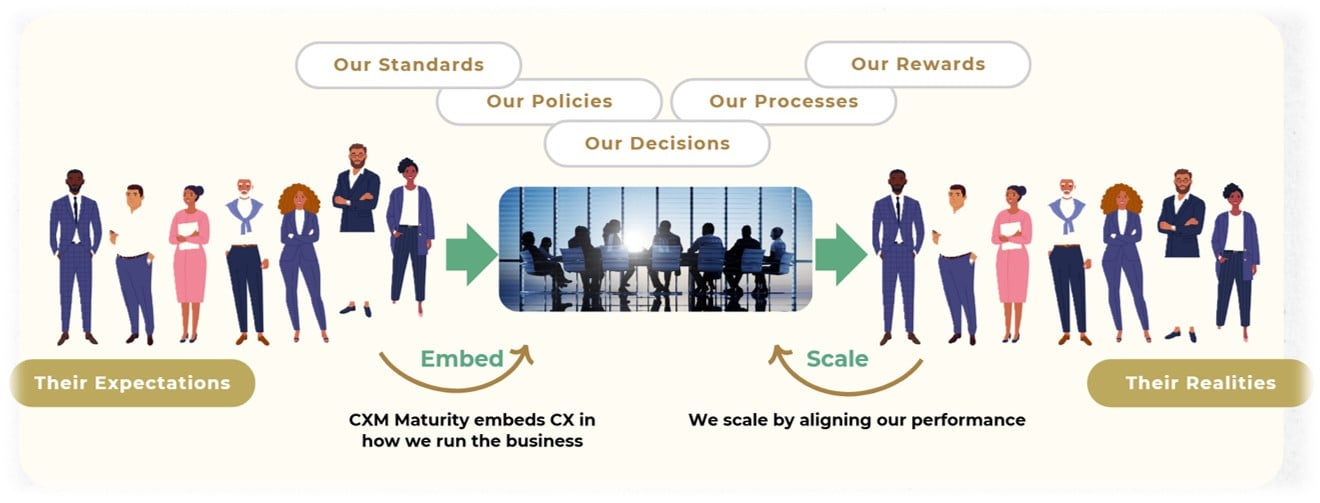
2. Top-Tier Leadership
To do this, aim from Day One (now) to use customer intelligence (“CX”) for top-tier leadership: Transformer and Collaborator.
If you do not, you will never reach it. You’ll be forever mired in analysis paralysis. You’ll be blinded by modest quick wins as a mirage of expertise and flawed scores as a mirage of financial growth.
 |  |
Transformer = Embedding CXM
Transformer leadership embeds all products, policies, processes, plans, people, partners, and performance (7 P’s) with customer intelligence (“CX”) guiding their starting point, decisions, development, reviews, and rewards.
My True Story: Embedding CX in All Employees’ Mindsets & Habits
A manufacturer data-mined customer comments from a variety of sources and discovered the 2 overall themes of core-growth customers: timeliness and simplicity. Employees company-wide received a workspace placemat describing the timeliness customer persona and simplicity customer persona. This reminded all employees to ask themselves daily: “Are my decisions helping or hurting timeliness and simplicity for internal customers and external customers?”.
Guiding outside-in is VP-Customer Experience purpose.
Outside-in = embedding CX in running your business: 1-to-1 ratio.
Prevents dysfunction, waste, risks.
Improves employee experience, productivity, and creativity.
My True Story: Embedding CX in All Managers’ Approaches
A Voice of Customer (VoC) Manager met with each leader for hiring, onboarding, development, performance reviews, succession, compensation, and recognition. She showed them customer expectations top themes from the annual relationship survey, and corrective actions underway by the business units. This inspired each HR program to represent customers’ top themes in its templates, criteria, and messaging to managers company-wide. The VoC Manager did the same with managers in Marketing, Finance, Legal, Planning, etc.
These examples are what true customer-centricity means: living it consistently.
Your aim is the key:
To be a top-tier leader — Transformer.
Start all you do with embedding CX.
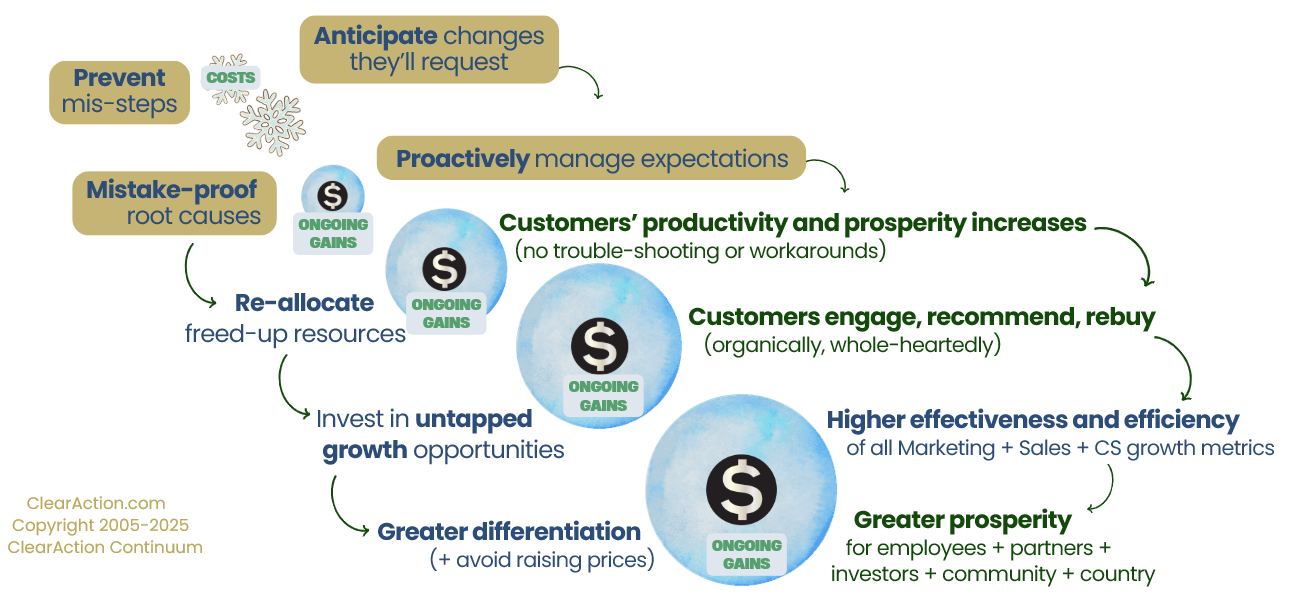
Growth results are exponential:
Alignment frees up resources.
Re-allocate them to growth opportunities.
New growth is perpetual.
Collaborator = Scaling CXM
Collaborator leadership aligns and scales CXM by reciprocally tailoring customer intelligence to each functional area, so they can tailor their performance to customer intelligence.
Does not add to their plate.
Adjusts what they’re already doing.
How they were doing it was spiraling costs.
Removes root causes of customer pain.
Turns ongoing costs into ongoing gains.
Aligns CXM mindset across your firm.
Scales your CXM team to all managers company-wide.
Focus each function’s managers on the top 2 CX gaps they cause:
Gaps are pebbles in customers’ shoes.
(a) What bothers them (they limp along): solve it.
(b) A need vital to their goal/destination (missing shoe): innovate it.
My True Story: Engaging All Organizations
The top 2 CX gap priorities were identified for each organization in a firm by using correlation analysis and Pareto analysis. In a 1-day workshop with each organization, their priorities were presented using their lingo and goals, followed by empathy mapping, 5 Why’s analysis, and creation of a single-page action plan for eradicating root causes.
Growth: This company permanently solved 100+ chronic issues every year for many years.
Saved millions in hours and costs for customers and the company.
Strengthened internal collaboration and customer relationships.
Freed-up resources for re-assignment to untapped growth opportunities.
It’s a snowball-effect:
Perpetually sunk costs are transformed into perpetual gains.
This is what I call “CX Annuities”.
Cost to Do This: A team of 3 CX Managers:
Divided the firm’s organizations among themselves.
Used stakeholder motivation skills to maintain each organization’s momentum.
Published the single-page action plans in a book quarterly.
Senior Leaders reviewed the book before investor presentations.
Gains to customers celebrated foremost.
Bonus compensation for Directors-and-above
depended on impressiveness of their progress
to permanently stop the root causes.
(much higher ROI vs. bonus pay for survey scores!)
In this example of a small issue for a small company, the CXM ROI is 9700% in the first year, and much more every year thereafter.

| Budget Expansion | Year 1 | Years 1+2+3 | Re-Allocate Resources |
| Increase Salaries | $346,800 | $520,200 | Allocate 10% |
| Increase Hiring | $346,800 | $520,200 | Allocate 10% |
| Empower Spending | $346,800 | $1.04M | Allocate 20% |
| Increase Profit-Sharing | $346,800 | $520,200 | Allocate 10% |
| Expand Markets, Products, Allies | $346,800 | $2.6M | Allocate 50% |
| Tip of the Iceberg | $1.73M/year | $5.2M/year | + New value generated |
The example above is for 1 “minor” issue.
Imagine your growth potential by:
Engaging every General Manager to do this.
Solving bigger issues.
Even if it takes a year to solve, ROI may be huge.
Apply this approach to (1) external customers and (2) internal customers.
And for (3) employee experience and (4) partner experience.
Teach all managers lite human-centered design.
They can map and manage journeys they own.
Apply this approach for aligned operations:
Every group’s annual strategy.
All growth efforts: markets, products, alliances, business models.
All efficiency efforts: cost containment, process improvement, etc.
All performance standards, reviews, and rewards.
This is what it means to be customer-centric.
Company-wide costs will shrink.
Company-wide budgets will expand.
Magnetic (organic) attraction will expand to:
new and existing customers,
employees, partners, and investors.
Note: The phrases “Transformer, Collaborator, Embed, Scale, Align” for customer experience maturity were first used by Bruce Temkin for VoC Maturity studies and State of CX studies conducted by Temkin Group prior to acquisition by Qualtrics XM Institute. However, when I first read Temkin’s reports, I immediately recognized their top-tier maturity descriptions as what we had been doing 10+ years prior when I was a Voice of Customer Manager at Applied Materials, in our company’s first year ever in formal experience management.
3. Urgent Turning Point
Today’s reality: extremely weak top-tier leadership! (2025 State of CX study by Qualtrics)
| 3% of companies6 | Transformer | Embed CXM |
| 11% of companies6 | Collaborator | Scale/Align CXM |
Silver lining:
You can outpace growth norms in your industry and nation as a Collaborator and Transformer.
“The disparity between the customer experience that brands intend to deliver and what customers actually experience is widening,” reports Forrester, based on 275,000 customers’ perceptions of 469 brands across 12 industries and 13 countries in 2025. 7
“Customer experience continues to erode worldwide, reflecting a concerning multiyear downward trend and a shift in sentiment from positive to neutral,” said Pete Jacques, principal analyst at Forrester.7
Take note that CXM practitioners are surely achieving positive outcomes, as evidenced by awards, yet these tend to be aimed at quick wins, too narrow and small to keep up with what the brand intends and/or customers’ expectations. Revenue-focus is a key reason: it’s short-term and self-centric more than customer-value generating.
Indeed, experience managers have severely inadequate skills:6
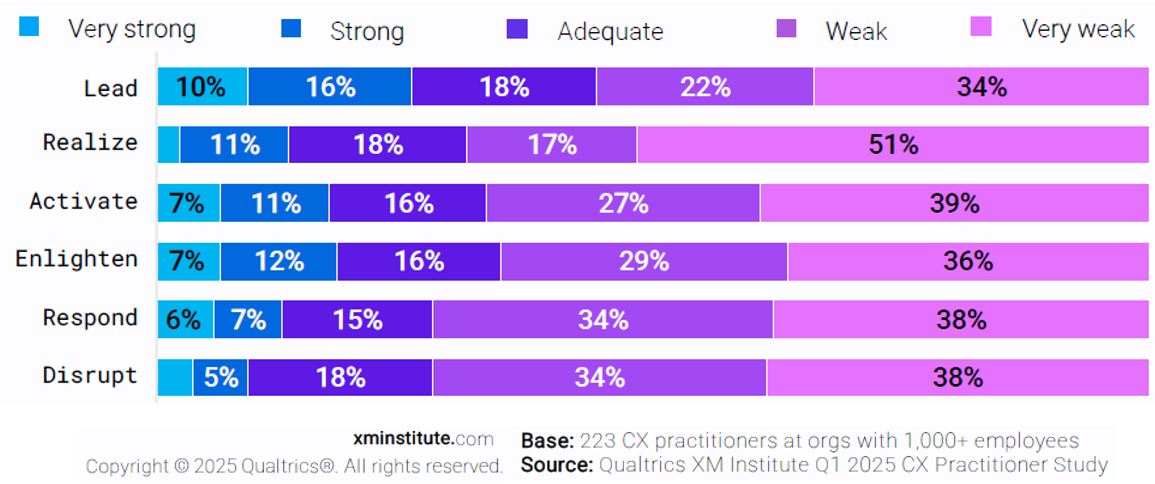
58% weak Lead8 : firm-wide customer, employee, partner experience strategy.
68% weak Realize: link experience improvements to business outcomes.
66% weak Activate: enable company-wide action on insights.
65% weak Enlighten: discover data patterns for actionable inspiration.
72% weak Respond: improve experiences and fix issues.
72% weak Disrupt: create new and better experiences.
Reversing weak CXM skills is crucial.
Re-think prioritization of your CXM training and development budget!
Note: “Enlighten” is the only competency specific to VoC data collection, yet it’s weak for 65% of practitioners as they rarely have time nor vision to discover actionable data patterns. Ironically, CX Design is still 72% weak due to narrowness and quick wins targets: not disruptive.
All these skills require critical thinking, financial savvy, and stakeholder motivation wisdom for ongoing momentum amidst inter-organizational evolutions. I’ve found it delightful that in my CXM masterclasses, this skill list piques participants’ interest and vision for their potential.
Sadly, massive budget dedication to-date in CXM think tanks and tech providers have stunted CXM professionals’ impact and tenure by commandeering their budget and energy while failing to nurture these skills. The key reason is nobody at these entities has pursued mastery of these skills. Fortunately, my market research and strategic planning early career background and my role at Applied Materials required me to indeed step-up and lead by these skills.
Why do business leaders allow these obstacles6 for experience managers?
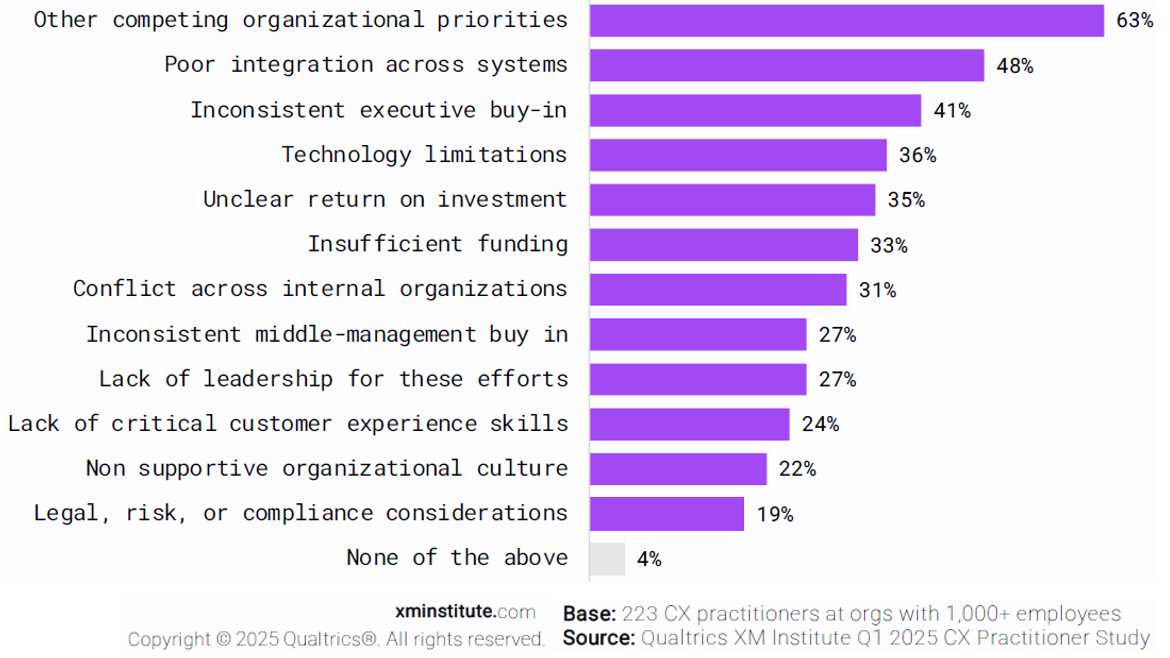
One reason why obstacles are allowed:
Fastest decline ever in integrity!9 (EY 2024: Integrity 1st = leaders walking the talk.)
No wonder CXM performance is crumbling.
Integrity is the heart of 1-to-1 performance.
| 2022 to 2024 Change9 | Integrity 1st | Compliance 1st | Lax |
| Europe | 26% to 16% | 21% to 30% | 52% to 54% |
| Africa + M. East | 39% to 25% | 16% to 22% | 45% to 54% |
| Asia | 37% to 26% | 13% to 17% | 49% to 57% |
| S. America | 31% to 24% | 7% to 19% | 62% to 56% |
| N. America | 42% to 33% | 12% to 19% | 45% to 48% |
Top 3 benefits of operating with integrity:10 (North America responses in EY study)
| 35% | Retaining customers |
| 33% | Retaining talented employees |
| 32% | Having an open and positive environment |
| 30% | Improving financial performance |
Shouldn’t CXM investment drive higher trust?!?
Trust in business is chronically weak.
Nearly half of people globally distrust business to do the right thing.11
(“Trust” = 6 to 9 on 9-point scale (generous!) in 2024 Edeleman study: 22 countries)
| Distrust | Trust | 2014 to 2024 | Do you trust them to do what is right? |
| 47% | 53% | +4% Trust | State-owned |
| 44% | 56% | +1% Trust | Publicly-traded |
| 40% | 60% | +3% Trust | Privately-held |
| 32% | 68% | -2% Trust | Family-owned |
What’s more important than embedding and aligning CXM?
Nothing. This is the heartbeat of financial growth.
Can you afford the status quo?
Clearly, top-tier leadership is missing.
An urgent pivot is vital in business leadership and CXM leadership!
4. VP-CX Role
The Vice President of Customer Experience is responsible for the end-to-end management of gap-free performance as viewed by customers.
Many gaps are caused by non-customer-facing roles.
Internal customer experience affects external customers.
Gap-free is preventive via educating all roles.
Customers’ performance standards are ever-evolving.
The VP-CX shapes enterprise agility.
The VP-CX drives CXM, and influences CS/Marketing.
CXM is NOT the same as Customer Support, Customer Success, Marketing, or Sales.
Do not make CXM (VP-CX) report to these roles.
Chief Customer Officer (CCO) is typically VP-Customer Success.
CCO/VP-Success is too busy for Transformer and Collaborator leadership.
Same with CMO: wrong skill set and power profile.

CXM: get managers to do/stop something for 1:1 business.
CS/Marketing: get customers to do/stop something for revenue.
| Marketing | Support | Success |
| Target market penetration CRM, hyper-personalization Merchandising and UX design Lead management Sales conversion | Self-service content mgt Inquiry channels Inquiry knowledge mgt Remedies, returns, refunds Escalation process, policy | Billing and A/R Customer education Account reviews Engagement processes Customer retention process |
User Experience (UX), Digital Experience (DX), Customer Journey Mapping (CJM), Human-Centered Design (HCD), Customer Relationship Management (CRM), Net Promoter System (NPS), and so on apply to all of the above.
These are not best as standalone teams (silos).
Silos are the opposite of gap-free end-to-end experience.
It’s best to teach every organization how to self-manage these tactics.
Service Delivery is similar to Product Delivery:
It’s giving the customer what they bought.
It’s different from Support or CXM.
Stop calling everything that touches customers “CX”.
“CX” is customers’ view of their realities vs. their expectations.
“CXM” is your proactive and reactive management of CX.
Is “Billing” a “CX role” or “Finance role”?
Billing touches customers, but it’s not CXM.
Is a lobby receptionist a “CX role”? Nope.
No need to re-label roles. (!!)
If it’s Support, say Support.
If it’s Success, say Success.
If it’s Marketing, say Marketing.
Do not mire your VP-CX with responsibility for CS/Marketing.
CXM is a different skill set.
Instead, your VP-CX’s team influences their 1:1 performance.
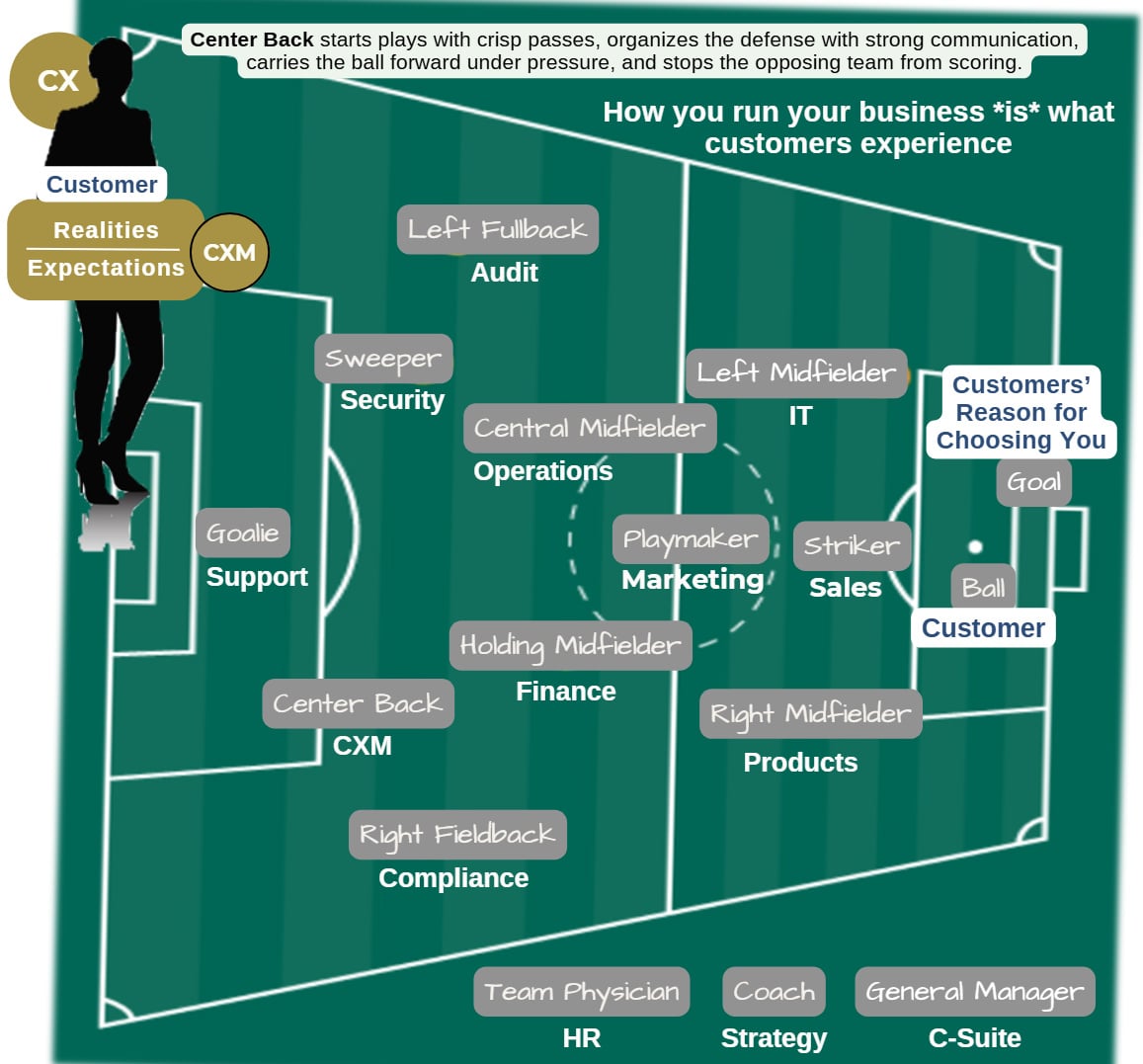
Transformation and Collaboration leadership is like a football team:
Guiding the ball (customer)
To its goal (what they want in their life or business)
(a) Every player keeps their eye on the ball constantly.
All roles are essential to win.
(b) All players backup teammates:
Collaborate and communicate transparently and constructively.
The VP-CX is like the Center Back in football/soccer:
Prevent the ball from getting near the goalie.
Transformation: Embedding.
Crisp passes to any player.
Coordination communication to defensive players.
Ally for all players to shine.
Collaboration: Alignment/Scaling.
VP-CX Drives Total Experience Management
Connects customer + employee + partner experience.
Discovers the intersection of their goals and expectations.
Fine-tunes enterprise performance for the high-potentials.

Stop saying “Brand Experience” and “Product Experience” and “Human Experience”.
Living beings are recipients of experiences you cause.
Humans or animals.
Customers: clients, patients, donors, citizens, etc.
Employees: execs, staff, contractors, interns, etc.
Partners: channels, alliances, affiliates, suppliers, etc.
They do not think about “brand” vs. “product” or other silos.
From their view, it’s a total experience, cumulative over time.
They define where/when their experience starts and ends.
Scope of Experience Management
1:1 Performance: customer-centered management company-wide
Senior leaders’ shared vision for customer-centered business value.
Prevention of issues for customers.
Permanently stopping chronic issues affecting customers.
Ongoing increases in value for customers..

Clarity and Scaling Precedents: HR, IT, Finance
HR requires all supervisors to conduct performance reviews.
IT requires every employee to be responsible for data privacy.
Finance requires every manager to be fiscally responsible.
Likewise, CXM requires every employee to get in-sync with customers’ aims.
If it’s driving 1:1 performance company-wide in (a) proactively managing expectations, (b) delivering exactly to expectations, (c) permanently solving root causes of bad experiences, and (d) syncing mindsets and outcomes across your ecosystem . . . then say Experience Management or CXM.
Experience Management Governance
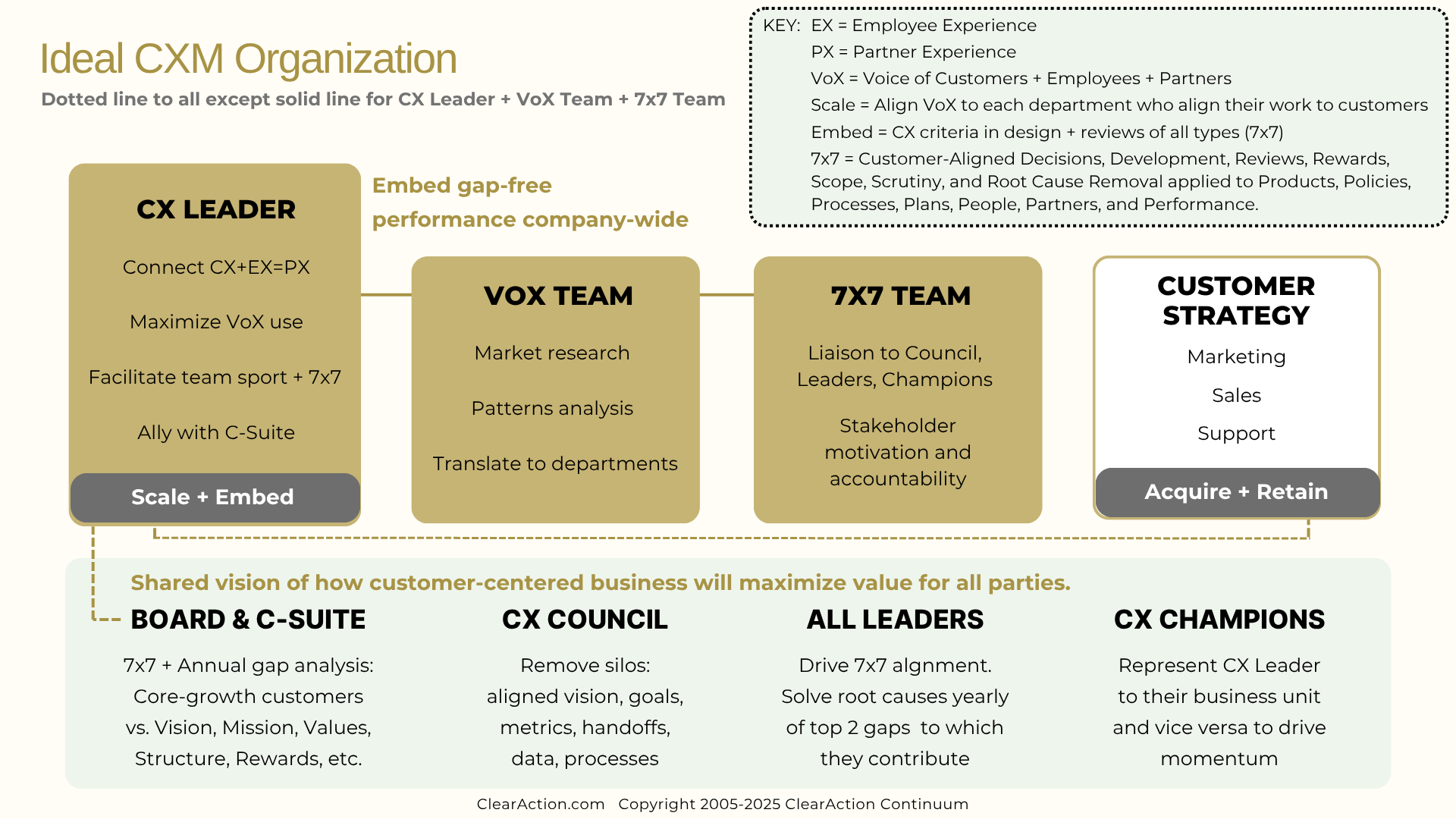
VP-CX liaisons with all leaders company-wide.
Close relationship with Board and Senior Leaders.
Execs’ role: Embed and Scale.
Close relationship with Customer Strategy Leader.
Customer Strategy role: Acquire and Retain.
CX Council discovers ways to reduce silos.
Representative from each business unit.
Meets quarterly or monthly.
CX Champions liaison with the VP-CX.
They have a separate full-time role in a business unit.
Charismatic for business unit’s CXM momentum.
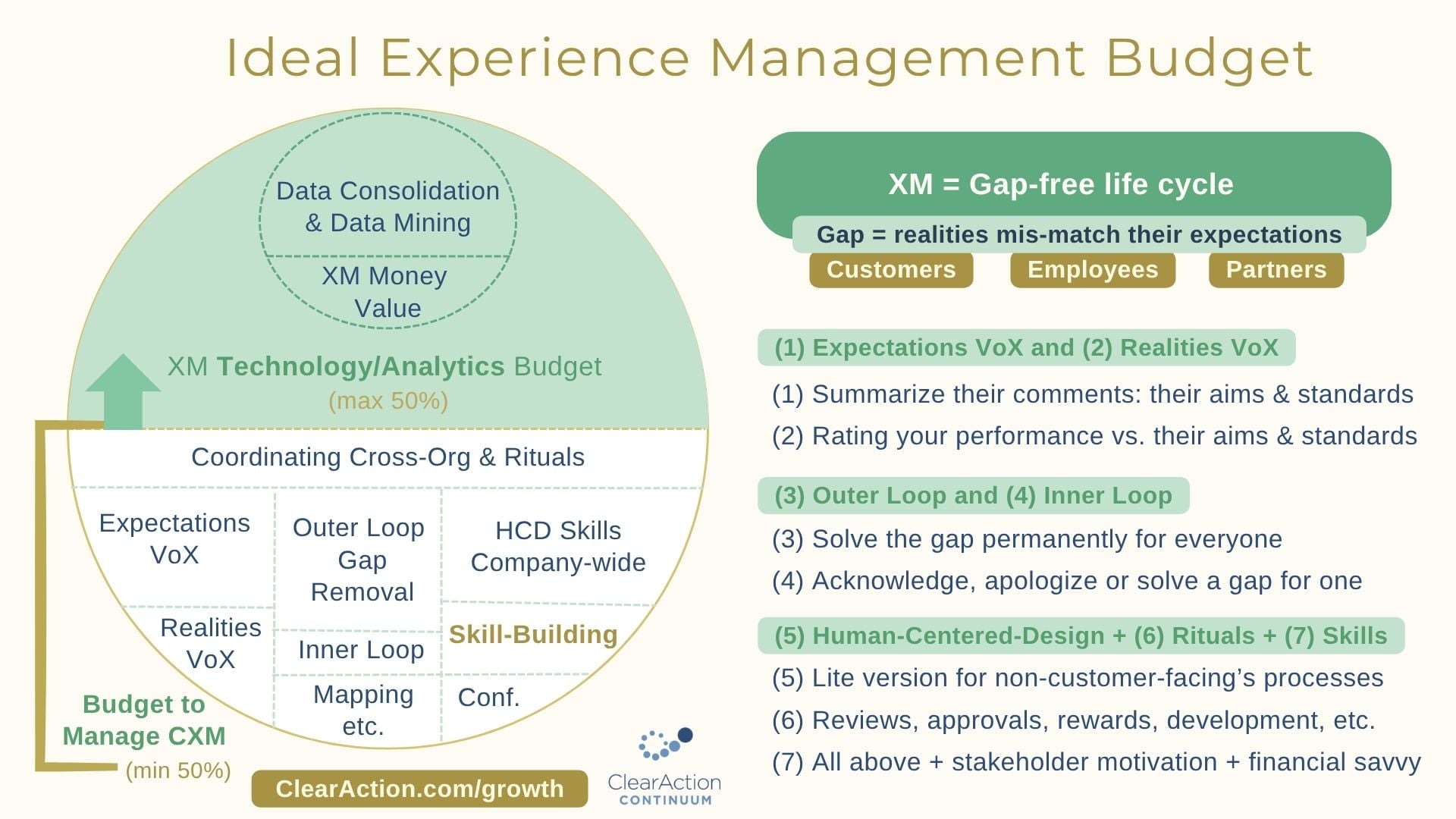
Reserve 50% CXM Budget to Influence People
Limit tech expenses to 50%.
Top tech priority is data-mining and quantifying money value.
Each wedge size below shows funds allocation.
Example: Outer loop should be 3X inner loop.
Budget to get these skills and expert guidance.
5. Board & Senior Leaders Roles
Customer Experience Management Strategy = senior leaders’ shared vision for customer-centered business maximizing value.

 “Our biggest problem with the organization structure was that it did not support the people in what we call the value zone: the place where value is truly created for customers,” said Vineet Nayar, CEO of HCL Technologies. “So, to shift our focus to the value zone, we turned the organization upside down and made management and managers … accountable to those who create value, not just the other way around.”12
All senior leaders should model customer-centric DNA.
Here are 10 ways advised by Annette Franz, author of Built to Win: Designing a Customer-Centric Culture That Drives Value for Your Business:12
- Customer Obsession: Opens meetings with a customer story before the financials.
- Empathy: Listens in on frontline calls to feel the customer’s frustration, not just read the metrics.
- Long-Term Focus: Protects service budgets even when cutting would boost short-term margins.
- Visibility: Spends time each month/quarter on the frontlines with employees and customers.
- Empowerment: Tells teams, “Do what’s right for the customer. You don’t need permission.”
- Connector: Breaks down silos with a CX Champions Committee aligning all functions around outcomes.
- Balanced Use of Data: Considers both the KPIs and the raw verbatims before making decisions.
- Culture Stewardship: Celebrates employees who deliver customer-first moments.
- Adaptability: Acts quickly when customers signal friction and doesn’t wait for the next budget cycle.
- Puts Employees More First: Recognizes the EX+CX connection and ensures that employees are cared for.
The CEO must ‘own’ company-customer alignment, set tone for values, drive customer experience insights into the strategic plan, and be transparent to customers,” advised Christine Crandell, who has led organizations to achieve 20-50% revenue growth. “Sales and marketing alignment is part and parcel of becoming a customer-aligned company, and vice-versa. Aligned companies see customer-focus as the rallying point to get to the outcomes needed both by buyers and sellers.”13
 “To drive customer-focus across your enterprise, your VP-CX (by whatever naming convention you prefer) is the CEO’s deputy, who allies with all senior leaders to embed and scale CX in the company’s DNA for topmost growth efficiently.
The VP-CX influences alignment among your CMO, CRO, CSO, etc. “In most companies, customer ownership is ambiguous, like two ships that pass in the night — nobody really knows what other parts of the company may be duplicating or doing simultaneously with any given customer,” explains Crandell. “When companies do strive for marketing and sales alignment, it’s typically a collaborative ownership of the customer life cycle, that still lacks consistent, smooth transitions end-to-end. A culture of distrust ‘gets into the paint’, perpetuates itself, and drives attrition: communication suffers and silos prevail. We tend to focus on products to shut out the noise of these consequences, rather than deal with trust and harmony that are essential to alignment.”13
Business success is actually about managing costs wisely:
(1) What you promise and (2) whether you deliver it.
(3) How you anticipate changes to make them simple.
(4) How you learn from preventable issues to refine 1-3.

“Our client-centric banking approach is driving momentum in our core business fundamentals,” said William H. Rogers, Jr., chairman and chief executive officer of SunTrust Banks. In November 2008, SunTrust executives rated themselves on a set of 50 client-centric dimensions, and they ranked in the bottom quartile of companies participating in the assessment. Jeff VanDeVelde, Senior Vice President of Client Experience and Loyalty at SunTrust said, “18 months into our journey we re-assessed ourselves and found we moved into the top tier of companies that exhibit these 50 customer-centric behaviors and traits. We’re excited that our effort to be client-centric has yielded this benchmark leadership.”14
Conclusion
Business success is a 1:1 ratio of meeting expectations.
1:1 ratio for performance to customers’ expectations is:
Crystal clarity of core-growth customers’ goals.
North Star for everyone’s decisions.
Doing the right things right the first time.
Lowest costs for highest growth.
Best way to grow investors, partners, employees, and customers.
Proactively managing expectations.
In-sync performance to promises.
CXM: get managers to do/stop something for 1:1 business.
CS/Marketing: get customers to do/stop something for revenue.
Guiding outside-in is the purpose of your VP-Customer Experience.
Outside-in = embedding CX in running your business: 1-to-1 ratio.
Prevents dysfunction, waste, risks.
Improves employee experience, productivity, and creativity.
Multiplies all growth metrics exponentially.
What’s more important than embedding and aligning CXM?
Nothing. This is the heartbeat of financial growth.
1 Bad Customer Experiences Put Nearly $4 Trillion at Risk in Global Sales, Qualtrics, November 19, 2024.
2 Massachusetts Institute of Technology, study of 1,193 successful innovations across 9 industries over 5 years.
3 Advocacy Drives Growth, London School of Economics.
4 Driving Organizational Alignment Around New Growth Strategy, by Ingrid Estrada, Keysight Technologies, SHRM Executive Network, February 22, 2024.
5 Keysight Announces Executive Leadership Transition, BusinessWire, March 16, 2023.
6 The State of Customer Experience Management, 2025, by Topher Mitchell and Talia Quaadgras, Qualtrics, 2025.
7 Forrester’s 2025 Global Customer Experience Index Rankings, Forrester, June 24, 2025.
8 The XM Operating Framework, Qualtrics XM Institute, October 17, 2025.
9 Global Integrity Report, by Jim McCurry, EY, 2024.
10 Why Leadership is Critical in Building an Integrity-First Culture, by Sharon van Rooyen and Ramesh Moosa, EY Canada, June 13, 2025.
11 Edelman Trust Barometer, 2024.
12 10 Characteristics of the CEO of a Customer-Centric Organization, by Annette Franz, LinkedIn, 2025.
13 Marketing & Sales Alignment: Breakthrough Discoveries, by Lynn Hunsaker, ClearAction, 2014.
14 Customer First Drives Business Performance, by Lynn Hunsaker, ClearAction, 2011.
This is the fifth of a CustomerThink Advisors 5-part series: Executives’ Guide to Customer Experience Value.
Part 1) Revenue Risks
Part 2) High Potential
Part 3) Alignment
Part 4) Metrics
Part 5) Top Tier Leadership
Image licensed to ClearAction Continuum by Shutterstock.
Lynn, this piece is an important reminder that customer centricity is not a programme or a department. It is how the organisation thinks, decides, and behaves every day.
What particularly resonated with me is the clarity with which you link leadership behaviour, operating models, and customer outcomes. Too many companies still treat CX as a reporting exercise rather than a management discipline.
My own work with mid-sized CPG businesses shows exactly what you describe.
When decisions start with the consumer’s goals, the entire system becomes lighter, more focused, and ultimately more profitable. When decisions start with internal priorities or legacy structures, the gaps multiply and so do the costs.
Your examples also highlight something I see repeatedly.
The companies that excel are those that embed customer insight into the “how” of the business, not just the “what”. This is the foundation of my QC2 approach and your analysis reinforces its importance.
When teams understand the two or three themes that truly matter to consumers, the organisation finally starts rowing in the same direction.
There is real urgency in your message.
Many companies have mastered the language of customer centricity but not the practice. Your article is a powerful call to reset that gap.
Thank you for raising the conversation to the level where it belongs.
Thanks for sharing your reaction, Denyse. I’m so glad there are people like you helping to shape things the right ways in enterprises across the world.