


These days, customer experiences increasingly need to be enabled with the
help of intelligent technology. In the past months I have given some
examples of how business areas can use AI to improve their part of customer
engagements to enable better experiences. Now they have different AI’s, but
then what?
It is time to connect some dots and talk platform.
Talking platform does not mean that direct interactions and people are not
important – on the contrary; but an increasing number of customers are
using the web, social media, or an app to identify suitable products or
services, or to resolve an issue, when needed. Businesses and organizations
are well advised to consider this, not only technology-wise.
Customer experience is only as strong as the weakest part of the customer
journey. A bad experience gets remembered longer and shared more often than
a good one. This is bad news for businesses – but it is human nature. And
it means that from the
Zero Moment of Truth to the
Ultimate Moment of Truth
businesses need to deliver a consistently high customer experience.
The question that arises is: How to achieve this?
Part of the answer to this question is a triple A: Analytics, Automation,
and AI, describing the how.
But not in isolation! Technology is only a means to an end.
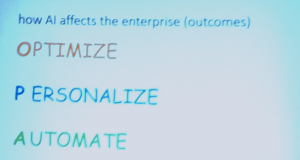
The delivery of consistent experiences mandates a coherent strategy that
bases on a clear vision that describes the outcomes. They are what Esteban Kolsky named OPA:
Optimization, Personalization, Automation.
Once the desired outcomes are established, one needs to give in-depth
consideration to the technology platform to have a shot at not repeating
the old mistake of creating silos. The technology platform is the
foundation of a business’s ability to deliver, and to deliver in a future
proof way. As this platform connects people and processes it needs to be
open and extensible.
And it needs to connect the existing and future application landscape to
offer highest business value. Else there will be data silos (and process
silos and what-not-silos) that prevent the business from delivering
positive experiences.
The AI platform supports all this, plus machine learning and shifting
priorities, and different types of exposition of AI, like bots, human
speech recognition and interfaces (NLP), understanding the customer better,
providing better service, giving the right recommendation at the right
time, doing segmentations to size one.
Ooops, just waking up out of my daydreams. Of course this platform doesn’t
exist.
All these objectives at the moment require different types of AIs and
platforms. Also, at this time, pretty much every vendor claims to have
built their intelligent applications based upon a proprietary AI platform.
From a business point of view AI technology can be grouped by Specificity
and Integration and therefore roughly put into four quadrants: Raw
toolkits, application platforms, value added intelligent applications, and
intelligent business applications
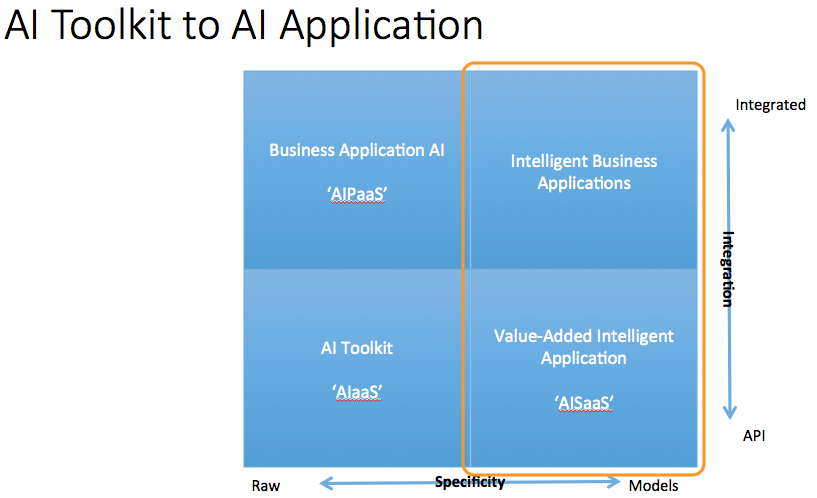
The AI platforms in the left hand of the quadrant basically make up
development environments to develop, implement, train, and deploy custom
intelligent applications. These can be part of the application platform
that a business application vendor offers, or standalone. Examples of AI
toolkits are e.g. Google’sTensorflow or OpenAI. They are not geared towards
business problems, in contrast to Business Application AI, which includes
services like Infosys NIA or
SAP’s CLEA
.
On the right hand side we have platforms that include not only models but
also prebuilt applications, either offering connectivity to other business
applications by APIs, Services, etc. or being part of a vendor’s
application suite itself. Value-added intelligent applications are often
built on a platform of their own and are built for integration with other
business applications, augmenting them in a best-of-breed style. An example
of these would e.g. be Crowdflower. Examples of
Intelligent Business Applications are SAP’s applications that use CLEA in
the areas of marketing, loyalty, sales and service, or Salesforce’s
‘Einstein’-enabled applications.
This is where strategy comes into the picture – and prominently so.
Companies will in all likelihood build an infrastructure that uses more
than one platform. The company specific business technology platform can
easily become a platform of technology platforms. If these platforms, and
the applications on top of them, do not play nicely the company will have a
hard time to provide customers with positive engagements that leave a good
experience. Instead, there will be inconsistent and duplication of data,
broken processes, hence frustrated employees and customers; in summary poor
experiences for everybody involved, leading to poor experiences. And not
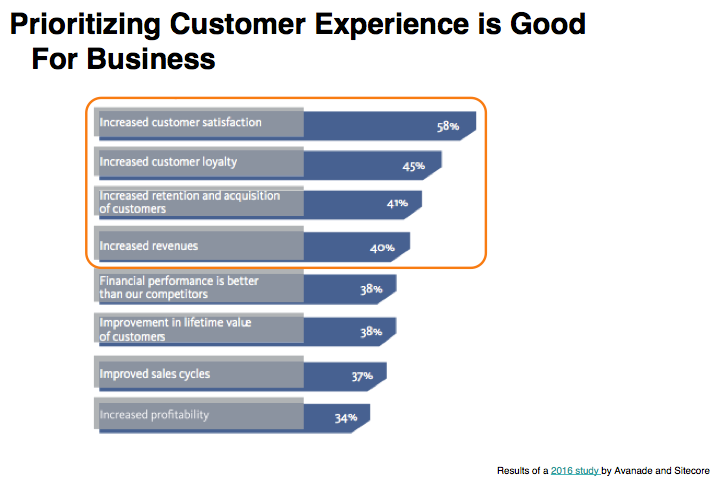
concentrating on good experiences leaves companies with missed
opportunities, as studies like
this one show.
This was also a topic of
my speech
at this year’s CRM evolution.
Of course many suites do not only cover one of the quadrants. Let me
illustrate this a little: SAP recently announced their machine-learning
platform being part of the SAP Cloud Platform. This would be a top left
entity. Intelligent Business Applications leveraging this platform, like
‘Brand Intelligence” are top right. Microsoft’s Cortana Intelligence Suite
or Salesforce’s Einstein, or Infosys Mana fit into the top left quadrant,
too, while Google Cloud Machine learning is probably closer to the bottom
left quadrant.
Intelligent virtual assistants, aka bots, are good candidates for the
bottom right quadrant.
What Does it Mean?
Most businesses can concentrate on the right hand of the diagram, as they
regularly do not have the skills or the resources to implement their own AI
solution. This is doubly true for raw toolkits.
If there already are platform based business applications available then it
is a good option to look at what the underlying AI platform of the vendor
is offering, always keeping the answer to the question “What experiences do you want to deliver?” in mind. If this platform does not deliver to expectations or does not
seem to be viable over time or a multi vendor strategy is preferred, select
another platform with applications based upon a set of criteria:
- Viability of the vendor and the platform itself. This is always a
consideration to avoid costly dead ends. - Desired target state: Can the platform support all/most of the
requirements that I have now? If not, how does the roadmap look like? When
do services that I want to offer at a later point in time become available?
The more the platform can offer right now the more flexibility I have in
adapting my own priorities that are partly dictated by the customers’. - Intermediate states: Which experiences do have priority for me? These
services need to be covered right now. - Integration-ability of the platform. If it is hard to connect the AI
platform to my current technology platform then I need to reconsider,
probably also my current technology stack. - Lock in! Lock in is even more interesting than for normal applications.
Not only can the data structures be proprietary, but also e.g. the used
artificial neural network (ANN). Additionally, any other ANN needs to get
trained and validated against the one that is to be replaced, to make sure
it delivers better results than the old one. This is a project in itself.
The impact of choosing the wrong platform can hardly be overestimated.
Therefore, he who plans to forever tie the knot needs to carefully consider
his options.