


Measuring marketing success as a small business means focusing on the metrics that connect directly to your revenue, customer behavior and long-term growth. It’s easy to lose focus of this when vanity metrics such as social media likes and followers are in the digital marketing mix.
The strategies I develop for all clients are based on my real-world experience over 10+ years as a small business coach and marketing consultant. I, of course, stay up to date with best practices via training courses, webinars and industry events but, more crucially, I learn lessons from past successes (and mistakes!) – both my own and those of colleagues.
I’ve worked for 2 years with a small eCommerce business that sell their products nationally, from a single physical base. I’ve developed and honed a strategy so that they can better understand which digital marketing activities move potential customers from awareness to action – because that’s what really matters to strengthen the financial health of the business.
It would be good to say that over those 2 years working with this particular client that a clear winning channel has emerged, but reality (as many things in life) is not always as neat as we would like. What I have seen is that almost all digital marketing channels contribute to the revenue of the company in different ways and at different times. That’s not to say we haven’t tested switching things around – such as reducing the Google Ads budget in favor of increasing search engine optimisation effort, or increasing the time and effort on email marketing; or reducing the time and effort on social media.
We have not yet reached the perfect balance between different marketing channels but we’re getting there. And we have removed one channel (more on that below) that was proved conclusively to not be cost-effective.
Take a look at the figures below from Google Analytics (data courtesy of Axion Now) which show the different percentages of sessions by channel. Both Organic Search and Paid Search (including Cross-Network) are currently just under 20% each of all visits and this balance follows a testing period where certain Ad groups were paused to see how much of the paid traffic was picked up by high-ranking organic searches. (The answer in case you’re interested was about 70%).
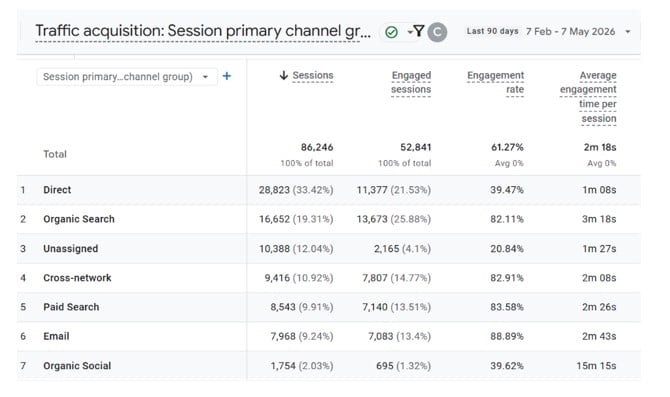
What this data also shows is that 12% of all sessions are Unassigned i.e. we don’t know where they came from. It’s fair to say that this is a common frustration. Even though we have multiple tools at our disposal to track website visitors, these tools have their limitations and the source of a lead cannot always be accurately identified.
Why measuring the right things matters
Marketing metrics are there to show how well certain efforts drive the customer actions that create value for a business. They assist in understanding exactly what goal is achieved by different parts of a campaign.
Yet it’s important to small businesses – with limited marketing budgets – to focus on meaningful metrics since some regularly reported metrics, such as social media likes or Google Ad impressions, don’t always translate into sales – or even traffic to your website.
This data can indicate a level of brand “visibility” but that’s a tenuous concept that doesn’t tell you if your marketing activity is simply influencing behaviour or if it is actually generating revenue.
That’s why a strategy such as that used for Axion Now also tracks the intermediate steps where customers get stuck. Understanding these interim stages help us make smarter decisions and avoid wasting money on tactics that don’t make a difference to the bottom line.
Understanding the customer journey
If you want to measure what matters, you need to understand how customers make the move from discovering a business to making a purchase. Traditional marketing funnels show this journey in stages: awareness, consideration and decision. Each individual stage has different indicators to success. Awareness could be website traffic or Ad impressions, consideration could be time spent visiting your website or social media engagement, and the decision stage is conversions or sales.
A quick side note about “conversions” in digital marketing – be aware that not all conversions are created equal (there’s a reason why Google changed the metrics that used to be known as “goal conversions” to “events” and their sub-group “key events”. That’s a whole other topic in its own right…
Modern customer journeys are very fluid, with people not always moving in a straight line. Again and again I have seen user behaviour on websites that confounds me and doesn’t follow the expected route. People might jump between unrelated pages, revisit earlier ones, or even skip pages or steps entirely.
See for yourself by using the Exploration section of Google Analytics for your own website.
Understanding this journey means that you can choose metrics that reflect every stage – the expected and the unexpected – and measure just how effective your marketing is in guiding people through to the final action.
Choosing metrics that reflect real business impact
Small businesses don’t need lots of metrics. What they do need is a select few that show what is working. When you focus on the right metrics you can make data-driven decisions that help refine strategies, and allocate budgets in a more efficient manner.
Take the example of my client Axion Now for whom I showed Google Analytics data above. Over time we have learnt that social media advertising delivered plenty of interaction in the form of clicks/traffic but with relatively little impact on sales. Perhaps surprising, given this company is a trading card game specialist (think Disney Lorcana or Magic: The Gathering) which has an active community on social networks. But important data nevertheless that we would have been unlikely to predict given the nature of their business.
This sounds obvious, but is worth repeating – metrics must align with business goals. The key is to choose metrics which best reflect progress toward the outcomes that are most relevant to you. In this case, measuring increased sales revenue from social media advertising enabled us to eliminate social media advertising from the marketing mix – they were just vanity metrics.
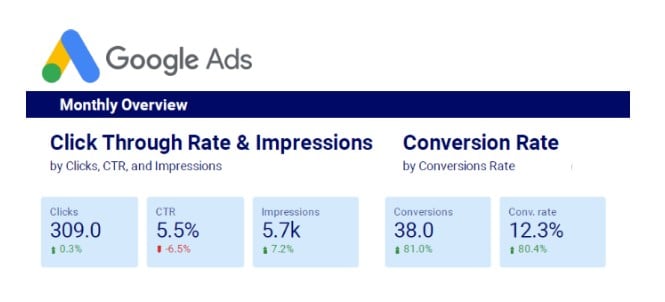
In the same instance, data we had from Google Ads did not look impressive but resulted in a significant uplift in sales. In this particular example, Google Ad impressions are 5,700 i.e. Ads were shown 5,700 times in the reporting period, but the number of people who clicked the Ad was just over 5% of that number at 309 clicks. And the actual number of purchases were even lower at only 38. That does not sound particularly impressive yet delivered significant revenue increase.
This doesn’t mean awareness metrics are useless, far from it, they can be very helpful early on in the customer journey, however they must never be your primary measure of success.
The bottom line
You do not require complex tools to measure what matters. Tools such as Google Analytics offers valuable insights about website performance and the effectiveness of marketing campaigns. It’s more than enough for most SMEs.
By collecting the right data and focusing on the metrics that best deliver real financial outcomes you’ll get the best out of your digital marketing budget.
As my example shows, a seemingly obvious marketing channel (social media ads) for a certain type of business may not, in fact, increase revenue. So, the moral of the story is – beware of vanity metrics, make no assumptions about the effectiveness of different channels and measure, measure, measure.