


Modern hiring has grown more complex. Talent teams manage large applicant pools, distributed stakeholders, and roles that require more rigorous skill validation. Yet many interview processes still rely on manual coordination and loosely structured conversations.
This gap creates inconsistency in evaluation and makes it harder to compare candidates fairly. As hiring volumes increase and roles become more specialized, teams need structured systems that bring clarity, documentation, and measurable criteria into early-stage screening.
Video interview platforms address this shift by standardizing how interviews are conducted and reviewed. Instead of relying solely on traditional formats, companies can introduce recorded responses, structured scoring, and AI-supported insights to make evaluations more consistent and easier to manage.
What is Video Interview Software?
Video interview software is a digital hiring tool that allows employers and candidates to conduct interviews remotely through recorded or live video sessions.
Most platforms support three primary formats:
- Pre-recorded (One-Way) Interviews: Candidates respond to predefined questions by recording video answers. Recruiters review these recordings later using structured scorecards or evaluation frameworks.
- Autonomous AI Interviews: An AI-driven system guides candidates through a question sequence, records responses, and may generate summaries or structured assessments for review.
- Live Video Interviews: Recruiters and candidates meet virtually in real time for a structured conversation.
How Are These Tools Shortlisted?
To identify the six platforms featured in this guide, we compared leading AI video interviewing tools against consistent, practical criteria relevant to modern hiring teams. Our evaluation focused on:
- AI evaluation depth: Quality of automated scoring, structured summaries, bias controls, and explainability of insights.
- Interview format flexibility: Support for one-way (asynchronous), live, and AI-led interviews.
- Ease of setup and usability: Implementation time, learning curve, and overall user experience for recruiters and candidates.
- Collaboration capabilities: Built-in scorecards, shared notes, role-based access, and stakeholder review workflows.
- Integration readiness: Compatibility with applicant tracking systems (ATS) and existing hiring tools.
- Scalability: Suitability for different hiring volumes, from startup teams to enterprise-level recruitment.
- Candidate experience: Mobile accessibility, clarity of instructions, and overall interview flow.
- Pricing structure: Transparency, flexibility of plans, and alignment with company growth.
Our evaluation is based on a detailed review of product documentation, feature depth, integration options, usability, and real-world hiring scenarios.
Top 6 AI Video Interview Platforms To Streamline Your Hiring Process
1. Jobma

Jobma is a structured, enterprise-ready video interviewing platform built for organizations that manage hiring at scale. It supports one-way, live, and AI-led interviews within a single system.
What sets Jobma apart is its combination of interview variety and enterprise control. In addition to video responses, teams can incorporate audio, objective, and subjective questions, coding assessments, and game-based evaluations. AI-generated insights and structured scorecards sit alongside role-based access controls, bulk sharing, and observation notes to support cross-functional review.
This platform is best suited for large organizations, distributed teams, and companies hiring across multiple roles simultaneously. It works well in environments where consistency, documentation, and collaborative review matter as much as the interview itself.
2. Glider AI
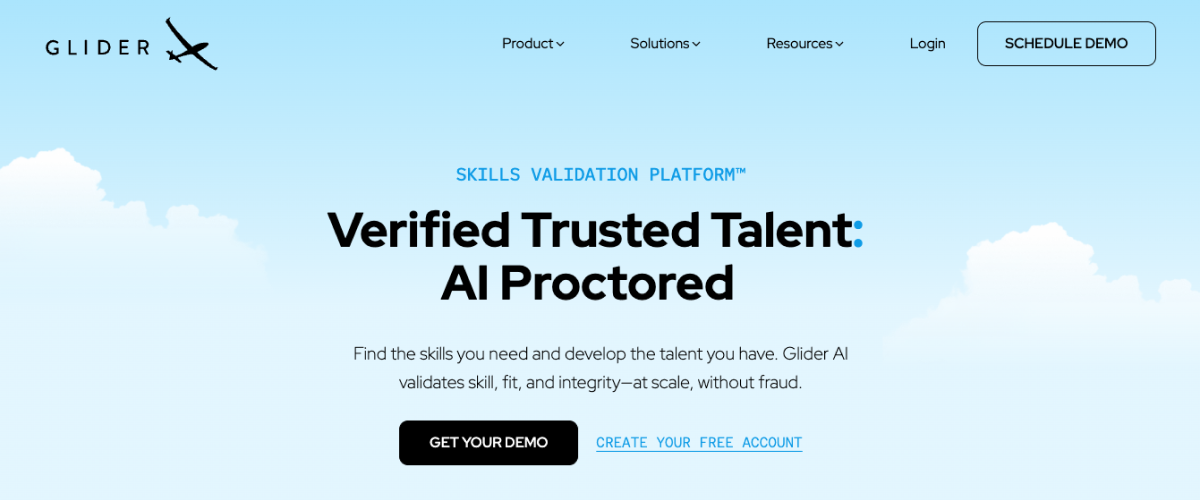
Glider AI centers on structured video interviewing combined with skill-based evaluation. It combines video interviews with built-in skill assessments.
What distinguishes Glider AI is its focus on role-relevant testing alongside video responses. Recruiters can configure interviews that align with predefined skill benchmarks, making it suitable for positions where measurable competencies matter as much as conversational performance. The interface emphasizes guided workflows, helping teams maintain evaluation consistency.
Glider AI is best suited for mid-sized organizations and growing teams that want structured, skills-oriented screening without adopting a full enterprise hiring suite. It works particularly well in environments that prioritize consistency and competency validation, such as technical, operational, or specialized roles.
A company would choose Glider AI over simpler async tools if it values built-in assessment alignment and structured evaluation frameworks.
3. InCruiter

InCruiter focuses on standardized, repeatable interview workflows designed for organizations that rely on structured evaluation across multiple roles. It offers pre-configured interview setups and reusable question libraries.
What differentiates InCruiter is its emphasis on process control. Recruiters can generate and assign structured question sets, define interviewer roles, and guide candidates through predefined stages. It suits organizations that require documented processes across teams.
InCruiter is best for companies managing recurring hiring needs, campus recruitment drives, or multi-location operations where repeatable interview frameworks are essential. It fits environments where predictability and standardization matter more than advanced analytics or deep customization.
4. PMaps
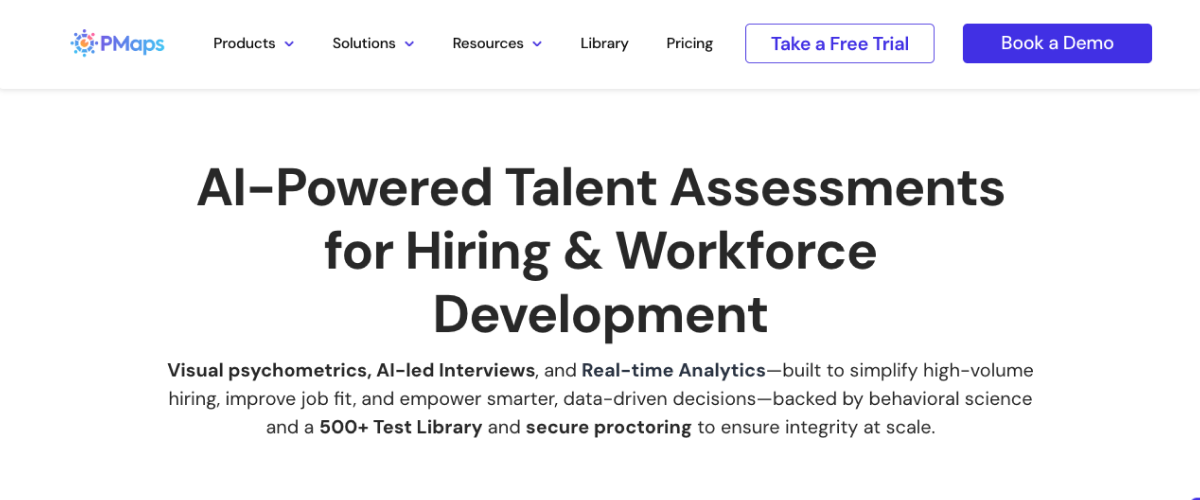
PMaps stands out for combining video interviewing with assessment science. It integrates psychometric testing and behavioral profiling into the interview workflow.
What makes PMaps different is its layered approach to decision-making. Teams can incorporate cognitive, personality, and role-fit assessments alongside interview responses, then choose between automated scoring models and manual review depending on the role’s sensitivity or complexity. Teams can combine automated scoring with manual review.
PMaps is best suited for organizations that rely heavily on competency frameworks, behavioral benchmarks, and structured role mapping. It fits environments where hiring decisions are tied to long-term performance indicators, leadership potential, or cultural alignment.
A company would choose PMaps over more interview-centric platforms if it wants assessment depth and psychometric rigor embedded directly into the evaluation process.
5. Willo
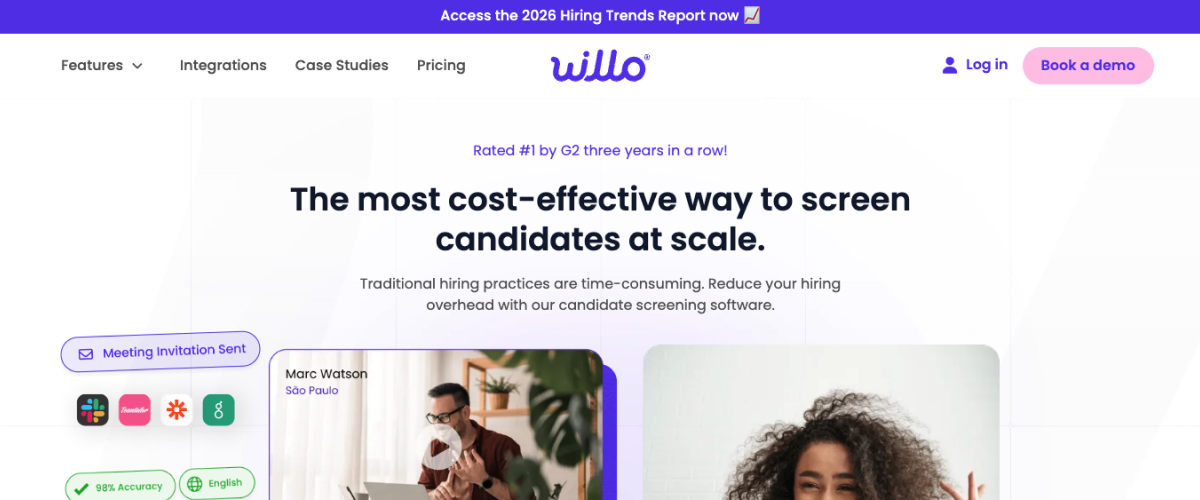
Willo is built around asynchronous video interviews with a strong emphasis on simplicity and mobile accessibility. Willo focuses on recorded responses and simple review workflows.
What differentiates Willo is its minimal setup and clean interface. Teams can create question sets, share interview links, and review candidate recordings without navigating complex configuration settings or advanced analytics dashboards. Basic employer branding options, such as adding logos and brand colors, are included and do not require technical customization.
Willo is best suited for startups, small businesses, and early-stage teams that want a dedicated async interview platform without adopting a broader hiring suite. It fits hiring environments where ease of rollout and clarity matter more than layered evaluation models or deep AI scoring systems.
A company would choose Willo over more feature-heavy platforms if it prefers a focused, lightweight tool for recorded interviews.
6. Interviewer.AI
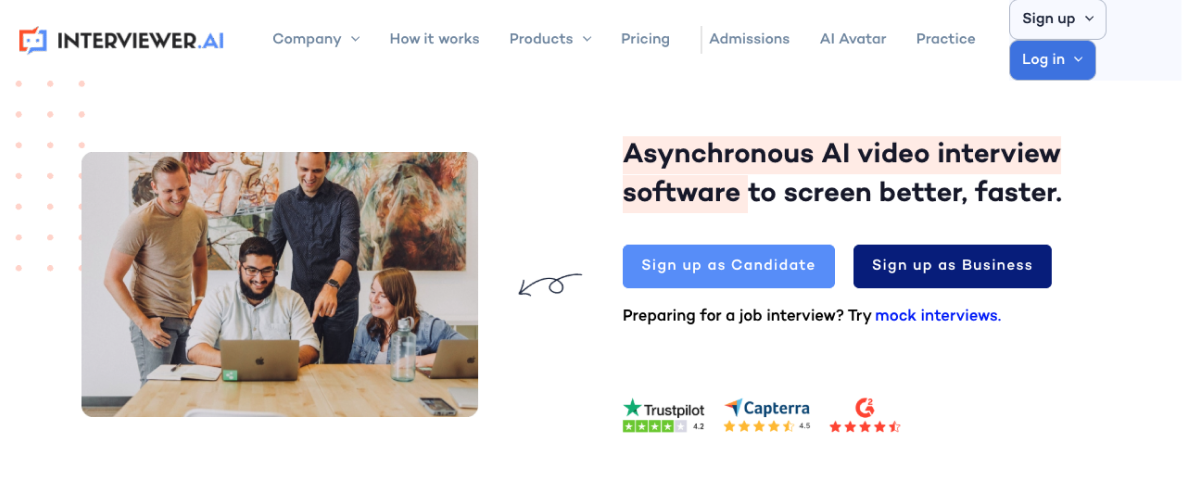
Interviewer.AI focuses on automated, AI-driven screening that evaluates candidate responses without requiring extensive manual review. It centers on AI-generated analysis as the primary screening layer.
What distinguishes Interviewer.AI is its emphasis on automated evaluation summaries and ranking logic. The system analyzes recorded responses and provides structured insights that help teams compare candidates using predefined criteria. The interface is intentionally simple.
Interviewer.AI is best suited for small and mid-sized businesses that want AI-assisted evaluation without deploying a full hiring suite. It fits environments where teams prefer automated comparison and prioritization tools but do not require advanced assessment science, multi-format interviews, or large-scale stakeholder collaboration features.
A company would choose Interviewer.AI over more comprehensive platforms if it values straightforward AI-driven screening and minimal setup.
Conclusion
AI video interviewing tools are not interchangeable. The right choice depends on your hiring volume, role complexity, and your team’s decision-making process.
Startups may prefer simple, easy-to-roll-out asynchronous platforms. Growing teams often need structured workflows with built-in skill validation. Larger organizations typically require layered interview formats, shared access to reviews, and stronger process controls.
Before choosing a tool, assess how much automation your team is comfortable with and how involved stakeholders need to be in the evaluation process.
The best fit will support your hiring workflow without adding unnecessary complexity.