


It is the day after a pleasant dinner evening with friends. As usual there
are quite a few dishes to wash. Just that your high-end dishwasher refuses
to start up. You call the service line and the friendly person on the phone
tells you that she needs to talk to the technician and will come back to
you as soon as possible. “Do you have a cell phone number on which I can
reach you?” An hour later she informs you that the next possible
repair appointment is a week later, between 10 am and 4 pm, after asking a
few questions about the nature of the problem. “Sorry, I cannot be more
precise, but the technician can call you about half an hour before he
arrives”.
The technician who arrives at noon on the announced day is in his
first week. He disassembles the machine, looks confused at
one part, “uhm, what is this?”, finds the broken one “oh, I do not have
this, need to return another day” and then has difficulties reassembling
the machine.
This is admittedly an extreme scenario but surely not
outside the realm of possibilities. We have seen one part or another of it, b2b or b2c. Field service scenarios are
notoriously difficult, with challenges throughout the process.
Time is Money
On the other hand the most valuable asset that people have is their time.
So spending little time in coordinating a repair, having an accurate
arrival time of the service technician, and a fast and efficient repair in
one visit are paramount traits of good customer service. This is something
that e.g. Forrester’s
Future of Customer Service
Study found. And this is true for businesses, too. Doubly so, as machine
downtime equals loss of income and perhaps even penalties.
All service technicians have different skills and specializations.
Minimizing the travel time to maximize time on site remains challenging.
Similarly it is hard to accurately determine the time needed for an actual
repair.
Even if the service technician has all necessary skills to action a repair
he might not have the right spare parts in the van.
Similarly, on the corporate and management side there are regularly
questions like: Who takes how long on repair jobs? Who of my technicians
spends lots of time on the road? Why are there so many repeat visits
necessary? Where can I optimize my processes to become more effective and
efficient? Plan ability is another factor here. That is why preventive
maintenance got introduced. Now, with the help of
AI and IoT, maintenance can even become preventive.
Of course, there is the technician’s view as well, as the technician is the
one who ultimately might the stress levels of an unknown issue, a customer
in an aggravated state of mood, traffic challenges, and perhaps the need to
admit a the need for a return visit.
These challenges get compounded if there is no appropriate, integrated
system landscape that helps in identifying possible root causes,
dispatching a technician with the necessary skill set, keeping travel time
short and making sure that the technician has all relevant parts in the
van.
The Ideal World
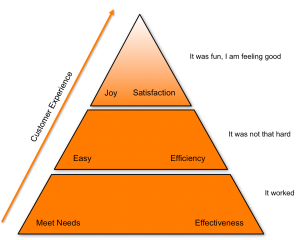
Field service needs to accommodate the same hierarchy of customer
expectations as general customer service. It first needs to be effective,
then efficient, and ultimately have a joyful component to it.
Having said this effectiveness is first. A service technician can be as
competent, good natured and possibly charming as – if he cannot get the job
done this is worthless for the customer.
AI- and IoT technologies can help meeting the two base layers of this
pyramid.
Let us revisit the scenario I started off with.
While not being AI, the incoming call can be translated directly into a
service request that can get assigned to a service technician efficiently.
Natural Language Processing helps in identifying the issue and can trigger
an automatic search for a likely root cause. This might even result in the
incident being resolved right away if the system finds a document
describing a solution and presents it to the phone operator along with a
confidence level.
If the issue cannot get resolved, the integrated intelligent system
determines the right service technician and, with a high likelihood, the
necessary repair time and the parts that the technician needs to have when
on site. Due to an optimizing route planner the wait time until repair for
the customer is minimized and more accurate, too. Time in traffic is
minimized and therefore the technician’s stress levels. It is even possible
to automatically send schedule updates to the customer.
On site the technician himself can get help by using AR-enabled glasses
that project maintenance and assembly instructions as an overlay to the
machine that he sees into his view. Besides keeping the process efficient
this also helps identifying parts.
What it Takes
The ideal world is not so far off. The ingredients for delivering this
scenario are available now, albeit often not yet pieced into one coherent
solution. Microsoft is strong where it comes to predictive maintenance and
combining IoT with business process. So is SAP, but less in
Field Service
scenarios at the moment, although recognized as a leader in Gartner’s 2016
MQ on Field Service. Salesforce has embedded Einstein Vision into their
Field Service Lightning
solution. Train the model, take a picture of an equipment, and Einstein
tells you what it is via chatter.
Or Oracle with its
Field Service
solution that looks at optimizing timings to create better results
Of course there are a number of smaller vendors in this area, too, like
Servicemax,
IFS, Clicksoftware, OverIT, or
Servicepower, to name but a few. All of them, and other unnamed competitors, too, have
good solutions for a part of the ideal world.
Get Prepared
To be prepared and to already improve capabilities, executives need to
consider a few points.
- Develop a solid strategy on how you want to make Field Service more
efficient without placing undue pressure on the technicians. - Keep current skill matrix of service personnel. This helps in efficiently
dispatching the right technician - Employ a smart route planning software that takes traffic into account as
part of the dispatching process to minimize travel time and to improve
predictability - Use geo-location services and electronic signatures as a trigger to keep
staff and customers informed automatically. - Agents and technicians researching documentation can already now be used
to train intelligent service systems - Data is key. It will first tell you where the low hanging fruit lie and
then help in training the business systems to better support personnel and
customers
Last, but not least, start with limited experiments using smart automation
technologies like the ones mentioned above that may help improving the
process – or building a better one. This will become a platform- and
ecosystem play. Don’t commit to an ecosystem yet but to technologies that
may help. If they do, choose a platform.
Thomas, thank you for your insights. I would respectfully add to your analysis that a key addition to an end-to-end Intelligent Field Service solution is the ability to proactively and intelligently optimise the technician van inventory you referenced as well as other supporting service inventory locations. The service inventory planning process should consider the same technician skill and route optimization strategies used within this overall process as well as additional customer, product and demand related information. By doing so, inventory cost is significantly reduced and first call fix rates will be increased.
You are right, Jim. It is implicitly there but I could have made it more obvious. Another component to it is that there needs to be a way to get inventory from a ‘nearby’ van instead of going back to a central location – or get a (automatic/autonomous) delivery on demand. In this scenario we are longer term also talking drones or autonomous vehicles. A scenario that apparently still has some regulatory hurdles to jump.
Thanks for your comment