


Source: Pixabay
Most sellers stop when they uncover a problem. The ones who win high‑value deals connect problems to strategic business issues and quantified value.
Most sales methodologies include questioning prospects to understand their circumstances and their situation. This stage occurs early in the sales cycle and is commonly referred to as “discovery.” The goal is to uncover the prospect’s “pain,” the problems or difficulties they are trying to overcome.
However, finding pain alone is incomplete.
Too often, problems uncovered during discovery represent only surface-level challenges. What appears to be the problem may actually be a symptom of a larger strategic initiative.
And that’s where many revenue professionals make a critical mistake.
Not all problems are worth solving. Problems don’t automatically create urgency, and they may not be funded with budget or resources. Strategic priorities, those tied directly to business objectives, are where funding and resources are allocated.
When discovery only scratches the surface and focuses narrowly on problems, opportunities can stall. Deals may end in no decision, leaving the revenue professional with a false sense of security that they had a qualified and winnable opportunity.
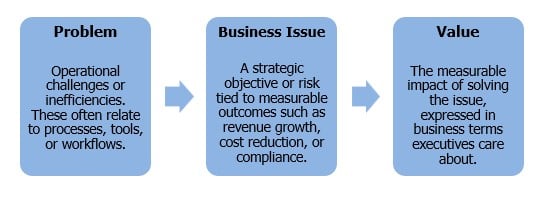
A Simple Framework: Problem → Business Issue → Value
High-performing revenue professionals move beyond identifying problems. They connect what they hear in discovery to the broader business context using a simple progression:
For example, the sales team at GHD Digital initially used to sell based on product features and functions rather than solving a business issue. Prospects would say they loved the company’s digital platform because it was “easier to use” than those of its competitors. But usability alone is not a compelling reason for government organizations to replace existing technology systems. These buyers needed to address real municipal priorities such as economic development, tourism growth, or improving digital services for citizens.
When the sales team shifted conversations away from product features and toward business issues with measurable outcomes, deals became far more predictable. The organization ultimately achieved a 450 percent increase in annual recurring revenue over two years, and its close rate rose to 32 percent as the sales team consistently connected its solutions to meaningful business outcomes.
When discovery progresses through these three stages, opportunities move from interesting conversations to funded initiatives.
When Problems Aren’t the Real Issue
Recently, a client selling HR analytic solutions asked me to review an opportunity and identify what might be missing in the qualification process. The account executive had uncovered several problems and was very optimistic that his solution was a strong fit.
The issues he uncovered included fragmented HR data, manual reporting, and limited staff to manage reporting manually.
These are legitimate operational problems. However, the underlying business issue has not been discovered. For example, fragmented HR data could be contributing to several strategic challenges:
- Extended time to fill critical roles, slowing revenue-generating teams
- Higher employee turnover, increasing replacement costs
- Compliance risk related to reporting accuracy
- Inability to forecast workforce needs, affecting growth initiatives
When framed in those terms, the conversation changes. Instead of discussing reporting efficiency, the discussion shifts to questions such as:
- How is workforce turnover affecting operational costs?
- How long does it currently take to fill key positions?
- What happens if leadership lacks reliable workforce data during strategic planning?
Now the problem connects to a measurable business issue.
The Difference Between a Problem and a Business Issue
A problem typically reflects an operational inefficiency that often relates to people, processes, or technology, and describes what is wrong or what needs to be fixed. Examples include:
- Disconnected systems
- Manual processes
- Poor Reporting
- Outdated technology
- Lack of Visibility
While these problems can certainly be a nuisance, solving them does not always produce meaningful or measurable business impact.
A business issue, by contrast, is a strategic imperative that ties directly to the organization’s objectives and priorities. It is time-bound and measurable, and relevant to leadership decision-making, such as:
- Reducing employee turnover by 10 percent
- Accelerating hiring for revenue-generating roles
- Meeting regulatory reporting requirements
- Improving workforce planning for expansion
When discovery identifies a clear business issue, urgency and executive engagement increase.
Why Discovery Often Stops Too Early
There are a number of reasons revenue professionals stop once a problem has been identified.
- Wrong level of conversation. Managers, administrators, or technical stakeholders often recognize operational problems but may not have visibility into the broader business impact.
- Surface-level questioning. Problems are easier to uncover. Identifying the underlying business issue requires deeper inquiry and stronger business acumen.
- Product-focused training. When sales training emphasizes product capabilities, those features tend to be linked to technical or operational problems rather than strategic outcomes.
The result is predictable: opportunities stall because the conversation never connects to executive priorities.
Research reinforces this point. A Harvard Business Review study of over 2.5 million sales conversations revealed that 40 percent to 60 percent of qualified B2B deals end in no decision, often because the problem identified is not important enough to warrant change. Additionally, value-based selling methodologies emphasize that deals tied to strategic outcomes are significantly more likely to move forward. In fact, research from ValueSelling Associates and Training Industry found that 87 percent of high-growth companies take a value-based approach to sales, compared with only 45 percent of negative-growth companies. Together, these findings highlight the same pattern: deals move forward when sellers connect the conversation to measurable business outcomes.
Without connecting the solution to a confirmed business issue, revenue professionals often struggle to gain executive attention or secure funding. Executives invest in and allocate resources for priorities such as revenue growth, cost savings, profitability, and regulatory compliance. They are focused on outcomes and impact, not operational inconveniences.
Many organizations live with operational problems for years. Leaders may acknowledge the issue but view it as a “nice to have” improvement rather than an urgent priority. In those cases, the problem may be annoying, but it isn’t compelling enough to trigger action.
The Cost of Stopping Discovery Too Early
Returning to the HR software example, the sales rep became excited when he heard problems he knew he could solve. As a result, he stopped asking questions and started pitching his solution.
He missed the opportunity to dig deeper.
He never explored why the problems mattered, what business outcomes were at risk, or whether the issues impacted cost, revenue, or the bottom line. In short, he didn’t discover why the problems were worth solving.
High-performing revenue professionals keep discovery alive. They work to confirm how operational problems connect to a broader strategic business issue.
That business issue becomes the “why” behind the buy!
A Case in Point: Reframing Discovery
A similar shift occurred when Kimberly-Clark Professional partnered with ValueSelling Associates to move its marketing and sales teams away from product-centric messaging. Previously, many conversations focused on product features in a highly commoditized category. By reframing discovery around customers’ underlying business issues, such as improving patient care environments, reducing compliance risk, or enhancing workplace hygiene outcomes, sellers began engaging higher-level decision makers and positioning solutions in terms of measurable operational impact.
The results were significant. Opportunities tied to clear business issues saw win rates increase by 23 percent, average deal size grow by 292 percent, and $33 million in annualized revenue generated. By linking solutions to meaningful business outcomes rather than product features, the company was able to elevate conversations with executives and create far stronger momentum in the sales process.
From Product Expert to Business Professional
Today’s revenue professionals must operate as business professionals, not simply product experts. That means asking more strategic and outcome-oriented questions during discovery to uncover the true business issue.
For example: What business outcomes are most critical for your organization this year? What happens if those goals aren’t achieved? How does this challenge impact revenue, cost, or align with corporate objectives?
Sometimes it helps to pause and broaden the conversation. A simple statement such as, “Let’s step back for a moment and look at the big picture,” can open the door to a more strategic discussion.
The Path to Higher-Value Opportunities
Business Issues tend to remain constant even when individual problems change. If a company’s objective is to double growth over the next four years, most decisions will align with that north star. Problems can flare up and seem urgent in the moment, but unless they connect to a strategic outcome, they rarely command sustained attention.
Connecting problems you uncover, and ultimately the solution you offer, to a clearly defined business issue is the foundation of selling value.
When the business issue is clear, revenue professionals can quantify the value of solving it, align their solution with executive priorities, and create real urgency for action.
The most successful revenue professionals do not sell only to problems. Problems may start the conversation, but they should never end it. When discovery moves from problem to business issue to value, sales conversations shift from solving inconveniences to enabling meaningful business outcomes. And that is when high-value opportunities become both qualified and winnable.