


For most organizations, Voice of the Customer (VOC) means surveys and complaints. Both sources are routinely challenged by skeptics because the data represents only a small percentage of the customer experience.
Over the past decade, CCMC has perfected a series of best practices for extrapolating these data sources to the marketplace, as well as integrating them with operations and quality data to create a unified picture of reality, in terms of the number of customers affected, that is readily accepted by skeptics.
VOC data is attacked because:
- Complaint and survey data are viewed as anecdotal and not representative. The basic question is: “How many customers in the marketplace are affected by this issue?”
- Data is not actionable; it is too general. For example, dissatisfaction with “billing issues” cannot be addressed: Which types of billing issues?
- Data does not deserve action because the revenue damage is not obvious. VOC must quantify # of customers, damage per customer, and total cost of inaction
When the following four factors are in place, data on points of pain (POP) has an impact.
- Credible data: Sufficient number of observations and client stories corroborated by multiple sources such as surveys, contacts, operational data, and employee input
- Transparent approach to analysis: creates a conservative business case for action on a granular issue or POP
- Visible path to mitigation or resolution of the granular issue: There is no silver bullet to solving “billing issues” but there are solutions to invoice adjustments
- Alliance with Continuous Improvement or Quality: For rapid tests of solutions
The VOC research basis
Four types of data should contribute to a best-practices Strategic VOC: complaints/contacts, surveys, operational data, and employee input. Each has strengths and weaknesses.
The most complex to understand and interpret are complaints and customer contacts. Contacts are the most challenging because their collection is, to a great degree, based on customer behavior, not systems designed by the company. This tip-of-the-iceberg graphic illustrates the challenge.
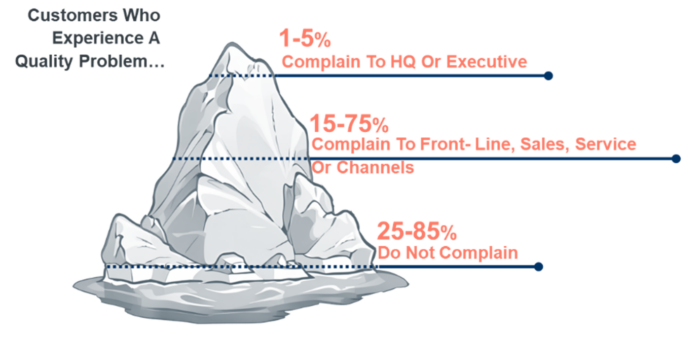
Many customers do not complain or seek assistance with questions and problems. The complaint rate is governed by problem severity, visibility of the complaint channel, and the belief that complaining will help. Improving complaint rates is addressed below. These barriers to complaining must be understood and, ideally, reduced to get more robust data.
Concept of “the multiplier”
The Multiplier describes the size of the iceberg. For each complaint received, how many other problems exist that were not reported or reported only to a retailer or social media? 75% of complaints tend to go to the retailer for CPG products — only 25% of the 20% who complain anywhere — resulting in 5% or 1 out of 20 problems being reported to the food manufacturer. Therefore, overall, the multiplier is 20:1.
The multiplier is used to scale up contact data to the marketplace. For example, if 50 complaints are received and the multiplier is 20:1, the analyst can estimate that 20 X 50= 1,000 customers have encountered the problem. A business case is created by multiplying the number of customers affected by the damage to their loyalty (ranging from 10% to 70%) and their long-term value. Value should be over 1-3 years, never more. For a CPG product, 50 complaints/month X 30% damage X $300 LTV = $90,000 in revenue damage per month.
Multipliers can also vary by where the customer complained, by product, and by type of problem, as well as by channel used. Telephone use is declining while chat use is exploding, so telephone multipliers are increasing while chat multipliers are decreasing.
Survey data
Executives are almost as skeptical of survey data as complaint data. Here’s why:
- Surveys often represent less than 10% of the market.
- Only those with problems complete surveys. (Not true. Loyal customers/heavy users respond more.)
- Surveys often ask hypothetical questions. “Who knows if they will really do or want that?”
- Surveys often take a long time to report. “That issue has passed, we’re on to other things.”
Surveys are very helpful for identifying the relative damage to loyalty and word of mouth a good, fair, or poor experience causes compared to an excellent or delightful experience. Surveys can also quantify the percentage of customers encountering problems who don’t complain because they allow quantification of the multiplier. Finally, surveys can identify where expectations do not match what the company is promising.
Operations data and transaction failure data
Operations data is, by definition, more credible because the company has collected it internally and it is viewed as eminently valid. No operations executive will argue that it is wrong. It is a strong estimate of the number of customers who have encountered a problem.
The usual difficulty is that such data is not reported in a CX context. While transaction failures, e.g., credit card incorrectly rejected, are tracked and linked to lost sales, delays in delivery or and failed searches are often never reported, yet they often cause a 10-30% damage to loyalty. Therefore, operations failure data describing key customer problems must be collected across the entire customer journey and reported in parallel to survey and complaint data to reinforce the acceptance of the number of customers affected.
An example would be a delivery company that has a container carrying 300 packages that misses an airport connection. Operations data quantifies customer affected – 300 packages will be late the next morning. The next day, 50 complaints from those customers identify their emotions and behavior. The following day, 30 surveys are received showing the damage to loyalty and word of mouth. The operations data noting that 300 customers had problems is credible to skeptics. This information is supplemented by the data on emotion and damage to loyalty and word of mouth from the surveys and complaints. The combined, unified picture is immensely more compelling than any one of the data sources.
Employee input and experience
I often ask front-line staff if they have a conduit for making input on operational issues. Two-thirds of the time, they don’t. Even the staff of the United Airlines 1K Desk told me to write an email to customer care where it would have more impact. At Toyota, we established an email box for the front line to send frustrating occurrences linked to a case number. Service employee points of pain overlap customer POP by about 30% and provide powerful reinforcement to the VOC. See article here.
Employee input can provide important process context and highlight issues such as a lack of empowerment, labor-intensive technology, and confusing marketing messages.
Strategy for creating a unified view of the customer experience
The approach is simple but not easy. Try this approach:
- Enhance the data sources via better survey response rates and representativeness via a series of operational improvements. Including offering granular issues and an enhanced invitation, and more accessible complaint channels and messages. Encouraging complaints! — “Gasp!”
- Extrapolating complaints and contacts to the market using the multiplier (how many issues exist for each one reported)
- Integrating multiple data sources to arrive at a single, agreed-upon picture of reality

Take data from multiple credible sources such as operations and quality, as well as multiple survey and complaint channels. Extrapolate each complaint and survey data source to the total customers affected in the marketplace using the appropriate multiplier (use the right column in the above table). Average the estimates to arrive at best estimate based on multiple data sources.
- Create a conservative but compelling economic model including loyalty, word of mouth, and price sensitivity. Multiply customers affected by damage to loyalty times the conservative value of an average customer (bottom row in the above table).
- Educate executives on four key aspects of customer behavior that are often counterintuitive.
- Not all customers complain. There is a tip of the iceberg and multiplier for POP.
- Complaints, surveys, operational data, and employee input all describe the same set of customer experiences, just from different perspectives.
- Half of customer attrition in most companies is due to specific preventable problems, and many of these customers have never complained but are still spreading negative word of mouth
- Soliciting complaints and granular problems in surveys builds trust and produces better data. Keeping a customer is five times cheaper than acquiring a new one.
Filling the Holes for surveys, complaints, operations, and employee input
Best practices for improving survey actionability and response rates
- Aid the customer with problem categories, either 6-8 general or 20 more specific. You will identify three times as many issues, including those that customers were too polite to mention, like being misled by their salesperson.
- Enhance response rates by including in the invitation a recent action taken based on customer input. This shows the customer that their effort at input will have a payoff.
- Limit questions to problems, complaint experience & impact and 4 key dimensions.
- Demonstrate respondents are similar to the overall marketplace on demographics.
Improve contact volume and quality
- Counter the perception that complaining won’t do any good. Show impact, like when Chick-fil-A said: “Based on your feedback, we brought back BBQ sauce!”
- Fear of retribution – note that you are focusing on problems with the process – not looking to blame people. Customers fear conflict or even being barred from future service or support. A service executive recently told me of his fear of complaining about his auto dealer for fear he would have to switch to a less convenient dealer across town.
- Aggressively solicit complaints. Highlight service and complaints, including the 800# and hours and first level options, on the home page (Gasp!) as well in the “Contact Us” tab at the top of the page, not just at the bottom of every page. Include problem and complaint in the search response.
- Break down helplessness with the statement, “We can only solve problems we know about!”
- In labeling and online processes, highlight complaint channels exactly when the customer will need them and put them visibly in front of them. For example, Dyson has its 800# on the vacuum handle, where it is always visible to a user.
- Aid the customer in articulating their problem via type-ahead supported by machine learning – you get more accurate complaint narratives
Extrapolate contacts to the marketplace
If you’ve done the basic research to quantify the multiplier in your business, either overall or at the broad issue level — e.g., product quality, value, availability, etc. — you can simply multiply the total contacts by the multiplier to estimate the number of customers who have encountered the issue. The same research will also give you an overall estimate of the damage such a problem causes, e.g., 20% for availability or 50% for quality issues. If you’ve not done the research, use 12:1 as a general norm, then do the necessary research.
Collect validating operational and employee input data
- Go to systems and IT and ask for at least one transaction failure indicator/metric (ideally the biggest point of pain), for each phase of the customer journey. Further, ask for data on self-service abandonments as well as failed searches, including what the customer was searching for.
- For the top five customer POP, ask employees how often they happen and the time wasted responding to them — the answer will shock Finance.
- For the top five issues raised by the surveys and complaints, examine your operational and quality data and find a metric that is a close, even if not exact, descriptor of the customer issue. Worst case, take a sample of 200 records and manually see how many customers have encountered the issue. Not pretty, but a credible start.
Creating a compelling business case for change both within the contact center and across the company.
Once there is an agreed-upon estimate of the number of customers affected by each issue, the overall customers at risk and revenue damage, and, ideally, word of mouth, is estimated. This is where the relative damage of different problems becomes important because not all problems do the same amount of damage to loyalty. The overall calculation is as follows:

Summary
The four sets of data describing the customer experience each have significant weaknesses, three (complaints, surveys, and employee input) border on anecdotal, and the fourth, operations data, is internally focused. However, when taken together, they can provide a strong estimate of the number of customers affected and the revenue damage done by the issue, thereby creating a compelling bottom-line case for immediate action. The only other requirement is the education of executives on the underlying customer behavior.