


Ten years ago, my co-author David Jaffe and I sat down to figure out why some companies were consistently good at delivering customer experiences while others were failing miserably. We wanted to investigate why these organizations were so much better at managing their customer relationships than others and whether there were consistent themes and lessons from these companies. We began to realize customer relationships were no different than other relationships, such as interpersonal relationships and those that organizations have with their employees. This made us pivot to find research that answered the broader question: “Why do relationships work?.” This research and findings became the core of our 2nd book, Your Customer Rules! Deliver the Me2B Experiences That Today’s Customers Demand (Wiley/Jossey-Bass 2015).
The academic world has done more research on “Why relationships fail” (e.g., marriages) than “Why relationships work.” However, research did exist into “the secrets of lasting relationships.” We were able to synthesize these findings and then test them against the companies that we had selected because of their success with customers. These included Vente-Privee, the amazing French online marketplace; the world’s biggest energy provider E.ON; fintech pioneer N26; Swiss-based tools producer Hilti; US retailer Nordstrom; Starbucks; and others. We also had an extensive secondary research base with recognized customer leaders such as Apple, Dyson, USAA, and Zappos.
Seven Key Relationship Needs: Why They Also Work for Employees
Our Your Customer Rules! publisher wasn’t convinced that we could cover customer and employee experience in one book. However, the foundations for both relationships are the same. The relationship research uncovered seven possible needs in these relationships, and they fell into a hierarchy that looked like this for both customers and employees.
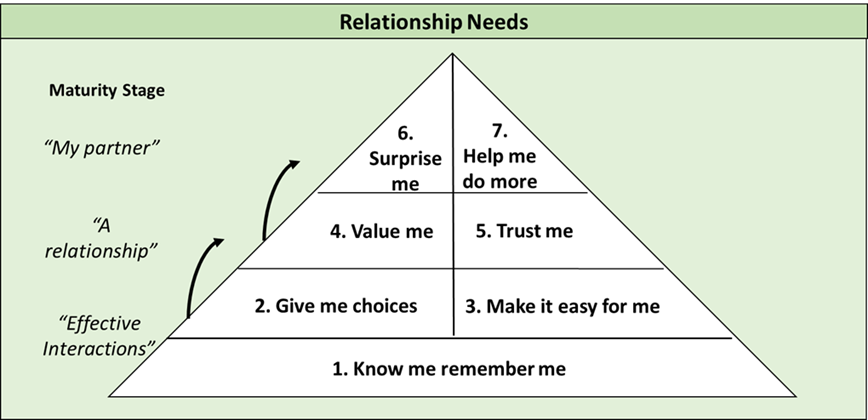
These seven needs are just as powerful for business-to-employee relationships since the basis for these “needs” was making any relationship work. They form a framework that every organization can use to think about how to deal with staff. The “needs” form a hierarchy in a Maslow-like fashion. Those at the bottom of the pyramid are needed consistently to create a positive but not a deep relationship. They are things employees look for in all their interactions with their employer. They are base needs: “Know me remember me” and “Make it easy for me.” Imagine how unsatisfying it is for a team member who isn’t known and remembered by the management they work for.
As we move up the pyramid, the needs add depth to the relationship but aren’t always possible all the time. For example, it’s hard to “trust” an employee brand new to a job or role, so they will need greater supervision and controls to start. When workplaces show that they do trust their staff and demonstrate ways to value them such as a bonus, award, or promotion, then loyalty and the bond between employee and company gets deeper.
At the peak of the pyramid are needs that are rarer opportunities in any relationship. We don’t expect to be “surprised” with things we didn’t expect in the workplace every day. Constant surprises would be almost impossible. However, if there are instances where employees get a positive surprise, then they are memorable moments. One company did this by having a small gift on every desk after a successful set of annual results. No one expected it, but the surprise added to the impact.
Relationships are also deepened if staff members are helped “to do more.” These can vary from getting further qualifications to supporting things outside the workplace. Some generous employers offer time off for staff to assist with community projects or give extra leave for elite sports representation.
We broke down these seven needs into a further 39 “sub-needs”, forming a complete cookbook of techniques for dealing with staff and customers. For example, the second Need, “You give me choices”, has six sub-needs:

How do you apply Needs and Sub-Needs to Employees?
Let’s explore each of the seven needs for Employee Experience (EX).
1. “You know me, you remember me”
For EX, an important sub-need is “You know me and mine.” When your supervisors and managers understand their team’s family situation and requirements, there will be a much tighter bond, leading to greater contributions and less turnover. We saw this with a global BPO that grew dramatically by focusing on its frontline staff’s family needs during the frantic holiday season, where previously they had ignored this and forced staff to work rosters that varied dramatically and were hard to plan around.
2. “You give me choices”
For EX, all of the sub-needs apply (as listed above). For example, “You let me design it” signifies that your processes can flex to allow staff to design aspects of their job which provides them with a sense of control and allows them to feel valued. After all, engaging the frontline to re-design the desktop, knowledge tools, and policies will be more employee-centric and therefore more effective. We saw this work with a laptop manufacturer that replaced its knowledge system with a Wiki, inviting qualified tech support agents to comment or produce superior articles that met their needs.
3. “You make it easy for me”
“You let me make the process easy for me” is an important sub-need for employees. It recognizes that each employee’s version of “easy” may be different. A great example of this is companies that provide staff with self-service “shift swap” software. Staff can then choose when and how they alter their shifts but in a low-effort manner. This combines the idea of providing choice with a low-effort mechanism to facilitate this choice.
4. “You value me”
This sub-need moves the hierarchy into a softer area where emotions begin to play an even bigger part. Here, sub-needs apply to EX as much as CX such as “You listen to me and act on what I say.” How many times have you held employee roundtables or collected employee surveys, but didn’t take action on their inputs? Lip service to listening creates cynicism towards the organization. We saw this sub-need work with a financial services company that posted all of their frontline suggestions with actions taken, or why actions could not be taken. Employees spotted their ideas, felt included, and appreciated the detailed feedback and actions that resulted. They also understood what couldn’t be done but recognized their ideas hadn’t been ignored.
5. “You trust me”
All the sub-needs fit EX including “You don’t tar me with the same brush.” This one resonates with employees who, correctly, feel that they are unique and need to be viewed as individuals who can be trusted rather than managed with the concern that some may be “bad apples.” We saw this work with a telco that reduced sign-off and approvals for some processes, trusting that staff would make the right decision instead of adding controls and checks in case one or two of them got it wrong.
6. “You surprise me with stuff that I can’t imagine”
This applies neatly with EX with the sub-need “You treat me like a new employee all the time.” After the fanfare, treats, and speeches when your employees join your company, how do they feel after others join or six months in? Do you celebrate their success as you did their arrival? We saw this work at a BPO that had recognized steps and celebrations at many milestones. They had check-ins at 30 days, three months, and six months to ensure staff were being engaged at multiple points in their first months in the job. This BPO had far lower attrition than competitors as a result.
7. “You help me be better and do more”
This almost fits EX better than customers. A key sub need is “You coach me.” There is a clear correlation between companies with great development programs for their staff with lower rates of staff turnover. We’ve also seen the opposite where understaffed organizations “skimp” on training and coaching and then wonder why staff attrition increases. In contrast, an e-commerce company that retained its training regimen during peak seasons reduced the level of staff turnover and helped it retain the workforce for the next year.
CX Principles Apply to EX
In short, when your employees are engaged and appreciated, following the CX sub-needs, they will be more loyal and productive. There is already much written to show that happier employees deliver better customer experiences.
Let me know if you agree!
Indeed, in the trajectory, or path, of employee experience – from basic satisfaction and engagement, to more progressive commitment and advocacy behavior – there is a great deal of overlap with the trajectory of customer experience, especially with regard to need identification: https://inmoment.com/blog/improving-employee-advocacy/
Thanks, Michael! Great CX/EX minds thinking alike. Striving the “Optimum Level of Commitment” is an excellent goal. Thanks for sharing your recent article.