


Did you know that customers are very likely to form biased memories of their experience with your business? It is what your customers remember about their experience with your business that determines whether or not they’ll come back for more. Stay with me, I’ll explain what this means and how you can take advantage of this evolutionary phenomenon.
The first thing you should understand is that customers do not remember every moment of their experience with your brand. For instance – When you are asked to rate your Uber experience, do you take the time to evaluate every second (or minute) of your trip with the driver?
If you’re like most people choosing an appropriate rating for the Uber will be a relatively simple task, you can quickly rate your ride as poor, average or excellent. Thinking about it, making this kind of judgement would involve serious calculation.
You would have considered comfort, driver attitude, driving skills, route and a whole plethora of factors before you arrive at your judgement. Researchers discovered that the human brain has a simple strategy for streamlining these factors and arriving at a judgement.
They found out that when we remember events, the brain filters out a lot of parts from the event which it considers neutral or inconsequential and prioritizes retaining memories that will be useful to future decisions.
What Is The Peak-End Rule?
The Peak-End Rule was put forward by psychologist and Nobel laureate Daniel Kahneman. He postulated that we make our evaluation of events based on only two parts of our experience – The peak and the end.
The peak refers to the moment when the experience had its strongest emotion (It can be positive or negative) and the end is simply how the experience ended.
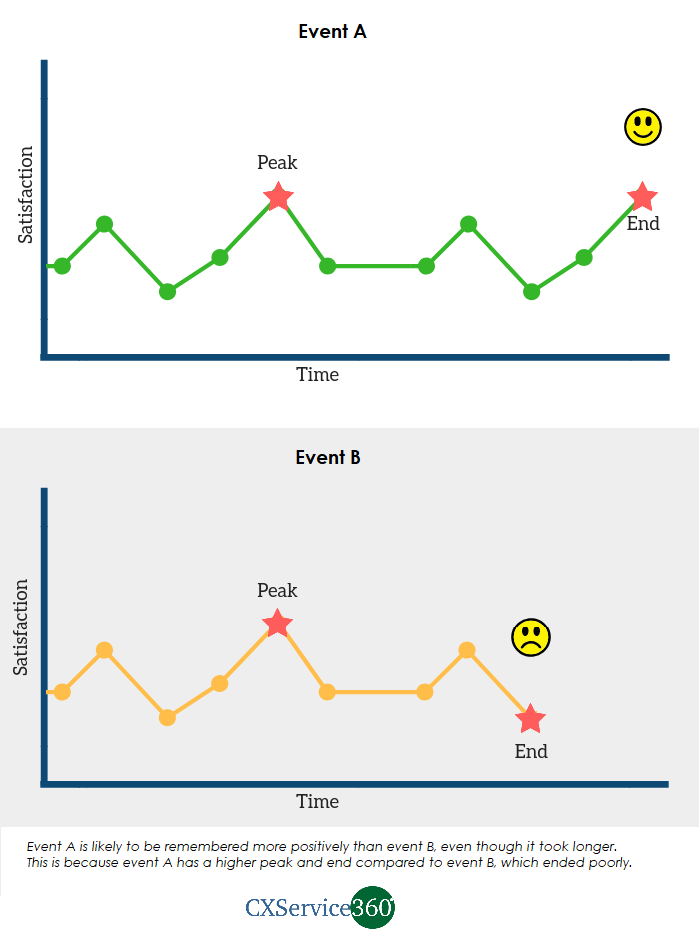
The peak-end rule works for both big and small businesses. If you are looking for cost-efficient ways to improve your overall brand experience, you can start by taking advantage of the peak-end rule to create memorable peak experiences along your customers’ journey and ending it all with a bang!
This article was originally published here on 5th March 2019
Daniel Kanheman’s research involved patients undergoing a colonoscopy. The experiment showed that whilst the two groups of patients had experienced different levels of pain throughout the process, they recalled experiencing the exact same levels of pain, despite the fact that their actual experience varied.
Kahneman concluded that the patients, and indeed all people, seem to perceive not the sum of an experience over time, but the average of how it was at its peak (e.g. pleasant or unpleasant) and how it ended. The graphic above illustrates the principle.
Consider this example.
A customer who has just been robbed calls two of his banks to cancel his cards. When he called the first bank:
- He waits approximately 8 minutes on the call queue before he’s connected to an agent.
- He explains his plight to the call centre rep, who shows empathy and quickly cancels his cards.
- The call centre rep goes further to ask the customer if he was hurt, or needs an ambulance or the police.
- The rep thanks him for choosing the bank and the call comes to an end