


The multiplier is the ratio of complaints received compared to the number of customers in the marketplace having a similar problem. The multiplier enables the extrapolation of complaint data to the entire market, to estimate the revenue damage associated with a particular issue.
CCMC’s predecessor organization, TARP, first introduced the multiplier via the White House-sponsored study of complaints in the 1970s to 1980s.[1][2] This study of the US population found that for very serious problems a majority of consumers do not complain and for most problems up to 96% do NOT complain. While every article on customer complaint handling alludes to this original study, there are several areas of confusion about multipliers that have impeded their use in creating a compelling business case for an enhanced CX.
Issues in understanding the Multiplier
What does the multiplier mean? The graphic below illustrates basic customer behavior in every market, consumer, B2B, non-profit, and even government services. A significant iceberg of customers do not complain due to fear of retribution and conflict, believe it will do no good, or to avoid hassle.

Most customers who do complain speak with the front line, in person, via phone, or, nowadays, 75% via digital channels. Only 1-5% escalates to a manager or HQ. If the percentage is 5%, this implies that for each complaint received, there are 19 others in the marketplace; therefore, a 1:20 ratio or a Multiplier of 20:1.
How is it measured? The research basis.
The multiplier is measured in two ways: by surveying a random sample of customers and asking if they have had a problem and for their most serious problem, did they complain to the company. For many customers, often a majority, the complaint was directed to the retailer or channel and never sent to the manufacturer. For help desks, less than 10% escalate to the supervisor or customer success manager. For the data to be statistically valid, in most environments, at least 1,000 customers must respond to the survey – though in large B2B environments I’ve used less than 100 with a lot of caveats. The second approach is to examine operational data that describes the issue and compare to the number of complaints received. This only applies when you are already collecting data on the operational failure the customer is complaining about. It works well for delivery companies where they know how many packages were not delivered on time. It works less well for issues of customer perception such as taste and rudeness or areas that are not observed such as ease of setting up an electronic baby monitor at home. The advantage of the survey approach is that you can also understand the level of angst or rage the customer has as well as the damage to loyalty and word of mouth.
Different multipliers: What do you use when, and how do you calculate yours?
There are different multipliers that you can use – depending on circumstances and data availability
- General conservative multiplier – 10:1 when dealing with executive management, with no specific research data from your customer base. Point out that this is usually conservative.
- For most serious problem – 5:1 to 15:1 to a manufacturer or operations service center -applied to the total number of complaints received via all channels, e.g., email, phone, chat
- Ranges vary for all kinds of complaints in a consumer market 10:1-25:1 – allows for facts only a third complain about even serious problems, and that 2/3 of complaints go to the retailers or channel – producer hears only the tip of the iceberg.
- Variation by problem severity – For consumer illness or bug infestation in the cereal, there is a high “ick” factor, so more people complain, often 1:4 to 1:10. For less serious problems – broken chips or irritating functionality, 1:15-1:50. The worse or more serious the problem is, the higher the complaint rate. However, that does not guarantee that the customer complains to you. They may complain to the store or channel and you are still not aware.
- Likewise, problem occurrence and complaint rates vary dramatically by type of product – simple products like bottled water have lower levels of problems and complaints, while perishable refrigerated products and complex software systems will beget many more problems and many more complaints. In one study sponsored by SOCAP, the bottled water segment received about 2-5 complaints per million products shipped, while perishable, refrigerated products received two orders of magnitude more complaints per million, e.g., 500-800. My point is that while general multipliers can help get management’s attention, the devil is in the details.
- Specifically determining the multiplier in your marketplace: Conduct a survey of a random sample of your end-user customers (500 replies for B2B and 1,000 replies for consumer markets) using a short list of common problems. Ask which problems have been encountered and, if so, whether the customer complained to you or someone else. This short set of questions allows a reliable estimation of the overall multiplier in your market. For multipliers for specific types of problems, you need larger samples or access to industry norms. For the most frequent problems, as resulting customer loyalty and word of mouth to allow quantification of customers lost and WOM damage.
Understanding the variation of multipliers via different channels
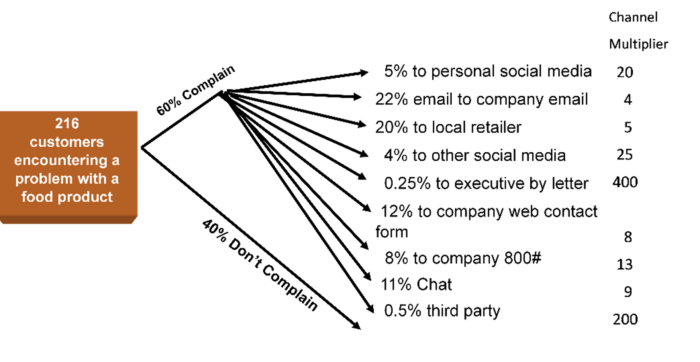
As digital channel use goes up, the multiplier for that channel goes down. Conversely, as complaining via phone decreases, the multiplier goes up. The multiplier for written letters to executives is very high, usually 1:50-200, because few people write letters.
The following is an example taken from the food products subsample of the CCMC 2020 National Rage Study. The complaint behavior was for the most serious problem encountered.
Leveraging Multipliers for Action and Impact
The multiplier is critical for making a business case for action more compelling. It literally “multiplies” the size of the business case by at least an order of magnitude in terms of the number of customers and the revenue impact.
The following are four functions that can directly benefit.
- Top management – For each major issue, quantify the number of complaints and translate them into the number of customers most likely at risk. Telling a CPG executive that 2,000 customers per month are having an issue allows them to do the math and justify action.
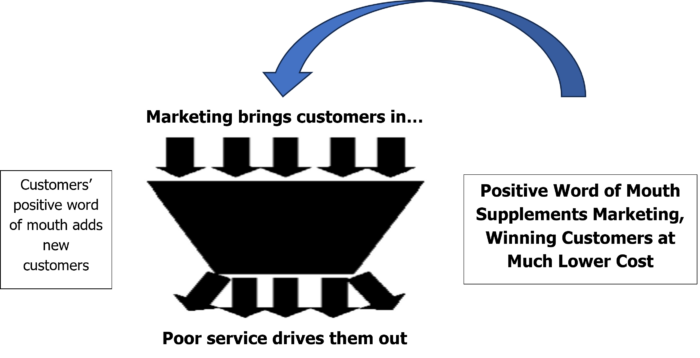
- Marketing is the second area where the multiplier can be effective – show the number of customers impacted and note that in most environments, at least 3-6 potential customers hear negative word of mouth and social media impacts. Compare the lost customers to the cost of new customer acquisition – how much work does marketing have to do to replace the customers lost by the issue? Use the leaky bucket graphic shown below.
- The Quality Function is, in some ways, the most enthusiastic user of the multiplier, because quality managers must justify every investment via a short-term business case. In most companies, quality is limited to justifying new projects based on cost savings. When one looks at CX, the big money is not cost savings — shaving ten seconds off a transaction — it is in improved satisfaction and revenue. The revenue impact are usually 10-20 times the cost impacts.
- The contact center likewise can move from a cost-saving to a revenue retention and new revenue production.
Example calculation from the CPG arena:
Keep it simple – use the following equation:
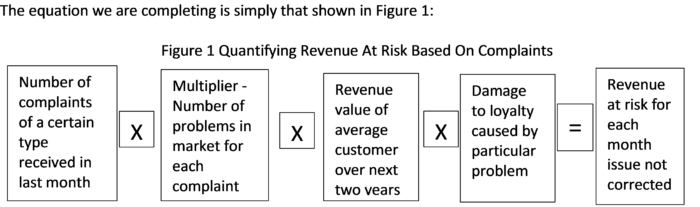
For a CPG product, the calculation can be as follows:
- if 100 consumers report encountering a problem with the taste of a product by the chat line,
- A multiplier of 15, which is average for CPG, implies 15 X 100 = 1,500 consumers encountered that problem.
- If a taste issue causes a 33% decrease in loyalty and a consumer is worth $400 over a two-year period, then the monthly revenue damage is calculated as follows:
100 complaints X 15 multiplier X .33 decrease in loyalty X $400 value = $200,000 per month
The $2+ million per year revenue hit is usually enough to get attention to the problem.
Summary
The multiplier signifies the majority of customers who do not complain or who complain to channels. It allows you to extrapolate complaint data received via your contact center or any reception point to the marketplace as a whole in a manner that the CFO and CMO will accept. Ideally, you should measure and quantify the multiplier overall and for major categories of issues for your company at least once every three years.
Notes
[1] Increasing Customer Satisfaction, White House Office of Consumer Affairs, 1984
[2] “Customers Mean Business”, Direct Selling Education Foundation, 1982
I don’t there is anyone more brilliant about customer care measurement than John Goodman. I have heard him speak and his Customer Experience 3.0 continues to be a key reference source to me.
Henry: Thanks so much for your kind words – I hope we cross paths again soon. Happy to send you a copy of my book – just send me an address to jgoodman@customercaremc.com