



Tech vendors all espouse personalization, but CCMC’s National Rage Studies continue to find that the second most prevalent cause of rage is still listening to too many long messages. (The top cause of Rage is simply getting a human on the phone.) These messages, as well as email communications, could easily be personalized if AI was used and CX pushed back against marketing and legal.
My Wish List for United Airlines
Below is my wish list for five changes to how United Airlines communicates to me, a 1K flyer with 2.9 million miles.
A little bit of AI could look at my previous three months’ interactions and modify the messages I receive, stripping out the ones that I’ve heard dozens of times, which cause irritation. Specifically for United Airlines,
- Stop telling me that my call is being recorded — I’ve heard it 100 times.
- Stop offering me a chat link after I’ve rejected it 20 times
- Stop asking me if I want to authenticate in advance, which I’ve rejected 20 times.
- Know what I was doing on the website just before I called — like trying to use Plus Points to upgrade to London.
- Allow me to stop receiving certain types of marketing messages — like cruises.
The “call being recorded” is a foundational message because of privacy concerns. However, for long-time customers, they have heard this message and are aware. If the IVR can recognize I’m an elite customer, it can assume I don’t need that message and skip me ahead. I have found that most lawyers are human beings who also become frustrated with IVRs and, in moments of logic and candor, will admit that knowing you’ve heard the message 20 times probably would satisfy even ardent regulators that the customer has been notified.
Further, a small touch of logic or AI can look at my history and flag me as not interested in chat links and advanced authentication, and “Voila!”, we’ve eliminated three messages and 50 seconds of irritation.
The same applies to email marketing messages. Most organizations treat email options as all or nothing. For example, I can’t opt out of United Mileage Plus marketing messages without also opting out of program updates. Each cruise email I have to delete is another point of irritation. McKinsey has a smart set of options enabling subscribers to select emails by content area and frequency of receipt (from twice weekly to quarterly). Marketing needs to learn that more is not better if it causes irritation.
Another Basket of Irritants
After having said the above, I’d still give United a B because they are better than the majority of self-service front ends, which also have the following flaws – adding to the above list.
- Force the customer to listen to the full list of options to determine which they need rather than providing the list of options wherever the 800 number is provided.
- Include a message that “our options have changed” when they haven’t changed recently and “your call is important to us”. It wastes time, and no one believes or cares about such messages.
- Don’t allow “barge-in,” so you must continue to listen to the entire list of offerings before selecting an option
- Use speech recognition that requires certain magic words rather than understanding customer intent presented six or eight different ways. Same for chatbots, with the extra advantage that you can suggest possible next words. AARP’s Help Screen suggests a range of next words that help the customer communicate their intent.
- Don’t allow the customer to opt out of some types of email and/or select the frequency of receipt.
- Don’t ask the customer if the AI-driven chatbot’s answer was helpful, ideally using at least three categories: “helpful”, “sort of helpful”, or “not helpful.” If the answer is “Not helpful” or “sort of”, acknowledge the reply, try one more response, and then offer escalation to a real person.
- Assure escalation to a human is easy with speech recognition exiting the minute they hear, “Representative, Customer Service Rep, or HUMAN!!” Not allowing and facilitating escalation immediately creates STRUGGLE which leads to rage.
- Give customers a progress report when they are waiting to be escalated to a human. Knowing my wait is 3 minutes is critical because wait time seems twice as long as it actually is. This is exacerbated by silence or bad music. Apple now lets you select the type of music you listen to while on hold. Better, for longer waits, use a virtual queue that assures a callback at the appropriate time, e.g., in 20 minutes.
- Asking for participation in a survey in advance and confirming the phone number. The survey tech vendors encourage this, but the request also adds to the number of up-front messages. AI should pick new users and only offer the survey to frequent users occasionally. If the frequent user has a complex issue, they can be sent an email survey after the fact.
What is the cost of struggle, irritation, and abandonment?
Irritation in accessing answers causes 10-15% damage to loyalty. It is critical to avoid both abandonment and struggle, because they increase the damage. If someone abandons, there is an additional 10-20% damage to willingness to recommend. The damage of struggle to escalate is even worse and becomes more memorable than the original issue called about.
The major change in outlook is not to look at the cost of escalation but to quantify the revenue damage of abandonment or struggle.
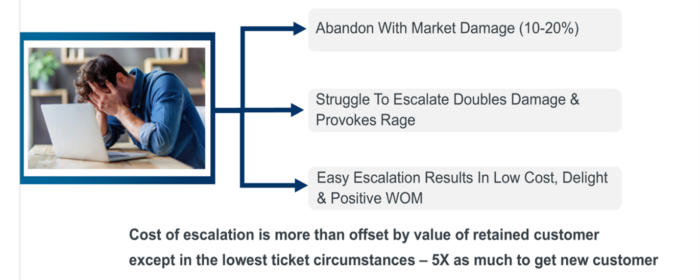
None of the above irritants are all that difficult to rectify without AI. Leveraging AI would make their mitigation or elimination even easier.
Actions to take tomorrow
Review the above 14 access irritants and check the ones your customers are encountering. Then start to quantify how many customers are bumping into each situation. To get started:
- Track the number of calls from each customer and when they hit 20 in less than 3 months, drop unnecessary messages.
- Make 20 test calls for each of the five most common reasons for calling and see how hard it is to escalate to a human from each of those issues. You may be surprised
- Educate marketing that repeated offers that are not taken/relevant weaken loyalty.
- Provide the customer with multiple opt-out levels by frequency and topic.
- Implement barge-in and eliminate the messages, “Our options have changed” and “your call is important to us.”
Suggest that your CMO, Compliance, and IT executives perform four tasks using the service front end each quarter. You’ll find support for eliminating irritants rises dramatically.
Great points, John. It’s amazing how many organizations fail your access irritants test, adding friction to their customers’ already hectic lives. I like all five of your recommendations, especially #2 to make test calls. When I’ve seen and heard execs make those calls for their company’s own customer service, they are often shocked, like in Casablanca: “I’m shocked, shocked to find that gambling is going on in here!”
Bill: The reason the irritants continue is that most of society accepts them as the norm and have given up complaining. Aggressive solicitation of customer frustrations – with examples of fixes made based on previous input will surface more of the issues. Second, executive “mystery shopping”, always works and only requires 30 minutes for an exec to make two calls.