


Most segmentation models rely on behavioral data such as clicks and pageviews. But in many industries, understanding the real-world context behind a purchase explains customer behavior far better than digital signals alone.

We measure clicks, pageviews, navigation paths, search queries and conversion events. Sophisticated analytics tools allow us to reconstruct a visitor’s journey almost step by step. From these behavioral signals we build segments, audiences, attribution and personalization models.
For understanding what customers are doing on a website, this works remarkably well. But in many industries, behavior is only part of the story.
During a recent experiment at Online Plastics Group, this limitation became increasingly visible. The products we sell are rarely impulse purchases. Most of them are bought as part of a larger project: a renovation, an insulation improvement, a modification to a house, or a construction-related adjustment.
Yet our segmentation and marketing logic were still largely based on behavioral signals within the website.
This created a recurring analytical blind spot. By the time a visitor arrived on our site, the underlying problem had usually already been identified. In many cases the customer had already explored potential solutions and was simply looking for the right material or supplier.
In other words, the behavioral data showed us what customers were doing, but not always why they were doing it.
That question led us to explore a different perspective on segmentation.
When Intent Exists Before Behavior
Traditional digital segmentation approaches often assume that intent becomes visible once a customer starts interacting with digital channels.
- Search queries signal interest
- Pageviews indicate exploration
- Add-to-cart behavior suggests purchase intent
But in industries connected to physical products or home improvement, intent often originates outside the digital environment.
It may start with a problem in the physical world: a window that lets cold air in, a rising energy bill, a leaking skylight, or a renovation that has been planned for months.
By the time the customer arrives on a website, the project has often been evolving for weeks or even months.
This observation led us to a simple question:
Could the physical context of a customer provide signals about their likely intent?
The Experiment: Linking Purchases to Housing Data
To explore this idea, we ran an experiment.
We combined our purchase data with publicly available datasets such as energy labels and building permit records. The objective was not to profile individual customers, but to explore whether characteristics of houses could reveal patterns in the types of projects homeowners were likely to undertake.
The results were surprisingly clear.
Homes from older construction periods showed a higher correlation with purchases related to insulation and energy efficiency improvements. Products such as secondary glazing or light-transmitting insulation panels appeared frequently in these orders.
Newer houses showed different patterns. These purchases were more often connected to modernization projects: adjustments to skylights, facade panels or other architectural elements.
The interesting part was that the products themselves were often identical. What differed was the problem the customer was trying to solve.
A polycarbonate sheet might be purchased to reduce heat loss in one context and to modernize a roof construction in another. From a behavioral perspective the purchase looks identical. From a contextual perspective the underlying project is entirely different.
This realization led to a distinction that is rarely made explicit in digital analytics:
Behavior tells us what customers are doing.
Context helps explain why they are doing it.
From Behavioral Segmentation to Contextual Segmentation
Most digital segmentation today is built around behavior. Visitors are grouped based on page interactions, session patterns, conversion likelihood or purchase history.
This approach is powerful but inherently reactive. It only becomes useful once behavior has already occurred.
The experiment suggested an additional layer of segmentation that focuses on customer context rather than behavior alone.
In our case, the most relevant contextual variable was the house itself. Different housing types often correspond to different project phases: maintenance, renovation, insulation or expansion.
This perspective can be described as contextual segmentation.
Instead of segmenting customers purely on what they do online, contextual segmentation attempts to understand the broader situation in which a purchase takes place.
In practice, much of this context can already be derived from publicly available data sources. Energy label registries, building permits and housing datasets together provide a fairly accurate picture of renovation activity within specific regions.
When this information is analyzed alongside customer data, a different form of segmentation begins to emerge. Not one based purely on demographics or browsing patterns, but one based on likely project phases.
What This Enables
Contextual segmentation opens up several practical opportunities.
Marketing teams can connect earlier in the customer journey because they better understand which problems homeowners are likely facing. Content strategies can be aligned with common project types rather than generic product categories. Product recommendations can be linked to real-world situations rather than just browsing behavior.
However, it is important to emphasize that these insights are still exploratory.
The patterns we observe today are correlations rather than causal relationships. The next step is therefore experimentation.
- Messaging can be tested across different housing types
- Campaign performance can be evaluated against regional renovation activity
- Product recommendations can be adapted to reflect the needs of specific building periods
Only controlled experiments can determine whether contextual signals truly improve marketing performance.
The Next Step: From Context to Prediction
One insight already appears difficult to ignore.
In digital analytics we often treat intent as something that emerges during a search or browsing session. In reality, intent frequently begins long before the first click occurs.
It starts with a problem in the physical environment. A renovation decision. A technical issue in a house. A structural improvement that needs to be made.
As the earliest phases of the customer journey increasingly move toward conversational AI and external information platforms, understanding intent requires looking beyond on-site behavior.
Behavioral segmentation shows what someone is doing right now. Contextual segmentation attempts to understand why.
And when contextual signals become strong enough, they may even allow organizations to recognize future intent before it becomes visible in behavioral data.
In marketing terminology this begins to approach what is often described as predictive segmentation. But the foundation is simpler than it sounds.
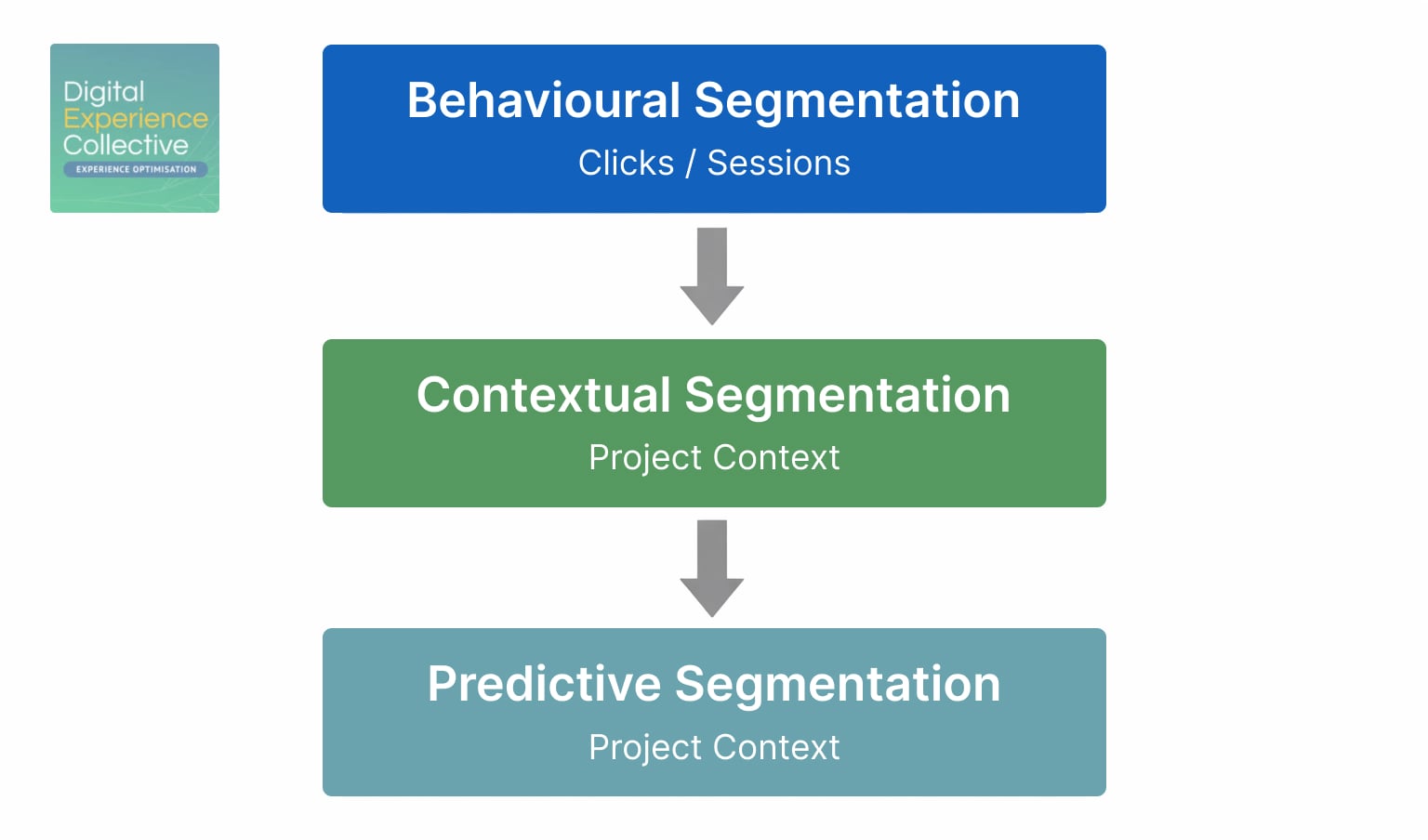
Segmentation methods by Tim Thijsse
Sometimes the most valuable signal about a customer’s future behavior is not found in their clicks, but in the real-world situation they are trying to solve.
And occasionally, that situation is reflected quite literally in the house they live in.