


Does your business-to-business (B2B) customer survey portfolio monitor expectations of everyone who impacts buying decisions? If not, representative
samples at the account level may not be representative at all when it comes to what really drives decisions to buy and re-buy from you.
When your product has a direct or indirect effect on safety, quality, financial, compliance, facilities, IT, or receiving – in addition to those who
actually use it in their day-to-day work – rest assured that each of those departments in your customer’s company has some say-so in what’s bought – or not
– from you.
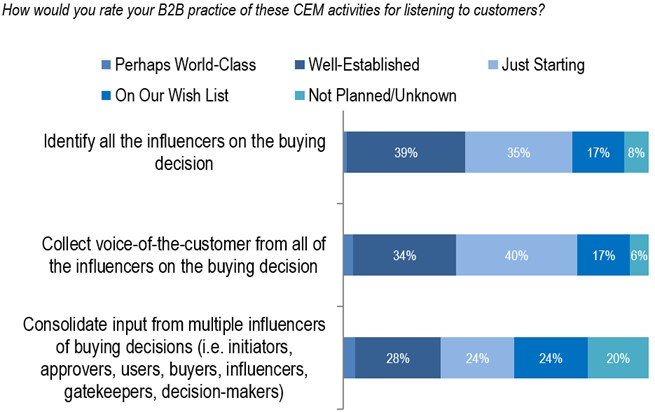
Yet, today few B2B suppliers pay attention to these facts. In research conducted over a 4-year period, only a third of companies say they identify all the
influencers on the buying decision.
Obstacles to Identifying Influencers of B2B Purchases
Why are we “content” that our voice-of-the-customer (VoC) reflects a fraction of what really happens in our customers’ decision-making? First of all, some
of us haven’t really thought it through like this yet: we may have been so eager to establish a survey that we borrowed methodology from a vendor
unfamiliar with the true workings of our industry, or we may have taken short-cuts in favor of time or cost or complexity constraints.
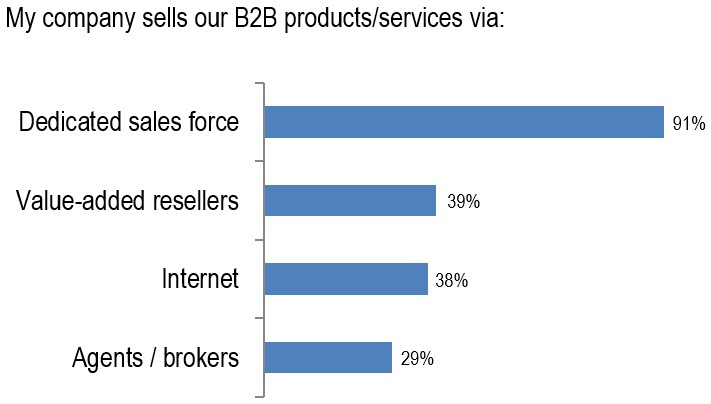
Most B2B companies sell through a dedicated sales force, which both helps and hinders customer experience management maturity. It’s certainly advantageous
for both parties to maintain continuity across interactions with any type of customer. In a way, the dedicated sales force is in itself a sort of CRM
(customer relationship management database). As such, the sales force can be a cornucopia of information and insights about B2B customers, but accessing
the sales force’s mental database can be difficult for anyone else in their company. And sometimes there are political reasons for the sales force to hold
a lot of information “close to the vest”.
Sometimes the presence of behind-the-scenes decision influencers is obscured by the customer’s Supplier Management organization that is the supplier’s
primary interface with the customer. And other times it’s a key influencer, such as CIOs for enterprise software, that dominate a supplier’s attention when
it comes to VoC methodology.
In any case, B2B buying decisions typically carry a lot of risk and/or have propensity to impact the customer company for a long time to come. And that’s
why numerous influencers get their say in buying and re-buying. Some of these groups/individuals make their influence felt via policies, while others
conduct audits or weigh-in on specific types of purchases. Some influence the very early stages of buying decisions, others can put the death-knell in a
deal at the last minute, and some emerge only after the first purchase, to influence successive rebuying.
Insights from All B2B Purchase Influencers
That complicates things from the traditional view of customer satisfaction surveys or net promoter surveys. One size does not fit all. A multi-pronged
approach to understanding your customers’ decision-making is essential for B2B customer experience management. Hence, a VoC portfolio is needed.
To identify the “village” of people who make or break your sales, you may start off with ethnography: “being a fly on the wall” during the course of your
customer’s day/processes. Or it may start with a deep-dive into your sales force’s mental database. Customer experience journey mapping (CXJM) may reveal
who’s involved at each stage of buying and rebuying decisions – if you structure your CXJM data collection right.
Ideal frequency of collecting opinions from various influencers will vary, depending on the degree and frequency of their involvement as influencers. Good
rules of thumb for VoC frequency anywhere are (a) how quickly can you show progress on what previous respondents have brought to your attention and (b) how
quickly might the influencer’s expectations and/or opinions change significantly?
Methods for accessing various influencers’ opinions should fit their natural habitats and rhythms whenever possible. If there are existing touch-points or
specific periods when these influencers want to vent/opine, adapt your listening accordingly.
Make a plan from the outset for how you will integrate the inputs from all the players. And most importantly, plan how you will use insights about the
holistic buy/re-buy decision process to center your employees and your business on customers, for strongest business results to be enjoyed by all parties.
Notes: see “
Business-to-Business Customer Experience: What’s It Like
?” for more information about the B2B customer’s realities. Research findings from the ClearAction
Business-to-Business Customer Experience Management Best Practices
Study.