



One of the largest under-acknowledged challenges in launching a new CX
initiative is getting front line employee buy in. Real time data collection
is pointless if only an exclusive coven of technocrats in HQ can see the
results. This is an important step in the CX value chain that is often
overlooked. We can’t begin to think about action if the front line does not
have nor believe in the information. But how do we get the word out?
Dashboards
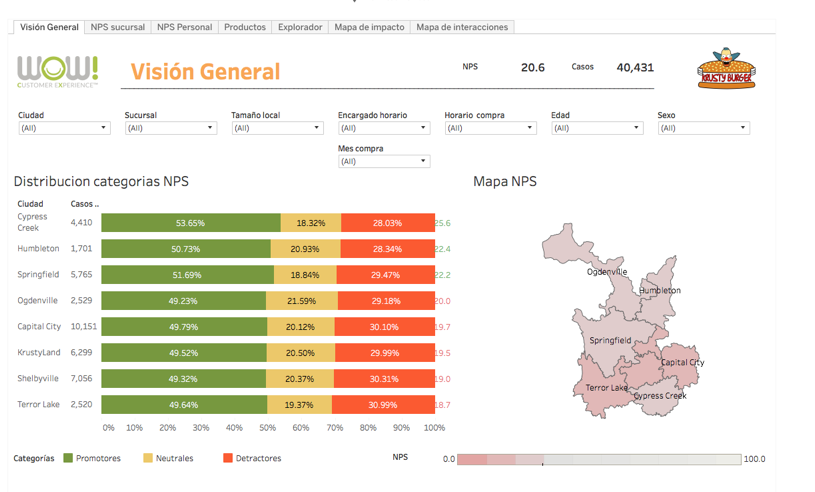
Dashboarding has become very popular as method, and when done well, of
communicating complex data simply. Companies such as Tableau, Domo, mTAB, and Dapresy have some very impressive
dashboarding tools. These can be assembled quickly and inexpensively. Here
is a
nice interactive example
in Tableau Public of a fairly comprehensive dashboard designed by
Gustavo Alberto
for the fictitious Krusty Burger
chain, albeit in Español.
Most CFM providers have a configurable dashboarding component as well. The
fact that most of these tools are also mobile enabled helps field
engagement with the information as well.
However, even dashboarding can be asking a bit much for the busy frontline
worker. The average working joe who is out in the parking lot, behind the
register, or in the call center really might not have the time, interest,
or know how to consult their NPS dashboard to see how well they are doing.
How can they find out?
Making CX Public
We know that engaging the front line can make or break the success of a CX
initiative. They are the intersection between the brand and the customer in
most instances. How do we make them aware of what is going on?
The answer may be simple. Why not go public with CX results? Let’s put our
report card on a very public refrigerator for the world to see.
This accomplishes a number of goals. First, it puts CX attitudinal and
behavioral metrics right under the nose of the very people who can make a
difference. Most motivation theories such as
Expectancy Theory and
Job Characteristic Model
hold that feedback is very important in improving performance. It also
makes a good deal of sense. How do I know if I am improving if you don’t
tell me on a regular basis?
Second, for customers it provides a degree of transparency about the
performance of that location and gives them assurances that this is a good
place to shop. The fact that a store isn’t perfect is not seen as a
negative any more than your credit score or your score on the vintage
Donkey Kong machine in your local pizza parlor. A “Not Perfect”
provides motivation for those in the store and creates a sense of trust
with the customer that the books are not, in fact, cooked.
In Store Public Displays
Many companies have taken this to heart. This example shows Weis Grocery store displaying
their CX efforts in a low-tech but effective manner.
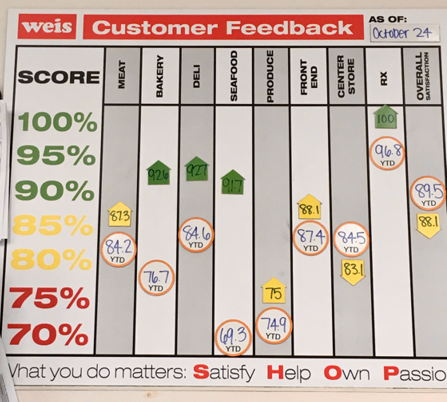
Here we see some challenges in the Produce and Seafood departments but some
recent victories in Bakery, Deli, and Pharmacy. This information is posted
right in the front of the store for all to see. To associates it is a
constant reminder of what still needs to get done and to customers it says
we are serious about customer experience and are always striving to
improve.
The other nice feature of this simple approach is it involves everyone.
Ostensibly the GM and/or department heads are physically updating their
scores and changes on a regular basis. As a result, I would imagine the
employees in the department are certainly attuned to those scores. Finally,
customers see it every time they shop. In short, it engages all
stakeholders where it matters; on the front line.
This second example comes from the London Midlands Railway in the
central Britain. This is posted right at the station, not hidden away in
some corner of the station, but right next to the ticket counter.
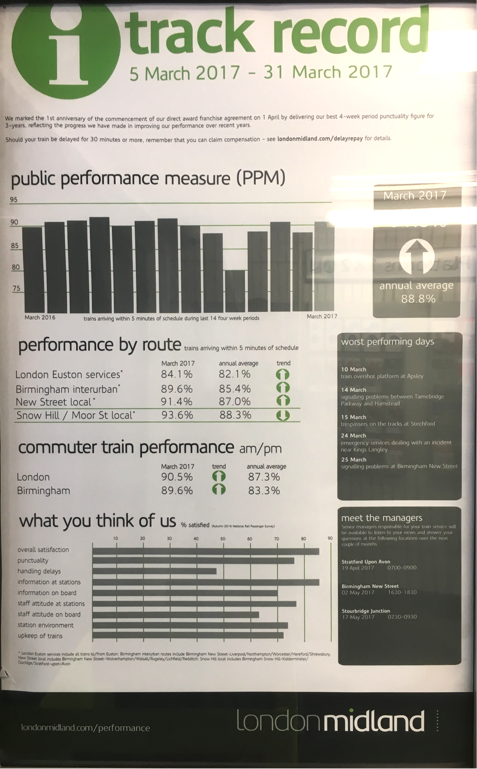
You can see here they display operational data (e.g., on-time performance), along with the trend. Right next to that information you can see how
they handle the human side of the business with information about
information provided and “staff attitude”. A very nice summary of all
results can be found online here as
well.
Online Public Displays
Publicly displayed information about Customer Experience need not be
relegated to physical locations. While digital reviews are fairly
ubiquitous not everyone has the fortitude to let all reviews get posted
unfettered. In some cases, corporate sponsored CX metrics systems either
cherry pick reviews or filter out the bad ones. This practice, however, has
consequences. The biggest of which that consumers will stop believing them
if they appear to be tampered with.
Here is a nice example from Best Buy that lets the CX cards fall where they
may. You can see that the reviews are verified (they have to be
purchasers). If you were to scroll down you would see many that are not so
stellar.
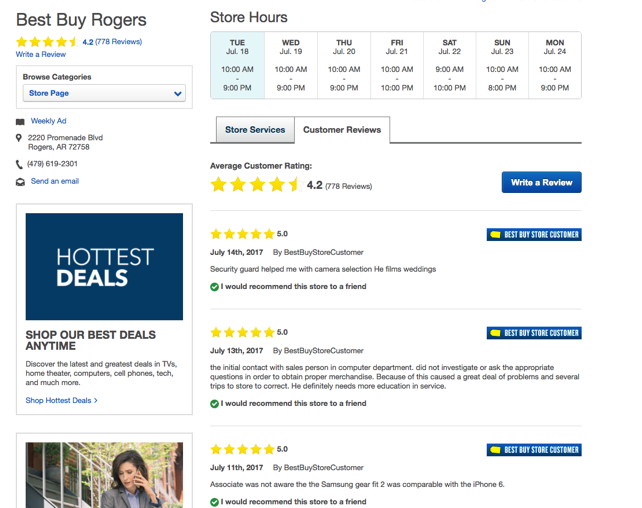
This level of transparency not only helps customers make a good choice, it
allows for self-policing of CX so long as it does not degenerate in a quid pro quo economy where there are favors (i.e., incentives)
traded for good reviews. That is a topic for a whole different post.
Many others, particularly in hospitality,
have adopted a similar approach, thus creating a natural selection system
for CX. While some ratings site have been criticized by having
reviews suppressed
and others have been accused of not being vigilant enough in preventing
fake reviews, other companies like SureCritic Reputation.com, and others act as
intermediary of
reviews that seek out to post the good, the bad, and the ugly.
Transparency Drives Engagement and Trust
We live in a time of information transparency. It is expected by customers
and integral to consumer decision making. A recent
report by Deloitte
found that almost 80 percent of consumers have interacted with brands
before they even set foot in-store.
While CX information is important for consumer decision making, it also has
a large role in driving both employee and customer engagement. Those
dashboards and reports sitting back in HQ do little to get buy-in from the
field. The private curation of data is seen as Big Brother
paternalistically trying to keep tabs on regions and outlets that clearly
cannot be trusted.
You can start to turn the cultural ship a bit by democratizing the data.
Push CX and operational data down to the lowest level and get the front
line’s buy in. If it’s under everyone’s nose every day and they feel like
they have some part in influencing it, it will help drive behavior.
Second, I personally prefer the low-tech version in lieu of, or in addition
to, technology based solutions. The grocery example is easy to set up,
requires about $14.98 of monetary investment and requires local management
and front-line employees to engage in the process versus being passive
recipients of data.
Third, make CX simple and embed it into the culture. I know many hotels and
retailers start the day by reviewing customer feedback. This a great
practice that gets everyone focused on the customer rather than the score.
It includes everyone in the solution; and most importantly those who can
make the biggest difference.
Finally, the practice of cherry picking, tampering, incentivizing, or
modifying customer feedback before it gets to the public domain is a very
bad one. People aren’t stupid and will catch on to these shenanigans. It
will reduce perceptions of trust and they will, over time, dismiss the
information as bogus, transforming an entire feedback mechanism into an
enormous waste of everyone’s time and money.
Getting unvarnished customer experience feedback out in the public, in a
simple to understand, and non-punitive fashion will help engagement with
employees and also engender trust in customers that you are dedicated to
making sure they have a rock star experience. When people have access to
the data, believe in it, and understand its impact they will be much more
apt to do something about it. And action is the whole reason for doing any
of this.
Note: Thanks to my colleague Dave Ensing
for the Best Buy example and Matt Inman for input on this topic.
Your Weis Market example is potentially troubling. Weis is a smallish supermarket chain HQ’d in Sunbury, PA, and I’d want to know much more about how they are generating customer data, i.e. if it’s from anecdotal or rudimentary satisfaction-based research, the validity of posted stats would be questionable. Having been born in Harrisburg, I know them as providing commoditized experiences. Also, the presumption that an in-store public display of departmental and overall performance, such as Weis uses, influences customer perception would need to be quantitatively validated through CX research..
Hi Michael, I was actually an employee of Weis Market many moons ago (I ran the soup and small paper aisles!). Weis actually has a pretty decent receipt VOC program run by MarketForce (https://weismarkets.survey.marketforce.com/).
I have to take exception regarding the observation that they offer a commoditized experience. In the markets I am familiar with they offer a much more personal experience than the big guys (Aldi, Walmart). They have long tenured employees who shoppers know by name (again anecdotal). Agree the need to prove it out the impact on customer perception. Nevertheless I prefer to deal with folks who are transparent in their business practices such as displayed by Weis…I imagine other may as well. Thank you for your readership and thoughts!
I agree that Aldi and Walmart offer commoditized experiences. Target, now in the grocery business as well as selling FMCGs, is also fairly commoditized. My last visit to a Weis store was about a month ago, in Hummelstown, near Hershey, PA; and my bases of comparison are Trader Joe’s, Whole Foods, and Wegmans, all offering distinctive experiences.
Hi Dave. Thanks for talk about the kb dashboard and give me the credit. In fact i’m not the one involved in this development it was a team work in WOWCX! with a interdisciplinar group.
Gustavo Alberto