


In my last column “Using Big Data Analytics to Find Your Best Agents and Supervisors” I introduced a new way to find more agents (and supervisors)
who are like your best performing agents (and supervisors) using Big Data
analytics. After collecting the metrics on two opposing axes, being
efficient vs. being effective, and adjusting using DIM or Dynamic
Individual Metrics, you can plot all agents on the X-Y axis as this example
shows:
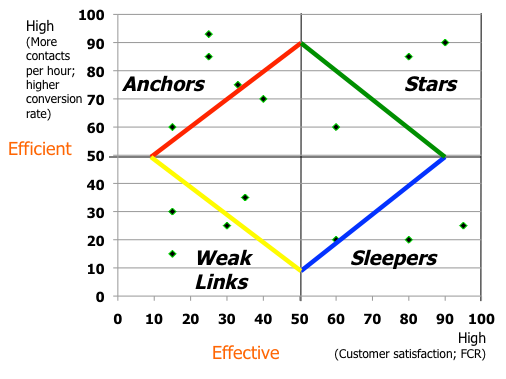
The Stars or “best agents” in the upper right corner somehow are able to
achieve both high levels of efficiency and effectiveness, so that’s where
we start: You can collect and model using Big Data potential drivers such
as prior jobs, hiring and initial training class, distance from work or
commute time, number of supervisors (and which ones), and more. By running
multiple models and finding best fit, you are able to learn what determines
a “best agent” and how to re-tool your hiring profile, trainer profile,
supervisory assignments, and the other key drivers.
Then you can run the same models for all other agents, revealing key
differences that begin to explain their weaker performance, and that’s what
I’ll address in this column.
Retrain “Anchors” to Slow Down
Let’s first start with the Anchors, those agents (and
supervisors’ teams) who are efficient but not effective. They might be the
folks who have always been rewarded for being fast, but whose effect on
customers hasn’t been collected or analyzed. When you do that you discover
that they routinely upset customers and cut short calls or interactions
that cause repeat contacts (what I like to call “snowballs”1).
Not good!
But when you “mash up” multiple data sources using Big Data, for
example agent-level repeat contacts or c-sat scores, you discover that in
some cases fast isn’t the right solution. What to do with the Anchors is
really hard, since they have been so successful at being so one-sided, but
it’s essential to re-train them to slow down, use established processes to
do the right thing for customers, and understand the negative impact of
being so fast.
Leverage “Sleepers” as Experts or Trainers
Now let’s spend some time with the Sleepers, the agents
(and supervisors’ teams) who are slow but highly effective. They might be
the folks who are methodical in their work, carefully listening to
customers’ issues and complaints, or patiently collecting customer
insights, oblivious to the clock.
While some companies quickly place the
Sleepers “in the penalty box”, perhaps with a draconian PIP (Personal
Improvement Plan), the best solution that I’ve seen is to re-position them
to become trainers or process experts in your operations.
Help “Weak Links” Find Another Opportunity
In the third corner are the Weak Links, those agents (and
supervisors’ teams) who are both inefficient and ineffective, a damaging
combination. Instead of placing them on a PIP or trying to improve their
performance, it’s probably best to acknowledge that these folks are really
hiring mistakes and need to go somewhere else.
Finding the Root Cause of Performance Differences
For these three corners, as well as the much sought after Stars, Big Data can play another critical role. Not only
does Big Data pull together (mash up, as I noted) disparate data sources,
but it can tell you why these agents (and supervisors’
teams) are performing in these ways. Is it because of…
- Their prior experiences?
- Their training at your company?
- Their first supervisor or manager?
- Your expectations and requirements?
- Rewards and recognition?
- The reader service boards festooned in your contact centers exhorting agents to
take more calls?
It might be these reasons, or not, and other ones. Only
using statistical modeling can you find out, and be sure not to repeat the
same mistakes.
After all, don’t we all want our agents and supervisors to be Stars? Of course we do!
Don’t Forget to Motivate
I’ll close with this comment from when I ran global customer service at
Amazon, in early 2001. We had just completed our holiday in the year 2000,
growing revenues by over 90% quarter over quarter, relying partly on an
outsourcer in Gurgaon, India that handled much of our email traffic.

Replicating an Amazon captive center recognition program called “Over The
Top” that I carried over from my years at MCI, that outsourcer sensed that
we had to over-deliver on quality for our holiday customers so they asked
if they could weight effectiveness 75% and efficiency 25% for their “best
performers” (the Stars) to join me at their 1st
Over the Top event in February 2001.
I then joined the top 15% of agents
who balanced excellent efficiency and effectiveness, the Stars, at a gala off site in a converted maharaja’s palace
northwest of Gurgaon. These agents relished their night, and many of the
became repeat winners; the other 85% heard about the events and clamored to
figure out how they could become Stars – A solid tradition was born.
1
The Best Service is No Service: Liberating Your Customers From Customer
Service, Keep Them Happy, and Control Costs, Bill Price & David Jaffe (Wiley 2008).