


AI sounds increasingly empathetic. Chatbots and voicebots now say things like
“I completely understand,” with timing, intonation, and warmth that are
barely distinguishable from human interaction. Yet something important is missing.
Customers increasingly describe the same experience:
“I felt heard, but not helped.”
A pleasant conversation, followed by no meaningful resolution.
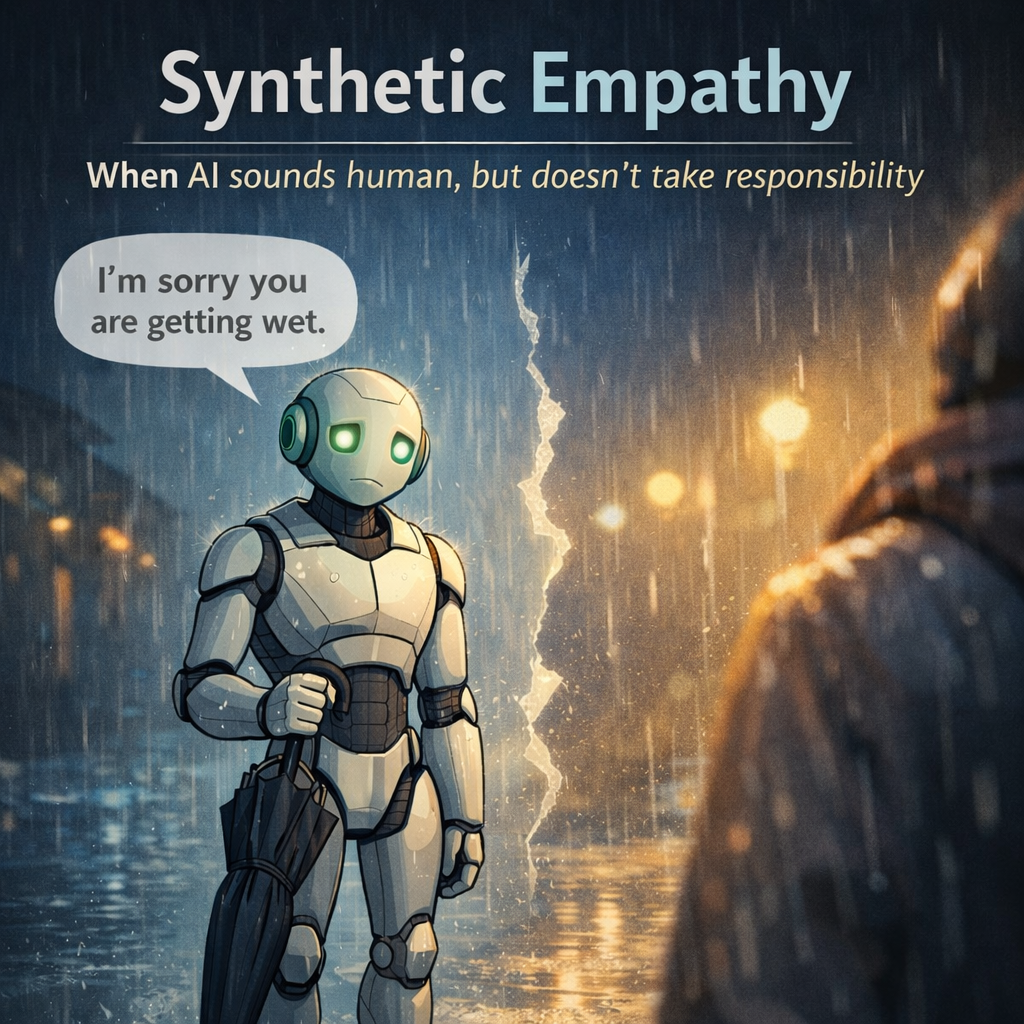
This is the outcome of what we can call synthetic empathy:
emotional recognition without responsibility, decision authority, or ownership of outcomes.
From optimization to understanding
Customer experience (CX) has evolved far beyond conversion optimization.
What started as friction removal has become relationship stewardship.
Modern CX focuses on trust, continuity, and long-term value creation, as
described by Lemon & Verhoef in Understanding Customer Experience Throughout the Customer Journey.
AI fits naturally into this evolution. It enables scalable personalization,
real-time sentiment analysis, and continuous voice-of-the-customer measurement.
But it also exposes a critical misunderstanding: empathy alone does not create customer value.
Empathy versus compassion
In CX, empathy and compassion are often used interchangeably.
They are not the same.
Empathy is the ability to recognize and understand another person’s emotional state.
It is cognitive and emotional awareness.
Compassion goes further.
It combines understanding with responsibility, decision-making,
and a willingness to act to improve the situation.
Empathy answers the question: “Do I understand what you are experiencing?”
Compassion answers: “What am I willing to do about it?”
Why empathy is not a language problem
Many CX implementations reduce empathy to tone of voice, microcopy,
or carefully engineered prompts.But empathy is not a linguistic achievement.
Daniel Goleman describes empathy as part of social intelligence:
the ability to understand others and navigate the moral and relational
implications of that understanding, as outlined inhis work on social intelligence.
C. Daniel Batson further distinguishes empathy from compassionate action inAltruism in Humans. Empathy gains real meaning only when it leads to responsibility and help.
AI can detect emotional signals with remarkable accuracy.
It can mirror concern, validate frustration, and adapt its language.
What it cannot do is carry moral weight.
It feels no tension when trade-offs are required
and bears no consequences when outcomes are wrong.
Synthetic empathy as a CX risk
Organizations increasingly deploy “empathetic” AI in the most sensitive moments
of the customer journey: complaints, delays, billing issues, and service failures.
When these systems lack real decision authority, empathy becomes cosmetic.
This gap between short-term survey scores and long-term loyalty is where synthetic empathy quietly undermines customer relationships.
In such cases, empathy acts as an emotion dampener rather than a solution.
Short interactions score high on satisfaction metrics, while long-term trust quietly erodes.
The experience feels warm, but hollow.
This dynamic has been observed in research on human–machine interaction,
where emotional fluency creates overconfidence without accountability.
CX as guardian of responsibility
This shifts the role of CX: from optimization to stewardship.
The central question is no longer:How human can AI sound?
But instead:Where does responsibility require a human presence?
CX leaders become guardians of the boundary between automation and accountability.
This requires ethical judgment, awareness of AI limitations,
and the courage to deliberately stop automation when compassion is required.
These responsibilities align closely with broader discussions on
AI ethics, explainability, and organizational responsibility.
From synthetic empathy to conscious compassion
Empathetic AI performs extremely well in routine, low-risk service interactions.
When outcomes are reversible and context is clear, automation is both efficient
and desirable.
When ambiguity, emotional load, or moral trade-offs enter the equation,
compassion becomes necessary.
At that point, humans must re-enter the loop.
The future of CX does not lie in making AI more human-sounding, but in consciously orchestrating human–machine collaboration. As Daugherty & Wilson describe in Collaborative Intelligence:AI scales efficiency; humans provide meaning, judgment, and moral framing.
The CX automation matrix
The decision of when empathy can be automated
and when compassion requires human involvement
can be summarized in a simple mental model:
| Dimension | AI-safe | Human-required |
|---|---|---|
| Emotional load | Low | High |
| Context ambiguity | Low | High |
| Moral trade-offs | None | Present |
| Consequences | Reversible | Irreversible |
| Explainability | Clear | Unclear |

Empathy is not a feature.
It is awareness.
Compassion is a promise.
It implies responsibility, action, and ownership of outcomes.
Tomorrow’s CX leaders will not just design journeys.
They will define and defend the boundaries between efficiency and genuine, compassionate understanding.