


Software-as-a-Service (SaaS) has been the pillar of most companies because it provides scalability, flexibility, and affordability. Among SaaS models, multi-tenant platforms are more notable because they enable different organizations to leverage the same application without compromising on total data isolation. This makes the model extremely efficient and secure for both startups and corporations.
Because of all these benefits, many companies are considering building multi-tenant SaaS platforms. In 2025. And here the similar question they have is: How much will it cost to develop one? The answer is that “It Depends”. The cost to build a multi-tenant SaaS platform depends on features, complexity, the location of the team, and infrastructure decisions. In the following, we discuss in detail the primary factors influencing the cost with realistic estimates and how they affect the price.
Factors that Influence the Development Cost of a Multi-Tenant SaaS Platform
A multi-tenanted SaaS system’s cost is based on various crucial aspects. Decisions regarding features, design, architecture, integrations, and security continue to add work required in development. The location of the team, as well as the continuous requirements of infrastructure, further influence the final cost.
1. Platform Complexity
Your SaaS product’s complexity is among the primary factors that lead to high expenses. If you have a simple system with fundamental components such as login, billing, and dashboards, then you will require less time and effort. However, when you incorporate features such as AI analytics, automation of the workflows, and role-based permissions, the development costs and time increase significantly.
Cost Impact: A basic SaaS system usually costs between $25,000 and $50,000, with extremely high-end systems costing over $80,000.
2. Architecture Design
The architecture affects how well your SaaS can support many users without problems with performance or security. Multi-tenant design needs careful planning to make sure each user’s data is safe, the load is balanced, and the system can grow. This takes more work than a single-tenant system.
Cost Impact: Costs are expected to be between $15,000 and $40,000. This depends on how well the data features can grow and how safe they are.
3. UI/UX Design
An easy interface can determine whether people will use or abandon the product. Creating easy-to-use dashboards, adaptable layouts, and customized user paths involves much time and creativity. The more customized and elaborate the design, the more expensive it will be.
Cost Impact: The costs typically range from $8,000 to $20,000, and generally depends on the design difficulty and branding requirements.
4. Development Team Location
Your source of developers affects your budget in general. Developers from Western Europe and North America are expensive, but if you choose to hire software developers from Asia or Eastern Europe, they are less costly yet qualified. This variable usually causes the most extensive spread in expenses in startups.
Cost Impact: The US and Europe charge between $40 and $80 per hour, while Asia or Eastern Europe charges between $20 and $40 per hour.
5. Security & Compliance
Security is critical because SaaS software holds high-end business and customer data. Features such as encryption, multi-factor authentication, and GDPR, HIPAA, or other compliance require more development time and money.
Cost Impact: Based on the applicable rules of compliance, you may require an average of $10,000 to $25,000.
6. Third-Party Integration
To fortify SaaS applications, businesses incorporate payment functionalities, cloud file storage, CRM, ERP, or email marketing capabilities. They need configuration, verification, and maintenance, consequently adding to development work.
strong>Cost Impact: Integration work usually costs between $5,000 and $15,000, depending on the number and type of added APIs.
7. Maintenance & Support
Instituting a SaaS system is only the beginning; ongoing maintenance, upgrading, and support are imperative for efficiency and expansion. Periodic bug fixes, new product releases, and server verification add recurrent expenses.
Cost Implications: For smooth operations, companies should maintain 15–20% of the original development cost every year.
Methods of Minimizing the Expense of Building Multi-Tenant SaaS
Creating a multi-tenancy SaaS offering is pricey, but the costs can be managed in a clever way. Through the appropriate techniques, companies can reduce expenses while at the same time gaining a safer, more adaptable, and future-proof solution.
1. Starting with the Minimum Viable Product (MVP)
Start with the bare minimum functionalities to validate your concept. Lower initial expenditures and prevent wasting finances on unusable modules. Later, add more based on user response and marketplace demand to spend money effectively.
2. Leverage Open-Source Platforms
Open-source software allows you to bypass license costs and get development underway more quickly. They provide you with pre-fabricated parts with solid community support. The result is fast development and high product quality.
3. Use Cloud Startup Credits
Cloud services like AWS, Azure, and Google Cloud offer startups free credits. The startups then get reduced infrastructure expenses in the initial phase. They get to experiment with new things and scale up with no financial pressure immediately.
4. Outsource Development Wisely
Hiring developers in Asia or Eastern Europe can save money without losing quality. Smart outsourcing finds skilled workers who charge less per hour. Picking the right partner also helps you keep things fast and dependable.
5. Automate Testing and Deployment
Automation reduces faults that require manual intervention and speeds up releases. Long-term costs decrease while the site remains stable and more secure. Additionally, the updates can be provided in the same timeframe with greater availability.
6. Design Scalable Architecture from the First Day
Plan your SaaS to grow easily. This stops expensive redesigns later and helps you grow smoothly as new users come in. A good base makes upgrades easier and cheaper in the future.
Estimated Cost Table
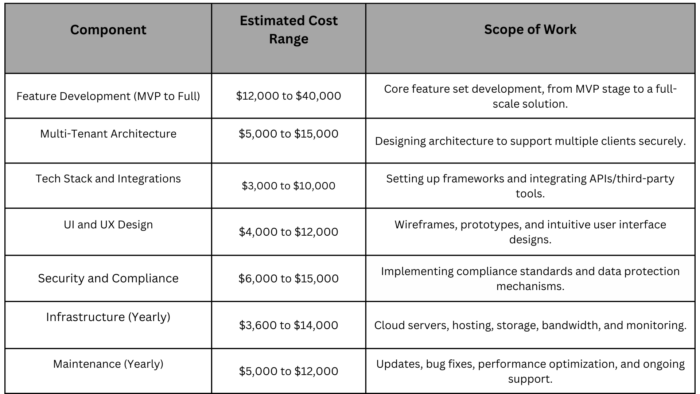
- Total Initial Development Cost in 2025: $30,000 to $80,000
Annual Running and Maintenance Cost: $10,000 to $25,000
Conclusion
In 2025, a software platform that multiple clients can use can be built for $30,000 to $80,000. The yearly upkeep costs will be between $10,000 and $25,000. The total cost depends on features, security, rules, and the location of the development team. It adaviseable to begin with a simple version and growing slowly, which helps control costs while testing the platform with real users.
Companies that require special functionalities or desire a solution tailored for operations can partner with a custom software development company to deliver the personalized platform based on their requirements. These companies can provide options that suit their needs and make it easy to scale the platform appropriately while remaining within the budget and being competitive.