


The use of AI in ecommerce and product data management is a response to the growing complexity of large, rapidly changing product catalogs, where messy, inconsistent data silently damages both trust and sales. AI product data management enables the cleaning, classification, and enrichment of product information through improved product classification, attribute extraction, and intelligent data cleansing to drive growth.

Your product data in today’s e-commerce environment is no longer simply a back-office task. Your product data determines whether consumers locate the correct item, if they have confidence in what they see, and if they will ultimately complete their purchase.
Numerous studies have reported that product data inaccuracies and incompleteness result in millions of dollars in lost sales annually. Also, an estimated 40 percent of product returns are caused by the consumer believing the item does not match what was described, and an overwhelming number of consumers state they will never purchase again from a company that makes false claims about the item. In addition, the adoption of AI technology for e-commerce operations is growing rapidly.
Currently, the AI in e-commerce space is valued at over $6 billion and is expected to continue its rapid growth as more companies look to leverage AI technology to operate their digital businesses at scale.

As a result, AI in e-commerce is driving the need for cleaner product data management. By leveraging the capabilities of AI, it enables retailers to speed up product data processing, increase product data consistency, and make smarter decisions regarding product data to support the complete customer experience with accurate product information.
The real problem: Why product data management is hard to scale
Product data management is extremely tough to scale. Here’s why:

Manually tagging products, manually cleaning spreadsheets, and implementing basic rule-based solutions cannot meet the needs of frequent SKU turnover, category mapping changes, and marketplace, ad platform and web store formatting requirements.
While basic product data management tools may effectively process tens of thousands of products, they fail when attempting to manage hundreds of thousands of products in multiple geographies. The next section will explain how AI in product data management addresses these challenges through five practical shifts in product data management with AI.
The 5 ways AI changes product data management
AI impacts product data management in different areas, including product classification, product tagging, and consistent product content accuracy among others. Below are five examples of how AI has positively impacted product data management.

1. AI automates product data entry & classification
Using AI models to analyze product title, description, and specification content with Natural Language Processing (NLP), and combining that with computer vision in e-commerce to identify objects within product images enable AI to classify and automatically categorize products with much greater consistency than manual tagging.
Benefits of AI automation of product data entry and classification for marketplaces and large retailers include:
- Faster ecommerce product data entry for new SKUs.
- Fewer category mismatches and listing errors.
- A consistent taxonomy that maintains alignment across channels.
Case studies from AI driven catalog platforms show that they have successfully processed more than ten thousand SKUs per template while reducing the time to market by approximately sixty percent and allowing a large portion of the product team’s efforts to focus on core tasks.
Product Information Management (PIM) teams should understand that yes, AI can assist in product categorization and tagging, but also enhance product information management by establishing a structure to unstructured and messy feed data.
2. AI-Driven image recognition improves product tagging & enrichment
With intelligent product tagging no longer starting from text alone, computer vision systems can analyze product images to extract attributes including color, pattern, neckline, sleeve length, material, and style, and then synchronize those with the product catalog.
Retailers who implement AI product tagging and image recognition for e-commerce report:
- Significant reductions in time-to-publish; typically forty to sixty percent.
- Richer attribute coverage without increasing the size of the team.
- Better quality filters, search facets, and collection pages.
The increased richness of product data because of product data enrichment at this level supports omnichannel growth. Search engines, marketplaces, and recommendation systems all depend on structured attributes to provide matches to intent; therefore, richer product data tags translate to improved findability and increased basket values.
3. AI enhances product content accuracy through intelligent data cleansing
AI increases accuracy through intelligent data cleaning. AI models review entire catalogs to:
- Determine duplicate or near-duplicate products using data deduplication techniques.
- Identify missing or conflicting fields such as unit or size mismatches.
- Highlight values that do not comply with brand or marketplace standards.
Research indicates that companies that leave the work of identifying poor product data to manual reviews could lose nearly ten million dollars per year. Additionally, about 40% of customers return products that do not match the description of the product and most of these customers do not return to shop at the retailer again.
By identifying product data inaccuracies early, retailers see fewer listing errors, reduced return rates, and more confident purchasing experiences. These factors are critical in today’s world where average e-commerce return rates are in the mid-teens to mid-twenties as a percentage of total orders.
4. AI streamlines marketplace compliance & product matching
Each marketplace has unique guidelines for category paths, required attributes, image sizes, and price format requirements. Catalog tools driven by AI compare product data across various data sources and map product data to the requirements of platforms like Amazon, Walmart and Shopify prior to product listing going live. The AI-based product matching and ecommerce compliance automation support:
- A consistent product identity across all marketing channels.
- A lower number of suppressed listings and fewer policy violations.
- Lower volumes of disputes between sellers and marketplace operators.
Catalog normalization at this level provides a better shopping experience for customers. Customers see the same product name, attributes and images everywhere they shop; therefore, they have increased confidence in the products they purchase and shorten the path to purchase.
5. AI powers real-time dynamic pricing & attribute optimization
Product data and pricing are closely linked. AI systems consume product attributes, historical sales, competitor prices and inventory levels and dynamically adjust prices in near real-time, based upon the business’s established rules.
This AI dynamic pricing strategy optimizes margin and sell-through while maintaining consistency with a brand’s positioning. Additionally, AI continually analyzes performance metrics to identify which product attributes have the most significant impact on click-through rates, search visibility and conversion rates per product category. Over time, this results in tangible product attribute optimization:
- Attributes that significantly affect search and recommendation engines are highlighted.
- Missing data fields that negatively impact performance are prioritized.
- Data used to inform content teams regarding areas of additional detail that will be successful.
Again, AI in e-commerce links operational control (pricing and inventory) to better product data management.
Additional ways AI supports product data management
Besides the previously described capabilities of AI in supporting product data management, AI supports product data management with regard to generating content and making recommendations.
Automated product content generation at catalog scale
Using Generative AI, automated product content generation at scale is possible. By utilizing structured product attributes, brand rules and previous examples of product content, Generative AI can generate product titles, product bullets, meta tags and variant level copy that adhere to a single voice.
Additionally, AI in catalog management assists in maintaining multilingual catalogs and format specific to each marketing channel. Feed and catalog platforms utilize Attribute Extraction AI to combine product data from the PIM, ERP and supplier feeds and create publish-ready listings for each marketplace and advertising platform, eliminating the need for manual effort and accelerating product launches.
Better product recommendation inputs
Recommendation Engines live on top of product data. When product attributes are accurate and consistent, AI-powered product recommendation systems can connect shopper behavior to relevant SKUs with greater accuracy.
Numerous studies have demonstrated that personalized product discovery and recommendations drive a substantial portion of e-commerce revenue. Some studies have estimated that personalization-related blocks generate more than one-fourth of revenue and demonstrate significant lifts in revenue when relevance increases. The inclusion of high-quality product data facilitates natural-feeling search and navigation, eliminates “no result” dead-ends and empowers customers to make informed purchasing decisions based on sufficient details.
Therefore, high-quality product data becomes a driver of revenue rather than a routine maintenance activity, a fact supported by numerous catalog enrichment case studies.
Best practices for implementing AI in product data management
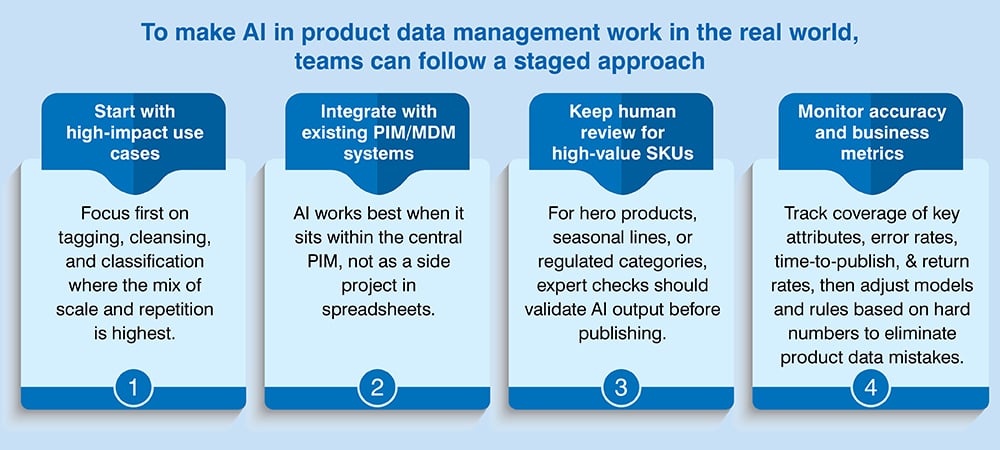
The benefits show up as lower manual overhead, higher accuracy, faster launches, and better support for downstream use cases such as ads, search, and recommendations.
Conclusion
AI for ecommerce product data management currently traverses the entire product catalog lifecycle; including product categorization and attribute extraction, intelligent data cleansing, marketplace compliance, and dynamic pricing. AI supports organizations to increase the speed and quality of their product data, as well as reduce the organizational resources required to grow product catalogs and marketing channels.
Considering the apparent cost of poor product data and the increasing reliance of search, ads, and recommendations on structured feed data, AI is no longer optional but is instead a necessary requirement for retailers managing large catalogs and desiring consistent and trustworthy customer experiences across all interactions.