


This month, in my exclusive column for CustomerThink, I continue to explore
in detail my perspective on
seven ‘tips’ that will enable any organisation to become genuinely customer centric. I must remind readers that the ‘tips’ are in no particular order – tip
number five is no less important than tip number one – although all the
tips are connected to each other in some way. Last month I shared
6 key questions related to the importance of engaging your people in
improvement activity. Engaging your people in playing a key role in improving the customer
experience is one thing, but what if customer experience is not actually a
key element of the business strategy in the first place?
“Strategy needs to be a balance between what the business wants and
what the customer wants. Creating that balance would mean that the
strategy does not just focus on business driven metrics (revenue,
profit, cost etc..), but also customer driven ones (loyalty,
satisfaction, effort etc.…). The better able a business is to create
that balance, the more likely it is that it will not just deliver a
better customer experience – it will also deliver a better employee
experience.”
We live in a world that has become increasingly and almost entirely focused
on ‘commercialisation’ (the process of managing or running something
principally for financial gain). Whether it be conscious or not, too many
organisations have spent far too long believing that their ‘reason for
being’ is making money. I have always fundamentally disagreed with this –
anyone who has had the fortune (or misfortune) to hear me speak, will know
that the mantra I preach is as follows:
“Organisations exist to fulfil a purpose – the better able they are at
fulfilling their purpose, the more money they will make”
The consequences of failing to abide by this principle are significant. In
researching for this article, I discovered a list of
accounting scandals on Wikipedia — it is quite an astonishing read! The list goes back to 1976 and includes
names such as Xerox, Bristol-Myers Squibb, Kmart, Nortel, AIG and Toshiba
among others. The list does not even mention
Tesco
and Volkswagen – two more remarkably high profile and recent examples of
businesses losing sight of the real reason why they exist. Although I have
never been privy to the business strategies that led to these less than
savoury outcomes, I would be quite comfortable in presuming that customer
experience was NOT incorporated into them in any way.

The purpose and ambition of any company ‘should’ be made clear in the
creation and documentation of its strategy – strategy being defined as ‘a
plan of action designed to achieve a long-term or overall aim’. Many
strategists would have you believe that the creation of strategy is akin to
a dark art – something that only a few have the skill to do and something
that needs very expensive consultants to conjure.
If an organisation has an aspiration to be customer centric, the business
strategy is a critical starting point to assess if it has defined its plan
to be for the benefit of the company, the customer or both. Strategy
is/should NOT be complicated – yet if it fails to contain a focus on both
what the business wants AND what the customer wants, then it will fail to
achieve the latter.
Defining business strategy is relatively simple (in theory) and consistent
across companies – usually, growth, through customer acquisition and
retention is at the heart of it. Business metrics such as revenue, profit,
return on capital employed, working capital among others are pored over in
great detail on a daily, weekly and monthly basis. Yet if an organisation
ONLY focuses on these business focused aims; and measures performance by
these business focused metrics, then all it will focus on day to day is
what the business wants.
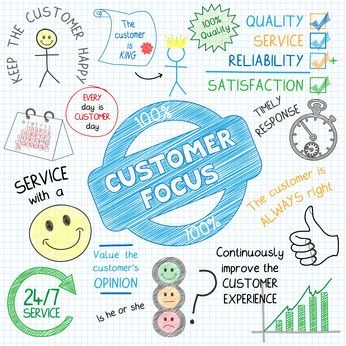
To be a customer centric business, it is AS important to ALSO focus on what
the customer wants; and to measure performance through customer focused
metrics (such as customer lifetime value; customer loyalty; customer
engagement; customer satisfaction etc.). A customer strategy can be defined
as follows:
- One that puts the customer at the forefront of thinking, when creating
procedures, conducting daily operations and training new employees. - It is a guide, a roadmap, a set of boundaries by which the business will
function - It describes the intended customer experience – and must be shared so
everyone knows what to do. - When companies implement a customer strategy, customer experience
automatically comes to the forefront of that company’s daily operations.
It is not complicated, yet so often, the customer element of strategy is
missing. I am not saying that it is wrong to have a clear understanding of
what the business wants in its strategic definition – quite the contrary.
What I am saying is that if the business ONLY focuses on what the business
wants, it will not be able to put the customer at the heart of the way it
works.
A simple test of whether your organisation has put customer experience as a
key element of its business strategy or not, is to ask the following
questions:
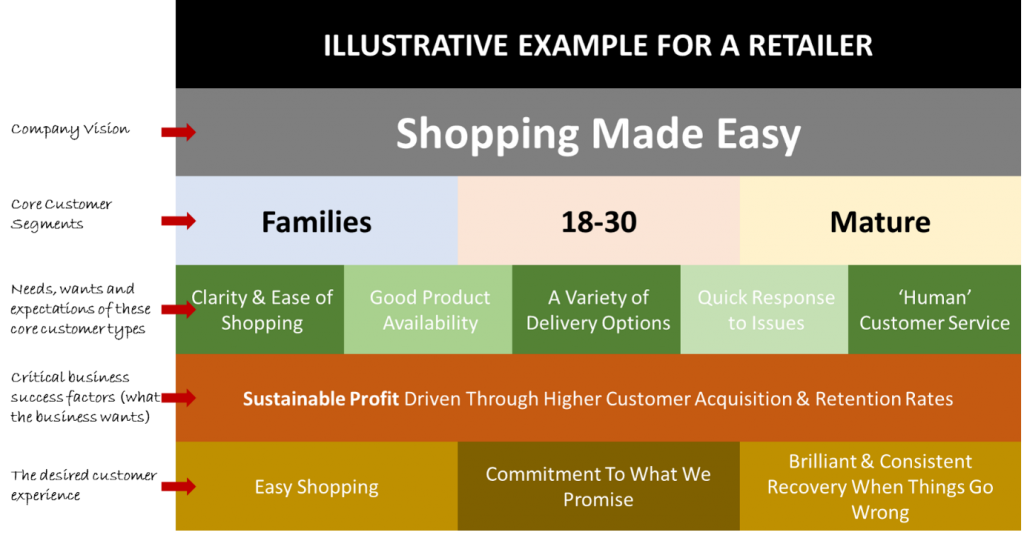
- What is your corporate mission/vision/purpose?
- Do you know/can you describe your core customer types/segments?
- Can you describe the needs, wants and expectations of these core
customer types? - Do you know what your key strategic business metrics (critical business
success factors) are? - Do you know what your desired customer experience is; what your
organisation has committed to doing for its customers; and how you will
measure success? - If you answered ‘yes’ to 4 and 5, are you able to align business goals
with the successful delivery of the desired customer experience?
In practice, most organisations I have worked with around the world
struggle to answer all 6 of these questions. The overwhelming majority are
most comfortable answering question number 4. Here is an illustrative
example of how the questions could be answered and a customer focused
business strategy constructed:
Ensuring customer experience is a key element of the business strategy
sounds so obvious – it is – yet to do so relies on leadership having the
mindset that allows them to understand the correlation between
meeting/exceeding customer expectation and financial performance.
The final point I would like to make on this subject is this – creation of
the strategy is only part of the challenge. Ensuring that everyone in your
business knows what it is, is the other part. Too many organisations keep
the business strategy as a closely guarded secret for the most senior
executives – the minions are rarely confided in. If you want to be a
customer centric organisation, it is not just essential to ensure that
customer experience is a key element of the strategy – you have to ensure
that your own people know what the strategy is as well!
If you are reading this and you do not know what your business strategy
is….. I urge you to ask your leaders as soon as possible!
Ian,
A well-written article, thanks.
In your opinion, what kind of companies, or under what circumstances, CES is a suitable key measure for your CX strategy?
Many thanks Sampson. In all honesty, I would argue that it may be better to switch the question around – i.e. ‘are there any circumstances where CES is NOT a suitable measure?’. CES is now as important an indicator of customer perception as NPS and Customer Satisfaction. I believe that the greater your suite of metrics, the better armed your organisation will be to make the best decision in the interests of the customer, the employee and the shareholder. So in essence, if you are able to measure all three – CSat, NPS and CES, then that is what I would typically recommend.
Though I don’t share the same view, l’m glad to know your thoughts. I”ll share mine in my coming article; feel free to comment by then. Thank you, Ian.
Ian,
My post “Stop Trying to Eliminate Customer Effort” is up:
http://customerthink.com/stop-trying-to-eliminate-customer-effort/
Do let me know your comments. Thank you.