


Photo credit: L+R
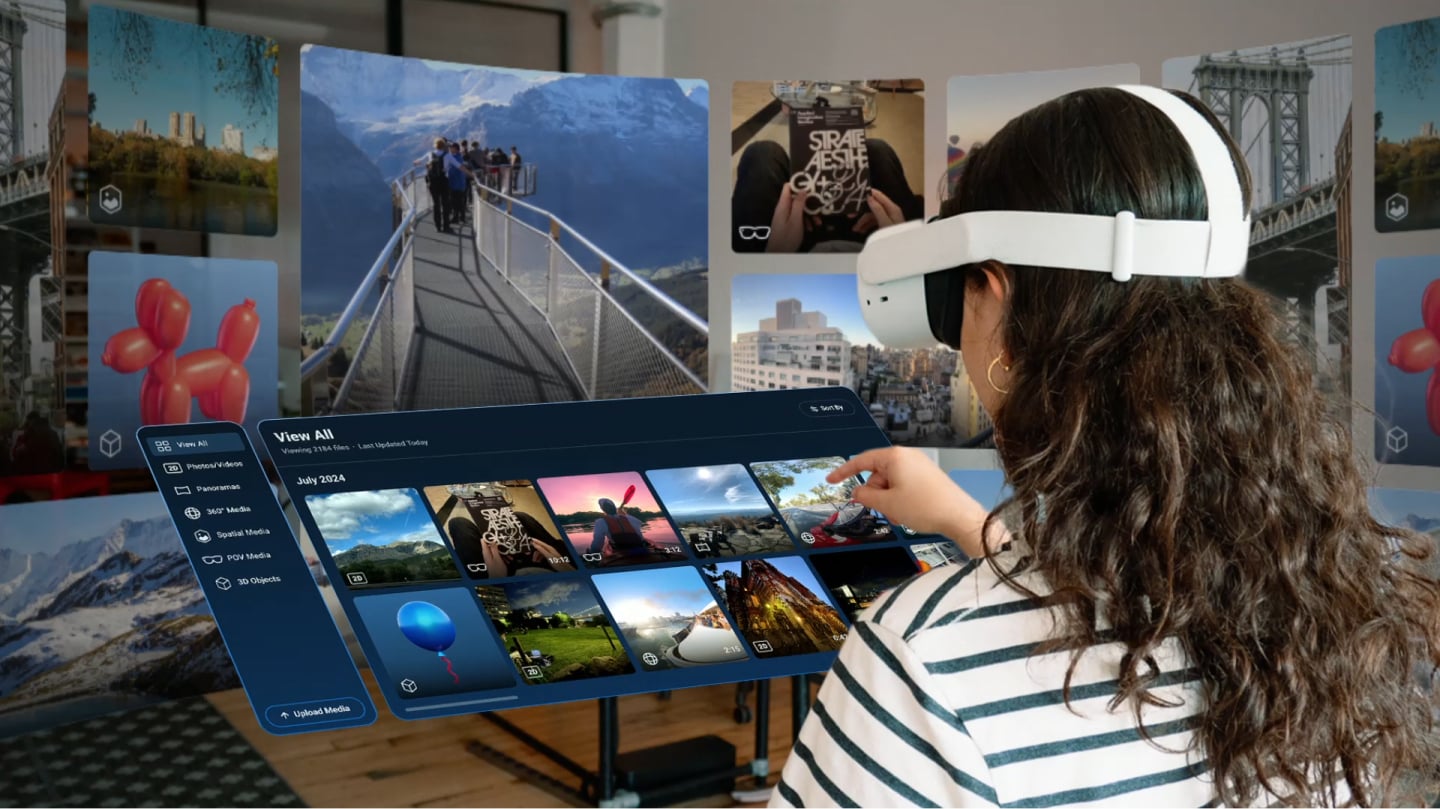
The stereoscope captivated Queen Victoria at the Great Exhibition of 1851, offering viewers a three-dimensional experience that transformed flat images into immersive scenes with depth and presence. This Victorian-era technology marked humanity’s early fascination with enhanced visual realities. What began with stereoscopic daguerreotypes has evolved into today’s augmented and virtual reality technologies, transforming how customers experience retail.
This evolution reflects a fundamental truth about human behavior: we seek to collapse the distance between information and experience. The same impulse that drew crowds to the stereoscope drives consumers today to engage with brands through spatial computing interfaces that merge digital capabilities with physical spaces.
Luxury brands recognize this continuity. When Gucci launched an enhanced documentary experience for Apple Vision Pro earlier this year, they were extending a technological heritage that includes their 2004 iPod case – both products reflecting an understanding that technology carriers themselves become fashion statements. The form-versus-function conversation has always been central to retail, with spatial computing representing its latest iteration.
Eye-tracking studies from Stanford’s Virtual Human Interaction Lab demonstrate that consumers examining virtual furniture spend 5.2 times longer exploring product details than viewing traditional photos. This deeper engagement mirrors what anthropologists have observed about physical shopping – people understand objects through spatial relationships, often circling items multiple times before making purchase decisions.
The neurological underpinnings are compelling. When MIT researchers examined brain activity during AR shopping experiences, they found activation patterns remarkably similar to those during physical shopping, yet distinctly different from traditional online browsing. This suggests spatial computing creates a hybrid space where physical and digital retail advantages converge.
This hybrid nature proves valuable across retail segments. Home improvement retailers implementing AR visualization tools report not only higher conversion rates (typically 65-75% versus traditional digital shopping’s 25-35%) but also meaningful reductions in returns – addressing a $761 billion annual problem for retailers according to NRF figures.
The data dimension adds another layer of significance. Traditional analytics capture what customers click; spatial computing reveals how they move, where they look, and how they physically engage with virtual representations. This behavioral intelligence helps retailers understand decision processes rather than just outcomes.
In our work at L+R, we’ve observed that successful spatial computing implementations typically originate from identifying specific friction points in existing customer journeys rather than pursuing technology for its own sake. The human-centered design methodologies we employ help identify where AR/VR can transform abstract concepts into tangible experiences – the exact moments where these technologies deliver maximum value.
Japanese media theorist Hiroshi Ishii at MIT’s Tangible Media Group describes this approach as “making digital tangible and physical information manipulable” – an elegant framework for evaluating potential AR/VR initiatives. The question is not “How can we use this technology?” but “Which customer experiences would benefit from spatial understanding?”
Critics rightfully point out that previous waves of immersive technology have fallen short of transformative retail impact. Virtual worlds promised revolutionary shopping experiences in the early 2010s, yet consumer adoption remained limited by technical constraints and underwhelming user experiences. This history of over-promise warrants healthy skepticism.
Yet current market developments suggest we’re at an inflection point. Apple’s significant VisionOS updates fuel their Vision device ecosystem, while Meta’s pivot toward non-gaming use cases for Horizon OS and Quest devices indicates growing enterprise confidence. With Google’s anticipated AndroidXR platform and Samsung’s well-received new AR/VR goggles expected later this year, the technological landscape is maturing beyond early limitations. These developments warrant retailers’ strategic attention, even while maintaining measured expectations.
Retailers gaining a competitive advantage recognize that spatial computing continues a long tradition of enhancing commerce through visualization. AR mirrors and virtual try-on solutions address the same fundamental challenge solved by dressing rooms in the 1800s: helping customers envision themselves with products before purchase. The medium has changed, but the human need remains constant.
As we move toward ambient computing environments where digital information suffuses physical spaces, the distinction between augmented shopping experiences and regular shopping will gradually dissolve. The most effective implementations will feel less like technology showcases and more like natural extensions of how customers already want to shop: with complete information, contextual understanding, and emotional connection.
By understanding AR/VR technologies as part of this continuous human desire to merge information with experience – a line traceable from Victorian stereoscopes to today’s mixed reality – retailers can move beyond technological novelty toward meaningful experience design that addresses fundamental customer needs and behaviors.
AR and VR are reshaping retail in ways that go far beyond novelty—their biggest educational value is how they help shoppers understand products more accurately through interactive, hands-on learning experiences. Being able to explore product details in 3D or simulate real-world use gives customers a level of clarity traditional e-commerce often can’t match.
It’s also fascinating how immersive tech influences decision-making.This MIT Sloan article breaks down how AR is changing retail behavior: https://sloanreview.mit.edu/article/how-ar-is-changing-retail/
Excited to see how retailers continue using AR/VR not just for immersion, but for smarter, more informative shopping experiences.