


In the year 2016 bots, AI, and machine learning seemed to be all the rage,
with all of these topics getting mixed into one big bundle. Many people
seemed to forget that they are not the same but only related to each other.
Advanced Analytics
Artificial Intelligence (AI) is an umbrella term that describes the part of
computer science that deals with making computers emulate human
intelligence. Machine learning is the part of AI that makes a computer
appear intelligent.
Bots are an application — an application being most
helpful if it is based upon a minimal level of (artificial) intelligence, and
that particularly serves interaction purposes. One could also say that
bots, especially chatbots, are a UI technology. Another aspect is that an
application that gets exposed by a bot can have the ability to act, not
only analyze. But then, the times of Commander Data from Star Trek, Wall-E,
or HAL 9000 from Space Odyssey are still, well, Science Fiction.
More generally, there are applications that use the services provided by
all three.

Less frequently talked about in this context, but even more important than
e.g. the hyped topic that AI, machine learning, and bots are, is analytics.
Essentially, any AI, including business AI, is nothing more than advanced
applied analytics – applied with the purposes of automating tasks and
getting better results, ultimately via a self-regulating learning process.
‘Applied’ in a sense that data is not only presented for human decision
making but ultimately for decision making of machines themselves.
AIs are increasingly used in businesses to improve all business areas along
its value chain, including marketing, sales, service, and e-commerce, but
also HR and finance.
Given that this is the case, where do AI, machine learning, and analytics
go? And where are we today? What does it mean in a business context? These
are questions that I want to cover in this and subsequent posts that
will make up a good part of this column.
Evolution Starts with Traditional Analytics
Analyst Esteban Kolsky sees the way leading from (traditional) analytics
via predictive analytics to automation and then AI/cognition/machine
learning.
Artificial Intelligence < > Predictive Analytics
analytics (optimization) -> predictive -> automation -> AI / Cognition / ML#NowYouKnow
— Esteban Kolsky (@ekolsky) July 21, 2016
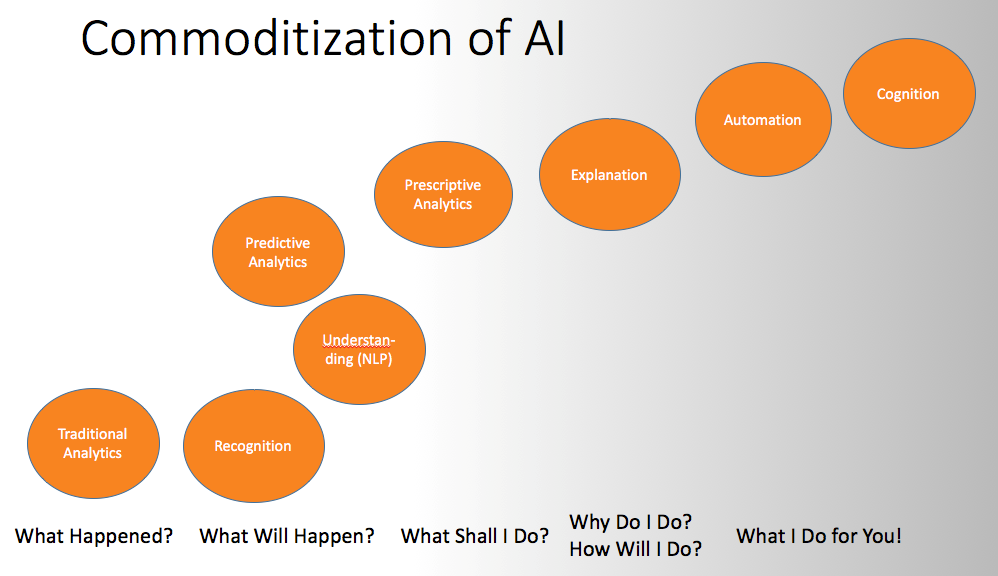
In other words, Esteban sees analytics going forward from answering the
question “What happened?” to “What will happen?” and ultimately to “What
can I do for you?”.
Abinash Tripathy, CEO of Helpshift, sees intelligence move on from
providing notifications, via suggestions, to predictions, and then to
conversations – which can be seen as a subset of the wider environment that
Esteban sees, focusing on service scenarios.
And we can already see this future developing with advanced analytics tools
suggesting next best actions, giving product recommendations, giving
relationship intelligence, suggesting predictive/prescriptive maintenance,
doing failure analysis and prediction.
And, of course, we have seen the dawn of chatbots this year with use cases
that stretch from sales scenarios through customer service.
In my eyes there are two more important steps in this evolution:
- Prescription, answering the question “What shall I do?”. With the ability
to suggest and predict, we will see machines getting an increased ability
to act. Once prescriptions can reliably be followed we come to automation.
Both might be hard to digest for humans for several reasons, but this is
part of a later article. - Explanation, answering the questions “Why do I do?” or “How will I do?”.
Currently there is no way to understand why a query to an AI system returns
with a particular reply. The systems are complicated black boxes. It needs
to be understandable why they came to the result. Machines must be able to
explain their ‘decision process’. This is equally important for autonomous
machines, e.g. self-driving cars, albeit more in a forensic perspective:
What went wrong?
The Future
During this evolution AI will deliver increasing value, which will go along
with increasing commoditization, and a change of the human-to-computer
interaction models. The mot du jour is ‘democratization’.
But, however we call it, from a business — and customer — point of view,
these trends have advantages: More (customer- and business) value, at lower
cost, with more efficient interaction.
We can observe already now that the main form of human-to-machine
interaction will change from point, click and type to touch and talk, via
touch, type, and talk. Cortana and Siri have arrived on computer desktops.
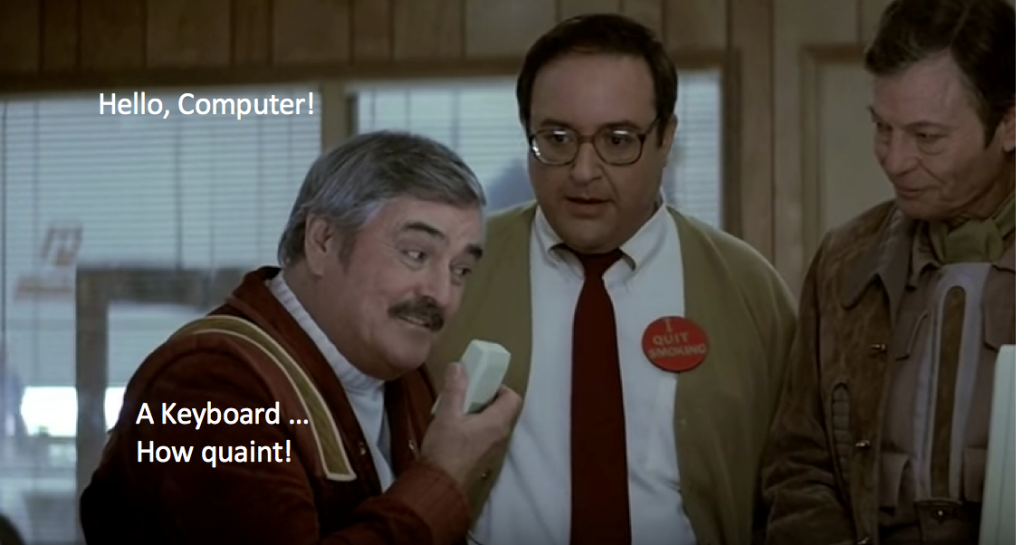
Conversational interfaces will become part of the next norm. The famous
scene from Star Trek IV – The Voyage Home has already partly become a
reality.
Holger Mueller
from Constellation Research is postulating that we will see voice
interaction being our main interaction model with computers sooner, rather
than later.
Voice and touch will replace click and type faster than we ever thought says @holgermu MyPoV: It's already well on the way.
— Thomas Wieberneit (@twieberneit) December 22, 2016
It is still in the beginning, but the trend has started.
What Does It Mean?
One brief word: Experiences!
Experiences for customers, suppliers, partners, and employees. Experiences
that couldn’t be delivered before and others that can be delivered in a
better way. Business leaders need to think strategically about what
experiences they do want to deliver, and how; and how to deliver them
effectively and efficiently.
To deliver these experiences, they need to be clear on their strategy and
build a clear vision. Once this is established, they need to give in-depth
consideration to the technology platform to avoid repeating the old mistake
of creating silos. The platform is the foundation of a business’s ability
to deliver, and to deliver in a future proof way. As the platform connects
applications, people, and processes it needs to be open and extensible.
Select one that that fulfills current and future needs and that supports
the transition from current- to target state. This is the important first
step of
a Think Big – Act Small
framework that helps in delivering continuous increments of value created
to employees and customers, while keeping strategic priorities in mind.
Once this is done the business can endeavour implementing uses for AI/bots
to improve experiences throughout its value chain, in an agile way,
following changing priorities.
And this is what I will cover in subsequent articles of this column.
This is a wonderful article, and I especially appreciate the roadmap for the commoditization of AI, from predictive analytics to prescriptive analytics and beyond.
I have been following research on both sides of the role AI plays: Customer and Employee applications.
The only unfortunate part is the current adoption rate is a little slow, as we need more data in production to build increasingly precise models to validate.
A great read, thank you!
thanks Jean-Marc. I think that adoption will pick up. This will have some reasons.
– vendors will sell more as AI apps, which they were hesitant to label like this before
– prices will go down as an effect of commoditization and new players emerging
– more useful business scenarios will get implemented
Thomas
@twieberneit
Great article, Thomas. I’m really looking forward to following your column in the coming year, and from my vantage point, seeing which applications of AI make the biggest impact in the contact center.
thanks Jeremy; likewise. I will certainly cover service processes and the contact centre is one of the main touch points there. On the nearer term how about the combination of bots for gathering necessary information, keeping the customer engaged instead of music and their ability to already solve simple, and increasingly difficult questions. Intelligently tagging knowledge articles … On the sales side intelligent cross- and upselling come to mind immediately ;-)
Some REAL impact I expect from voice systems. Replace the annoying IVR tree with a conversation. Chat based systems are showing the way.
More later … cannot write a spoiler, can I?
Cheers
Thomas
@twieberneit
That’s a great approach, Thomas! Looking forward to reading more :)
Before anything else, many organizations are not making right investments to validate if they really need chatbots (and AI, ML, NLU stuff).
Scott Abel wrote quite a thought provoking post on Medium, on the need, relevance, and then strategy for chatbots (and AI, ML), lots to gain from here: https://chatbotsmagazine.com/chatbots-for-business-needs-misconceptions-and-marketing-hype-3ae661bef7cb
indeed a very insightful article, Vinish. Thanks for pointing us to it. However, I wouldn’t fully agree to your investment statement but think that there is a dire need for working conversational inferfaces (be them textual or voice). I rather think that they are not validating the right problems to address first along with the right depth of engagement. And they often start running before they can really walk, wanting too much in one shot. That leads to poor ‘tool’ selection and is a problem that is caused by hype.
Rgds
Thomas
@twieberneit
Hi Thomas,
Very nice article
A survey by the SMG/CMSWire and Digital Workplace Group as an industry insight for the 2017 Digital Workplace Experience conference revealed that 95 percent of organizations agree that a digital workplace is important.
thanks for your comment, Kavya. Yes, a digital workplace is important. It is part of the outcome of what is currently called digital transformation. Sadly, many companies still need to work hard to get where they want to be. The good news is that some companies already are and that many others are working hard on this objective.