


By controlling the causal factors that bring randomness to the innovation
process, companies can bring predictability to innovation.
Innovation appears to be a random, inherently unpredictable process. But
what if we could understand the causal factors that contribute variability
to the innovation process and learn how to control them? Would that bring
predictability to innovation? The answer is yes—we have proven it can be
done, but it requires new thinking.
Innovation is the process of devising product/service solutions that
address unmet customer needs. There are 2 key inputs into the innovation
process: (1) solutions: ideas for new products or product features that use
new or existing technology in a new, unique or novel way, and (2) customer
needs.
It is rare that we see companies struggle to generate ideas—in fact the
opposite is usually true—they often have more ideas than they know what to
do with. The reality is companies struggle with innovation because those
responsible for conceptualizing, developing and evaluating ideas for new
product/service offerings struggle with the “needs” side of the equation.
Our experience has led us to conclude that companies struggle with 5 key
issues related to understanding and targeting customer needs. These factors
contribute significant variability to the innovation process. In nearly all
our consulting engagements, we often find that the members of the product
team:
- Do not agree on what a “need” is or what types of customer needs exist.
- Do not agree on how a “need” statement should be constructed to
effectively inform the innovation process. - Do not know what all the customer’s needs are.
- Do not know with certainty which customer needs are unmet.
- Do not know if segments of customers exist with different sets of unmet
needs.
Clearly, if these issues cannot be resolved, the chance of devising a
solution that effectively addresses the customer’s unmet needs is highly
unlikely—thus making the innovation process appear random. But it doesn’t
have to be. These issues can be resolved using the research methods we have
devised as part of our
innovation process, Outcome-Driven Innovation.
What types of customer needs exist?
Customer inputs must be captured that inform the development team what
functions the product should perform, how customers want to interact with
the product throughout its lifecycle, the emotional benefits they want to
receive, and their financial goals and constraints. These types of inputs
are detailed in the Jobs-to-be-Done Needs Framework (Figure 1).
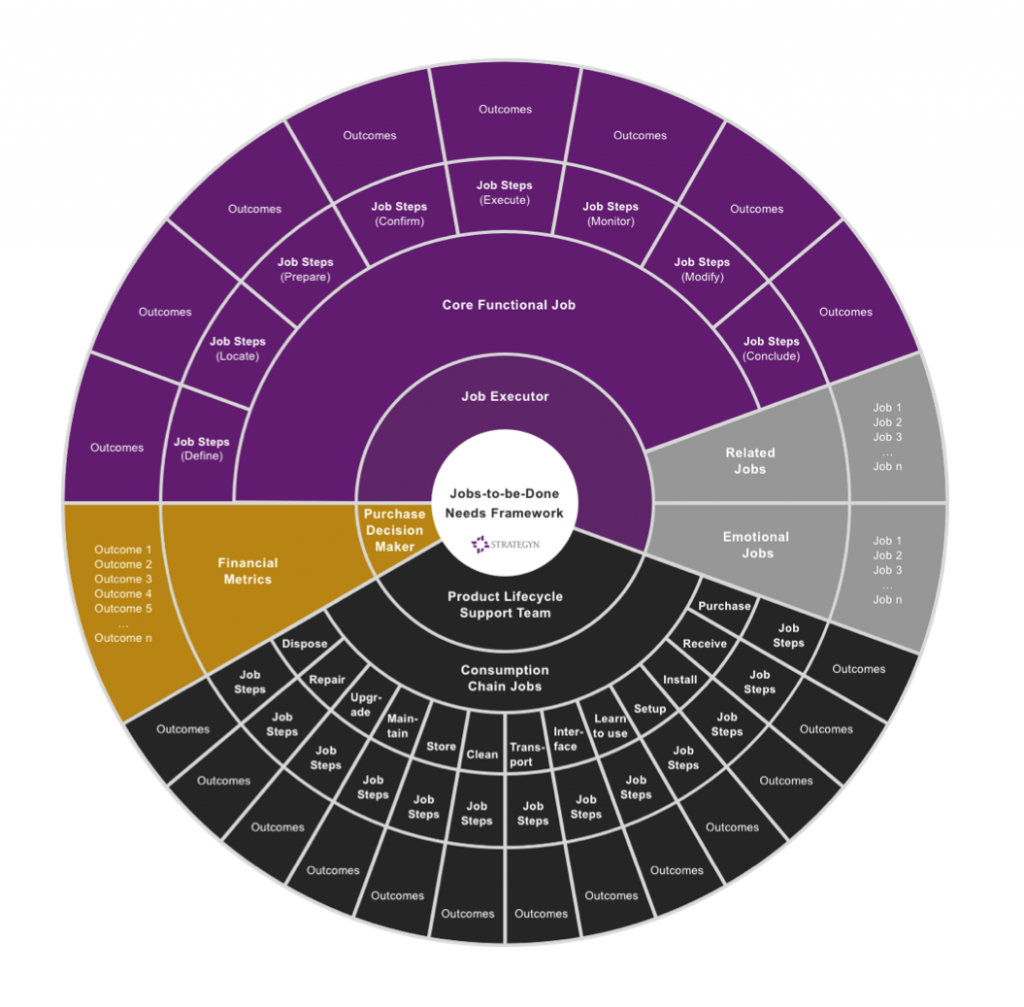
The customer’s desired outcomes related to the core functional job inform
product function. The desired outcomes associated with the consumption
chain jobs done inform product lifecycle activities. Related jobs explore
additional function that may be desired, while emotional jobs detail the
desired emotional benefits. Lastly, the financial outcomes detail the
customer’s financial goals and constraints. Each need type is defined in
more detail in the book
JOBS TO BE DONE: Theory to Practice.
How should a “need” statement be constructed?
A need statement must unfortunately be stated in words. Therefore those
words must be organized in a sentence that communicates how the customer
measures success and value when getting a “job” done. That same set of
words must provide actionable input to the development team—in other words,
it must inform the product function and design. The ideal “need” statement
should also be stable over time and devoid of solutions—this means they
must be associated with the job-to-be-done, not the product.
For these reasons, we structure a need statement as follows: Verb
(minimize) + metric + object of control + contextual clarifier. For
example, “minimize the time it takes to get the songs in the desired order
for listening” is a desired outcome associated with the core job of
listening to music. For all the details on structuring need statements go
to
Giving Customers A Fair Hearing (MIT Sloan article).
How do you collect all the customer’s needs?
Need collection begins with the creation of a job map. A job map breaks
down the customer’s core functional job-to-be-done into discrete steps,
detailing what the customer is trying to accomplish—independent of
solution. The job map is created through customer interviews and refined
throughout the qualitative research process. Additional details on job
mapping can be found in the HBR article,
The Customer-Centered Innovation Map.
The job map bounds the need-gathering process. With a job map in hand the
next step is to capture/create a complete set of desired outcome statements
for the core functional job and relevant consumption chain jobs. It is
often the case that 5 to 10 outcomes are captured for each job step, and
100 or more desired outcomes statements are collected in total.
A complete set of outcome statements will detail (in chronological order)
exactly how customers measure success as they go about getting the job done
step-by-step, from beginning to end. Outcome statements can be captured
through customer interviews, but can also be extracted from literature,
books or papers written on the subject.
How do you determine which needs are unmet?
A need is unmet when it is important to customers, but not satisfied with
the products/services (or ad hoc solutions) they are using today. Knowing
which of the 100 or more desired outcomes are most important and least
satisfied pinpoints the opportunities for value creation.
Statistically valid quantitative research is required to determine which
outcomes are underserved. First we create a survey that includes the 100 or
more desired outcome statements. Then we survey anywhere from 120 to 1200
customers (depending on a variety of factors), asking them to tell us the
importance of each outcome and their current level of satisfaction. With
these inputs we can determine which needs are most underserved (and
overserved). See the HBR article
Turn Customer Input into Innovation for more details.
How do you discover segments of customers with different unmet needs?
To discover segments of customers with different unmet needs you must
segment the market using unmet needs as the bases for segmentation—not
demographic, psychographic or other classification schemes. Companies
rarely segment their markets in this manner because they cannot agree on
what a need is, what the needs are and which are unmet. This is why so many
innovation efforts fail.
In nearly every market we’ve analyzed over the past 25 years we discovered
segments of customers with different unmet needs. This means that most
markets are not homogeneous—and that a one-size-fits-all solution will
rarely win in the marketplace. Outcome-based segmentation is critical to
success.
We segment markets using the data collected in the quantitative survey. We
first run factor analysis to discover which outcomes customers rate
differently, and then run cluster analysis to place the customers into a
predetermined number of segments. We then profile the segments to determine
what unique complexities they face that cause them to have different sets
of unmet outcomes. Learn more about our approach to segmentation in this
white paper.
Once a product team knows precisely what unmet needs exist in an
attractive, underserved segment of the market, it can apply its creativity
to create a product that will deliver significant value to the customer.
With the causal factors under control and a well-defined target in its
sights, a product team is more likely to create a winning product. This is
how you bring predictability to innovation.
Hi Tony: With regard to your questions 1 – 5, how do you regard rapid prototyping and iterative design? Many of my entrepreneur clients use these approaches as part of their launch strategy. They introduce products prior to establishing answers to these questions. Instead, they accept that they don’t have perfect clarity.
Also, I’m curious – in questions 3 and 4, ‘all’ and ‘certainty’ seem impossibly high targets. Do you recommend companies hit these levels pre-launch?
Andrew,
Rapid prototyping and iterative design is an alternative approach to understanding the customer’s needs. A better understanding comes with each iteration. This approach, however, does not guarantee that a complete understanding of the customer’s needs will ever be achieved, thus their is no guarantee of success. We recommend that you start with a complete understanding of the needs and then use rapid prototyping and iterative design as required. Far fewer iterations will be needed and success will come quicker.
Regarding your second question, these may seem like impossibly high targets, but they are not when you use the approach we recommend.
All the best,
Tony